An Interview...
James Wendorf – Learning Disabilities, Dyslexia and Difficulties Learning to Read
 James Wendorf is the Executive Director of the National Center for Learning Disabilities (NCLD). NCLD increases public awareness and understanding of learning disabilities and conducts educational programs and services that promote research-based knowledge, and provide national leadership in shaping public policy. Additional bio info
Mr. Wendorf is dedicated to improving the learning and life opportunities of children and adults with learning disabilities.
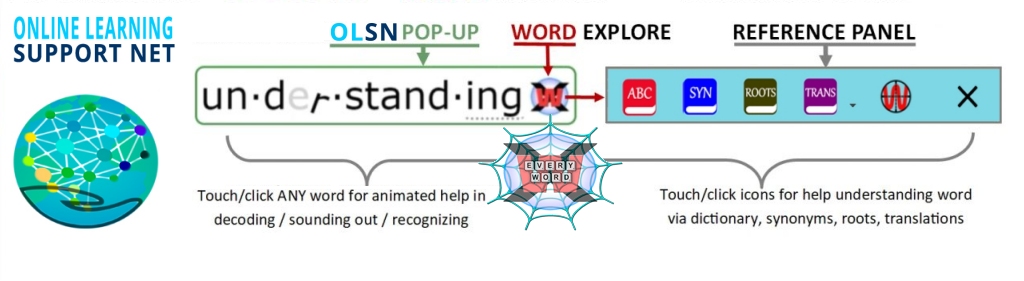 Note: Remember to click on any word on this page to experience the next evolutionary step in technology supported reading.
-----------------------------
Personal Background:
David Boulton: First of all I’d like to start by saying welcome and thank you. I really appreciate you making the time.
James Wendorf: David, thank you. It’s a pleasure to be here.
David Boulton: How do you come to be here and what is the National Center for Learning Disabilities? Why does it exist? What does it do?
James Wendorf: Well, I’m here because my career over the last twenty-something years has been primarily about building literacy and learning programs for kids. Working with not-for-profit organizations, working closely, especially recently, with people in the research community as well as with practitioners, to bring those programs to the field. To get them to kids, to get them to teachers so they can start to make a difference.
Prior to coming to the National Center for Learning Disabilities, I spent many years at Reading is Fundamental. The goal there was to provide access to books for kids who generally did not have access. The challenge that I faced in coming to the National Center for Learning Disabilities was to address this access issue in a new way. To ensure that kids with learning disabilities had access to not just books and to learning materials, but also to a curriculum, to teachers who were well trained, and to the kind of evaluation procedures that would really test what they knew rather than what they didn’t know or couldn’t do. So, that’s what attracted me, and why I came to the National Center about four and half years ago as the executive director.
David Boulton: What personally hooks you about this work?
James Wendorf: I think all of us are challenged by the toughest cases. When you look at the kinds of struggles that children with learning disabilities face, you quickly realize that these kids must overcome a lot of obstacles; there are a lot of challenges. I, and the people I work with in the research community and in the advocacy community, are very much attracted to this group of kids and adults. We want to help make their lives better – to give them opportunities that they wouldn’t otherwise have.
Defining Learning:
David Boulton: The National Center for Learning Disabilities, implicitly you must have some operational definition of learning itself.
James Wendorf: I think when you talk to people in the field of learning disabilities and ask about learning, you quickly start zeroing in on processing. How does information processing impact learning as a very, very key component of the learning process? For kids and adults with learning disabilities that’s where the chief problem is – how the brain either does or does not process information. How the brain sometimes very inefficiently retrieves information, stores information, processes it and expresses it. So, any theory of learning for us is very practical. How do people make sense, especially sense of language, and of other kinds of information that the brain has to work with?
David Boulton: So, rather than it being subject-specific or topical in the outer boundaries of experience, you’re focused more on the core process of processing.
Learning Disabilities:
James Wendorf: Information processing really is an issue that cuts across so many different disabilities. The term learning disabilities is itself an umbrella term that encompasses a wide range of disorders and problems, the biggest one being dyslexia or reading disability. Even within reading disability, there could be problems with decoding, there could be problems with comprehension, there could be problems with expression, any number of things. So, it’s the processing of information that is really critical. Rock bottom: how does the brain either work or not work in dealing with that information?
Neurobiological Vs. Acquired Deficiencies:
David Boulton: An important distinction here is the difference between a biological insufficiency or mis-development of the capability to process, as distinct from an instructional or learning environment inefficiency or deficiency that’s led to a learned or acquired learning disability. How are those two related and how does that spectrum play out?
James Wendorf: I don’t think we draw that kind of distinction. I think there is a difference between a student who is an ‘instructional casualty’; in other words, a student who has not flourished in the schools, who has not had access to the right kind of teaching, a student whom the schools have failed in some way. There’s a difference between that kind of student and a student with an underlying neurobiological disability. Learning disabilities are not acquired; they are there – they are life long – they are real. They can be expressed in any number of ways early on; they could appear later in a school career, even as late as high school or adulthood.
David Boulton: They come in at different developmental stages.
James Wendorf: Different stages depending upon the kinds of learning tasks that a person might actually face.
David Boulton: So, you don’t make a distinction between this across the spectrum as to what might be the cause of it?
James Wendorf: Well, we’d love to know the cause. We’d love to know the cause.
David Boulton: I mean the distinction between what’s neurobiological in origin and what’s a consequence of instruction.
James Wendorf: Well, I think for most people, and especially teachers, the kinds of problems that they’re trying to deal with, the weaknesses that they’re trying to address in children, whether they have a neurobiological cause or whether the cause has been simply lack of access to a certain kind of instruction or teaching, makes very little difference. An appropriate scientifically research based intervention that’s delivered in the right way can address both of those problems.
That’s good news for teachers; it simplifies the task. It says that what works for kids with learning disabilities, reading disabilities for example, also works for students who may have problems with reading because they didn’t have access to books or spoken language as they were growing up…kids from poverty.
Instructional Casualties:
David Boulton: Right, and I totally understand and appreciate that. And with respect to what to do, how to be helpful to any particular individual child, defining the cause is less important than meeting them on the edge of whatever they’re showing and learning to work with them at that level. But, in terms of the kind of education that we need to provide, we do need it to reduce the amount of instruction related casualties. In that sense, the more that we understand, the better. For example, in our conversation with Dr. Lyon, he suggested that about ninety-five percent of kids failing to read are instructional casualties and that they are not neurobiologically deficient.
James Wendorf: There’s good research that points to the dramatic efficacy of good instruction. It is true that not enough good instruction is getting to kids. Kids just don’t have the benefit of it. Teachers need to be trained in order to carry out the kind of instruction that is effective. There is good research to show that up to ninety-five percent or so of reading problems, reading difficulties can be effectively addressed if that instruction is there and delivered in the right way.That still leaves about four to six percent of the student population that is not responding, that is still struggling, that needs some other kind of intervention, some other kind of instruction.
And interestingly, the percentage of children in the school age population who have learning disabilities right now is about five percent. And they need even more intensive, individualized instruction in order to address their underlying problems. Not all the problems are going to be solved simply because we get classroom teachers up to a certain level.
Most of Our Children Not Reading Proficiently:
David Boulton: If we look at the basic and below reading stats and the proficient and below reading stats, and if we aggregate the populations, we’re talking about most of our children reading less than proficiently. Most of them.
James Wendorf: Yes.
David Boulton: And we know that the consequences of not reading well are profoundly influencing and shaping the core information processes that you’re talking about. So, to some degree, all of the children who are not learning to read well are developing/acquiring some degree of disability to learn.
Profound Reading Crisis:
James Wendorf : I wouldn’t go there. I wouldn’t go there. I think it’s important to maintain some distinctions. (see Postscript) There’s a reading crisis in the United States. It’s undeniable. Thirty-nine percent, almost forty percent of fourth graders do not read even at the basic level, and as we know, a majority of students do not read at the proficient level. In inner cities the percentages are much higher. So, there is a profound reading crisis in the United States.
Children with reading disabilities and other learning disabilities are part of that reading crisis, they are part of that group, and their problems need to be addressed as well. We need to reach children – whether they have learning disabilities or whether they have reading difficulties – virtually in the same way, and reach them early on before they even get to kindergarten and identify their strengths and weaknesses and then step in with the appropriate kinds of instruction.
By doing that, by reaching out to all of those children, we can ensure that the children with difficulties can actually be brought up to speed, can be brought up to grade level in reading and they have a very good chance of having that happen. But we also ensure that children with reading disabilities and other learning disabilities are identified early on and have the opportunity to get better instruction, individualized instruction, special education services early on rather than later in upper elementary school or middle school when it’s very difficult and very inefficient to address their problems.
David Boulton: Good. I appreciate and agree with your distinction and focus. I’m just wanting to stretch us out here.
James Wendorf: Not a problem. We’re not going to go, as some will say, that fifteen to twenty percent of the population has a reading disability. The data don’t support that. About five percent of children in the schools have been identified with a learning disability. (see Postscript)
None of us is happy or satisfied with the methods that are currently being used to identify at risk children. However, there’s pretty good history over ten to twenty years to suggest that we’re in the right ballpark regarding the percentage of the population that might have a true disability.
Stewarding the Health of Learning:
David Boulton: Right, but let’s suppose for just a moment that your position wasn’t the National Center for Learning Disabilities, but the National Center for Stewarding the Health of Learning.
James Wendorf: Absolutely.
David Boulton: And you were the executive director for stewarding the health of our children’s learning.
James Wendorf: Yes.
David Boulton: From that vantage, we then take a look at reading and the consequences of reading, the consequences of not reading well early. There’s the Matthew Effect, what reading does for the mind in terms of developing self-reflexivity, core cognitive processing ecology, information processing efficiency, the infrastructure of our abilities for abstractions, generalizations and on up to the more obvious educational implications. Then the down side, the downward spiral. For example, Lesley Morrow said in our interview last Monday that reading is so powerfully predictive that some states use literacy data to project how many prison cells to build.
James Wendorf: Yes.
David Boulton: Some research is saying that how fast a child comes up to speed in reading in first grade predicts where they’ll be in the twelfth grade.
James Wendorf: Yes.
David Boulton: It’s that solid of a correlation. So, how well children come into learning to read profoundly effects how healthily they learn in their life.
Reading is the Gateway Skill:
James Wendorf: Reading is the gateway skill. It leads to all sorts of success, both academically and in life. It is the skill that undergirds most of the curriculum, and if children aren’t learning that skill by the end of third grade, they are in desperate trouble. For kids with learning disabilities it’s a double whammy. You know seventy to eighty percent of students with learning disabilities have their main problem in the area of reading, with reading based learning disabilities.
For us in the learning disabilities world, we’re very much concerned about literacy, about getting children up to speed in reading, and that usually means an early diagnosis and very intensive intervention…breaking skills down into individual steps so that students can actually learn step by step the decoding process, everything that goes into that plus comprehension strategies. It’s incredibly important.
You said, if I were looking out for all kids. Well, in many ways we do. The National Center for Learning Disabilities is very interested in the well being of all kids. That’s why we’re calling for universal early literacy screening. Every four year old should have the chance to have his or her skill development in literacy screened before entering kindergarten. That should be universal just as it is for vision and hearing. We should know where a child is in making progress or not making progress on the road to reading because reading is so important. It is the gateway skill.
David Boulton: Excellent. I totally agree. I guess where I’m trying to go with this is, again, most of our children aren’t learning to read well. Most!
James Wendorf: Yes.
David Boulton: And not learning to read well is learning capacity diminishing.
James Wendorf: Yes.
David Boulton: So most of our children in the process of their struggle to learn to read are going through a process that is diminishing their ability to learn.
James Wendorf: Yes.
David Boulton: That seems to me to be the nation’s biggest learning disability.
James Wendorf: There is a reading crisis and the reading crisis leads to an education crisis, and also is certainly connected to an economic crisis as you look at job formation. Do we have people coming through the school system who can really perform the job functions that American business has to have? The answer to that now is clearly no. The schools are not producing.
What we’re really talking about is lost human potential and it’s absolutely tragic. It’s tragic. Parents who have children with learning disabilities have lived this tragedy for many, many years. They know what’s it’s like to see a child not able to fully embrace what a school has to offer. They’ve seen schools that have failed in reaching the children, that have failed in actually addressing the children’s individual methods of learning and addressing their needs.
David Boulton: I just think that we, the parents of the sixty or sixty-eight percent, or whatever number you want to say that are below proficient, don’t grasp the significance of this in terms of how learning disabling, learning constraining the effect of this is because it’s accepted as almost normal.
James Wendorf: Yes.
David Boulton: There’s a gross miss on how significant this is to the developmental process.
Good and Bad News:
James Wendorf: Well, there’s been some good news over the past ten, fifteen years. Some good news is that I think there have been many campaigns with some success in focusing on children’s books, reading to children, reading aloud to children, making sure that children have access to literacy opportunities. There has been a lot of talk and a lot of campaigning about that and it’s done some good and it’s helpful.
What we’ve seen less of is sort of the hard edge of literacy: the instruction. What kind of instruction in what kind of setting over what period of time is most effective in getting children up to speed in reading? Now we have some reports and good studies that have come out and there have been efforts to get the word out not only to parents and the public, but certainly to schools – the 15,000 school districts around the country that are making decisions everyday about how to teach kids the skill of reading.
The real problem, the tragedy, is that even now we see that school districts are not fully embracing the most effective methods of teaching reading to children. They are not doing it. And they need more help, they need more guidance in making better decisions about the instructional materials they use and also the kind of professional development that teachers need in order to be effective. Because teachers do want to be successful. They do want to help kids, but they’re not being given the chance.
We need to raise public awareness and we need to change the way that decisions are made in schools. Parents can be a loud voice; they can be terrific advocates. Not just for various kinds of activities in the school, but specifically, advocates for curriculum reform to make sure that reading is being taught in the most effective way. That’s what we want to hear. That’s what we need to produce across the country.
Early Literacy Screening:
David Boulton: And as you said, we need a screening tool. We want to check where children are at when they are coming in. Just like we want to check their eyes and their ears to see where they’re at in their development so we can meet them closer to where they actually are, rather than over generalize.
James Wendorf: We have the means now to screen children for early literacy skill development. It’s not invasive; it does not involve testing kids. But with twenty questions over a period of twelve minutes costing less than two dollars per child, a teacher or a parent or a paraprofessional can be trained to actually screen a child and understand what it means.
To understand how a four-year-old child is making progress in areas such as knowledge of print or written expression or linguistic awareness, knowledge of how language works is incredibly valuable to an early childhood educator, to a preschool teacher. There’s much that can be learned, and once teachers and parents can understand that, they can then become better teachers, whether it’s in a home as a parent or whether it’s in the pre-school.
There is a revolution coming. It is happening. Instruction, curriculum, an emphasis on cognitive development, an emphasis on early literacy skill development. It is coming to pre-school. Over the next five to ten years that’s going to be a very important new frontier in the literacy movement.
Learning to Read is All But Fating:
David Boulton: One more step on this front end. What we’re saying is that how well children learn to read is all but fating to their academic, economic, psychological, intellectual, and cognitive health – that it’s that pervasively powerful. A great deal of this depends on the soundness of the instructional process, the educational process and also on the preparation of the child long before they get to school, how well they are unfolding. That it is in fact critical, how they come to school, how well they’ve started to develop and exercise the kind of sound and letter distinctions and familiarity with the correspondence between oral and written language, which are the ideal ground to pick up from and move with in education. That solidly rests on the parents.
James Wendorf: All of us have a responsibility to kids, to our youngest kids. Certainly parents have that responsibility to help them develop the language skills, the literacy skills so that they are ready to embrace school when the time comes. It’s true that children who come from backgrounds of poverty are at a tremendous disadvantage. By the time they actually enter kindergarten, they’re lagging in skill development and their vocabularies are dwarfed by the vocabularies of children of middle class and upper-middle class homes who’ve been surrounded by language in very different ways.
So they enter the school door, they enter the classroom really lacking the equipment, lacking the context to even understand a lot of what the teacher might be saying. They don’t know the names of things. It’s not just that they don’t know, in many cases, the letters of the alphabet. It’s that they don’t know the names of things. They lack language.
Insufficient Oral Language Experiences:
David Boulton: There’s an insufficiently rich oral language facility from which to move into learning.
James Wendorf: Correct. And as we talk about the development of literacy skills, certainly we can’t neglect vocabulary development, oral language experience. It’s probably one of the most difficult areas to work in and it’s the one subject with the least amount of control. Most of it is not in the classroom; it’s out of the classroom. And it’s oral, it’s not written; very difficult to control.
David Boulton: That is why it seems so important for parents, across the spectrum socio-economically, to understand how significant this is.
Whitehurst’s Dialogic Reading:
James Wendorf: There are some things, some steps that parents and teachers can take to help improve comprehension and to build vocabulary development. One of the areas is actually in the sharing of children’s books. One of the programs that Dr. Whitehurst has developed called Dialogic Reading addresses this very issue.
Those of us who’ve worked in the literacy field, we’ve all said ‘Share a book.’ But we also know, those of us who have worked in this area, that many parents and some teachers simply do not know how to effectively share a book with a child. It may sound bizarre but it’s true. Videotape doesn’t lie when you’re actually running demonstration programs and then studying what happens when a child and an adult and a book share time together.
The Dialogic Reading technique that Dr. Whitehurst has developed – and it’s the only research based program of its kind – is really there to encourage a specific kind of interchange between a child and an adult with a text as the shared experience. A child is actually drawn out to answer certain questions, to use language, to point, and in doing so is led through a series of exercises that actually builds language skill and vocabulary development.
David Boulton: It helps them focus on distinctions.
James Wendorf: And to demonstrate that he or she knows what’s being said and developed in a story. Whether it has to do with colors, characters, words on the page, letters on the page, any of those things.
David Boulton: Or meta-cognitive summaries.
James Wendorf: Right, and understanding of plot and understanding of the beginning, the middle, the end…all those things.
The Costs of Teaching Reading:
David Boulton: Do you have any sense of what it costs us to teach our children to read?
James Wendorf: I don’t have a number for you. I don’t have a number.
David Boulton: Even a rough idea? A percentage?
James Wendorf: No. I can tell you that for those children who need remediation, if children do not have reading fluency by the end of third grade, it’s going to cost seven to eight times as much in time and in money to address their reading problems and get them up to grade level in reading.
David Boulton: Seven or eight times ‘x’, an unknown?
James Wendorf: Right. In other words, I don’t have that. In terms of dollars, every school district spends a different amount per child and that’s a statistic that is usually a very important one for school districts to trot out and either pride themselves on spending so little or pride themselves on spending so much, depending on where you live and what the property tax is like. But, I think it would be very difficult to come up with something like that for the country as a whole because there’s so much diversity.
David Boulton: There’s a lot of talk about the aggregate expense of reading difficulties from the 200 billion dollars in lost income opportunities to the adults that can’t read above a fifth grade level to the costs that literacy organizations, the federal government and so forth are spending to remediate reading. Do you have any number, any scope at all that you can comment on? Even a magnitude of order?
The Real Cost is Lost Self-Esteem:
James Wendorf: Well, it’s billions. Billions lost.
I think the main thing to emphasize for anyone who has worked with a child or with an adult who has a reading problem, either who is low literate or is just struggling with reading, is that it is very apparent that it is the lost human potential, the lost self-esteem…that is the most poignant. And in the end it’s the most significant, because the loss in self-esteem is what leads to a whole host of social pathologies that are very difficult to look in the face. Crime, substance abuse, and the school drop out rate -any of those things – they are very difficult to face. And there is a line to be drawn between low literacy skills and those social pathologies.
David Boulton: Please say as much about this as you care to.
James Wendorf: There is a twenty-seven percent drop out rate of students with learning disabilities; that is more than twice the rate of the general population …lost human potential. There are problems with substance abuse and juvenile justice problems. And certainly looking at the general population of students that drop out, one can go to prisons and see that it is very apparent the majority of inmates lack reading skill.
What We Have Learned:
David Boulton: When we first began our conversations on the phone you referred to an interview in which somebody had asked you, and I’ll repeat the question for you…what have we learned in this last decade? What have we learned about the center of this problem?
James Wendorf: Over the past ten years we’ve learned that learning disabilities are real. For those who ever doubted, it’s absolutely apparent now in the science that learning disabilities are real. The brain research and the fMRI research showing images of the brain at work reveal conclusively that dyslexia and reading disabilities are real. We understand where in the brain the problem is and the functioning that is not happening in those who are experiencing that disorder.
The research is also leading us toward instruction, leading us toward ways that we can address the problem. That really is the challenge for the next ten years: to apply the basic science, the research that’s taken us so far in understanding the neurological based root causes and issues, and moving towards practice. How do we train teachers so that they can carry out instruction in a way that effectively addresses the reading problems, the reading disorders of children in the classroom? Because the children are there day in and day out and they need that kind of help.
The teachers being trained today in schools of higher education are simply not, in many cases, getting access to the kind of training that is based on the insights that the research has revealed to us. We need to close that gap and we need to ensure that our teachers are ready for the schools of the twenty-first century.
Inside the Brain Visualization:
David Boulton: We’ve designed a set where we’re going to be able to look at the text the child is reading. Then we’ll move, almost like a virtual tour, from the text to the face. Then we’re going to mirror it in such a way that we can see the face and the text together so you can see what’s going on in the face while the child is attempting to articulate as he or she is looking at the code. And then we’re going to spin around and while still maintaining that shot overlay a multi-media animation that’s illustrating what is happening in the brain.
James Wendorf: fMRI, where the brain is firing.
David Boulton: Yes, at one point a simulation of that and another time a multi-media neurological schematic visualization showing the relationship between these various processes happening in real time, in relation to the code, in relation to the expressions of the face, the tone of voice, as we go in and out of decoding fluidly, from happy satisfaction into stuttering up into shame. We will actually be able to see the correspondence between this code confusion and the stuttering of the mind, the movement into shame and the dark downward spiral into the collapse.
James Wendorf: The stuttering of mind – I haven’t heard that one before – that’s an interesting way to put it. With the fMRI’s, it looks very much as if the brain of dyslexics is working overtime. So, often kids with learning disabilities are accused of being lazy. ‘They’re lazy; they can’t do it; they’re not trying hard enough.’ When you look at the fMRI’s you see very clearly that that brain is trying to work very, very hard to make sense of what is in front of it and it can’t do it. It’s firing away very inefficiently, ineffectively and the code is not being broken if it’s a decoding task, or the words are not being comprehended if it’s a comprehension task. It’s absolutely fascinating.
David Boulton: They’re not co-implicating. These various processes that have to cooperate in such great synchronization, aren’t.
James Wendorf: The point for kids with learning disabilities is that again, it demonstrates that this is not an issue of laziness; it’s not an issue of not trying. Kids with learning disabilities try very, very hard. I think your demonstration showing a person, the child, engaged in the act of reading and showing that and then also demonstrating what is happening in the brain, I think that would be fascinating to show. I think understanding what works can sometimes best be done by showing what doesn’t work for some individuals.
Dispelling the Myth that Reading is Natural:
David Boulton: Let’s go all the way back to something you said about self-esteem and connect the dots between where we just were and there. My sense of talking to parents and teachers is that they have this undifferentiated sense, even though they may have some intellectual awareness that reading is unnatural, their gut level sense is that it is natural.
James Wendorf: That reading is natural or what?
David Boulton: Yes, that kids should be able to read. ‘I can read, why can’t they read? There must be something wrong with them.’ Rather than understanding that reading is a radically unnatural challenge to the human brain of which there is no evolutionary precedent.
James Wendorf: Right.
David Boulton: And it’s in relation to this technology…this code-thing is as much a machine as a VCR or dishwasher. And this machine is pretty confused because of the way that it’s grown to be here. It is a 2,500 year old invention; it’s not been carefully watched over.
Venezky, and other orthographists, linguists and other language historians pretty much all agree that nobody was minding the store when all this mess just kind of happened.
Reading is not Natural:
David Boulton: Most of our children are in some degree of struggle that is diminishing their ability to learn because they’re trying to interface with a technology that is a mess because nobody’s ever paid attention to it or tried to do anything about it – as if how well the children could learn it was important. Now, my sense is that parents and most teachers don’t get that.
James Wendorf: Reading is not natural. Speaking, language, oral language is natural. What does a baby do when it’s born? It cries. It’s natural. But reading has to be learned and has to be taught. It is not a natural activity. It is a difficult activity for a significant percentage of children. It is not difficult for a certain percentage of children. They can pick up reading very easily, no matter which way it’s taught. Why? We’re not sure why. But it happens.
Other children need to be taught in a very different way – very systematically, intensively, breaking the process down into its components and they need to learn it hands on in a multi-sensory fashion. The good news is that almost all kids can learn to read if they have access to that kind of instruction.
And your point about language, I don’t know if I can actually address about it being a mess or whatever. Reading, as you point out, is only a few thousand years old and our brain is still getting used to it. You know, we’re evolving.
David Boulton: The mass of our population has only been reading for the past couple hundred years.
James Wendorf: For mass literacy.
David Boulton: Yes. Right. Which would mean that whatever could effect any kind of selective evolutionary-adaptation pressures hasn’t had time.
Lost Potential and Suffering From Self-Esteem Loss:
David Boulton: I want to circle back to the self-esteem conversation because, in addition to the economic things, and as you said there’s this huge cost, from the child’s point of view, from the family’s point of view: it is suffering.
James Wendorf: Yes, well anyone who works with children who have learning disabilities confronts the issue of low self-esteem head on. By the time a child is usually identified with a problem in reading and the further identification is made that there is a learning disability…that child usually needs to be put back together in some way. There’s been failure, and usually over a long period of time. And usually by the time that special education services are provided or some other kinds of services are provided, the child needs some serious help with self-esteem.
Now we’ve actually looked into this at the National Center for Learning Disabilities. We’ve worked with researchers, and one of the best ways to address the self-esteem problem is through skill development. Children who actually are able to build their skills show an increase in self-esteem that is every bit as high as programs that might address their self esteem head on.
So, by focusing on skill development, working on instructional issues, you can often bring the self-esteem up in the same way that might happen if a child were involved in some kind of social emotional development program that directly addresses the issue of self esteem.
David Boulton: Parenthetically, a good friend of mine, John Vasconcellos, a State Senator in California, is one of self-esteem’s most visible proponents. He’s the one Gary Trudeau cartooned for creating the California Task Force to investigate the relationship between self-esteem and personal and social responsibility. Back in the eighties his work brought self-esteem to national attention.
My own sense, based on engaging in dialogue with philosophers, scientists and researchers in that space, is that the issue isn’t self-esteem, rather what happens to children who learn to be self dis-esteeming. They learn to not trust, to not feel good about themselves. It’s an acquired shame.
James Wendorf: I think low self-esteem causes a child to pull back, to not engage. Why go out there and put yourself on the line if you know it’s going to be another failure and you’re going to be called on it either by your teacher or your classmates and you will be open to shame, to disapproval. Kids aren’t dumb; they know when something isn’t working and they know what’s going to hurt, so they pull back.
What children need is the experience of having success. That is what nourishes self-esteem. Success in building skills is one of the best ways to do it. When children have shown that they can actually master something and they have proof, they can point to it and they can be legitimately praised for it. That’s what works.
Self-Esteem and the Affect of Shame:
David Boulton: Back to reading, in addition to this summary level, shame and consciously-volitional: ‘I don’t want to do that’, there’s an animal level, biological shame mechanism. Human beings are shame averse. On the one hand, shame is this great learning lens; at the deep biological-animal level, shame is a learning prompt. On the other hand, at the self-reflexive level, shame is a feeling we want to avoid.
There’s been a map that’s been made called the Compass of Shame that goes into all the different things we do to get away from shame when it happens. It happens pre-cognitively; it is underneath the cognitive machinery that is projecting our experience. This is not something that we’re volitionally controlling. We don’t want to feel shame and the very experience of shame will cause us to move away from it and how we’re processing what’s going on.
So, it’s all the more critical that in the case of reading, we’re talking about a situation where children are day after day, week after week, month after month and in some cases, year after year, immersed in an environment that’s frustrating them in some way and that’s causing them to feel insufficient. The way the context works, as if there’s something wrong with them, this shame aversion starts to inter-script with the learning to read process. Once it does, there’s an aversion to learning to read that is pre-cognitive. So this shame conversation is really, really important.
James Wendorf: I think the low self-esteem, the sense of shame, is life-long. At the National Center for Learning Disabilities, we have a wonderful board of directors. We have at least two individuals on that board, both of whom have dyslexia and both of whom are former governors. They are extraordinarily accomplished individuals, both of them dyslexic. And both have talked at length about the continuing sense, not just of frustration or memories of failure, but precisely a sense of shame that is still remembered…classroom based, other children around, a teacher, not being able to do what other children seem to be able to do so easily. It stays for a lifetime. (More “shame stories”)
How should we Educate?:
David Boulton: Previously you touched on the relationship to education and the evolving need for educated people by the emerging world market place, particularly in our country. It used to be, fifty years ago, one hundred years ago, certainly back beyond that, that the rate of change was sufficiently stable. That we could say we need so many mathematicians, drafts people, whatever it was, and develop a relatively crude and mechanical railroad track switching system about aptitudes and almost grow and harvest people to fit what we projected to need. I’m being crude, but you get the drift where I’m going.
Today, this is absurd. What we can say is children need to learn to read: we can say that they need to have good mathematical skills; they need to be able to write and express themselves. All three of which are artificial code processing skills that happen at different speeds and they need to be able to interface with the other kinds of codes and technology to be able to learn what they need to learn when they encounter a need to learn it in the future.
Stewarding the Health of Learning 2:
David Boulton: All these things translate into how well someone learns. That how well children learn is fundamentally more important than what in particular they’re learning. What in particular they are learning is an exercise environment to help enrich and extend their general capacity for learning as they unfold in life because what is relevant twenty years from now, we can’t predict. Nothing in particular, other than these basic skills we’ve said, will be more relevant to their futures than how well they can learn when they get there.
So, we come all the way back to where we were a while ago. It seems like we need to be stewarding the health of our children’s learning as our fundamental, central educational mission. This doesn’t negate curriculum, but reframes it, reorients it. How does that wash with you? What do you think?
James Wendorf: As we look at kids who struggle, who struggle to learn, whether that struggle is related to an underlying learning disability, whether it’s related to issues of poverty or English as a second language, we still have an obligation to make sure that those kids have access to a curriculum. I think it’s one and the other, it’s both/and.
The idea of creating simply a generation of students that are expert at thinking and thinking things through at the expense of content knowledge, whether that content knowledge is history, mathematics, literature, whatever it might be, I think is absurd. You’ve got to balance the two. No one can be at the expense of the other.
David Boulton: With technology getting to a point where it’s becoming more pervasive, every television set is going to have the power of a computer ten to fifteen years from now, so that any conceivable question that a human being can come up with can be the basis for piloting through the ‘super Googles’ of the future.
What is content other than an exercise environment for getting to be better learners?
James Wendorf: Look at it this way, think back to the fact that too many kids right now are entering kindergarten without the context and the content that vocabulary provides. They are at risk.
David Boulton: Sure, but it’s not the particular words. It’s the exercise, it’s the distinction.
James Wendorf: It’s the particular words as well. I think it’s both the exercise of the mind and the content.
David Boulton: Are you saying that we could say with respect to first graders we’ve got a word list that they should know? Or that they should know a list of words?
James Wendorf: They should know a list of words. There are some words that are more important than others because they’re used so often – they’re the building blocks of subjects and curriculum. But they’re needed; they have to have them. I’d say the same thing about content.
There was a letter to the editor in the New York Times from a mother whose son had just graduated from Harvard and she was praising the curriculum reform that’s underway at Harvard. She said, ‘Gosh I wish this had happened when my son was there; he is one of the best thinkers I’ve ever seen but he doesn’t know anything. He lacks content knowledge and that means a frame of reference.’ He might be able to Google anything, but understanding, whether it’s historical content, literary content or whatever, may be lacking and puts that person at a disadvantage.
David Boulton: We’re in sync about this. Now we’re talking about how is it that we develop a sense of perspective, a sense of background from which to comprehend one’s life, one’s civilization, where we are – that’s the background reference for this ability to extend into learning about things we can’t predict right now.
James Wendorf: Learning is life long, and what we know because of the work we do at the National Center for Learning Disabilities is that learning disabilities are life long. The problem doesn’t go away. It stays there and has to be addressed. Tools have to be used, whether they are built by the person himself or because of accommodations, whatever it might be, so that that person can access the kind of content, the kind of knowledge that becomes important as you move throughout your life.
The issue of curiosity, the issue of intellectual curiosity is extraordinarily important. Henry James’ point, be a person upon whom nothing is lost, doesn’t apply only to novelists and writers, but it should apply to all of us. That constant inquiry, constant curiosity about how the world works, how to make sense of it, is something that all of us not only have to encourage in ourselves, but also in our children.
David Boulton: Really well said. For me that translates into the inverse of the Baconian adage that ‘knowledge is power’: ‘the power of knowledge is its resourcefulness to learning.’
James Wendorf: Yes.
David Boulton: Is there anything that we didn’t cover that you think we ought to?
We Don’t Value Reading in our Culture:
James Wendorf: Sometimes it’s through understanding disabilities that ability is best understood. The majority of kids can read. Some read with a lot of help, some with almost no help. Then there is a group of kids that need extraordinary help, intensive help in getting them to read.
David Boulton: There’s this gray spectrum between those that just can’t and those that don’t do it so well – yet it may be shaping all their lives in some way, going all the way up to the other side of proficiency, which includes most children.
James Wendorf: Yes, there is. Right. We’re not a nation of readers. We’re not. We’d like to be, but I think our culture is still not supportive of reading in the way it should be.
David Boulton: Which again comes back to this unnatural to the brain technology interface skill and to the fact that how well a child acquires it is all but fating their life.
James Wendorf: I think also so much of this is cultural – apart from the biological, it’s cultural. Is reading valued? Is it promoted, not just with lip service, but is it truly promoted, valued, encouraged, is it demanded; is it r
Transforming Society’s Understanding of Reading:
David Boulton: Which presupposes that our population generally goes through a transformational reframe in its appreciation of how significant this is.
James Wendorf: Yes, and I think the understanding has to be that reading is power. You said that knowledge is power, and we sometimes talk about reading power. I don’t think we’ve been effective yet in showing the power of reading. If we show the true power of reading and the kind of impact it has on a person’s life, I think then we’ll start to get the message across that it is worth acquiring and that there is status involved in being expert at it. We haven’t done it yet.
David Boulton: And that if you love your child and are interested in the health of their learning, you’ve got to put the effort in to make sure that they don’t have a struggle with this. You’ve got to help them, you’ve got to meet them with what they need because this is shaping, all but fating, their life.
James Wendorf: What we know from a number of polls that have been conducted is that many parents wait too long to take action…sometimes a year or more before they actually go to professionals, whether it’s to a pediatrician or to the schools to say I don’t think my child is learning at the proper rate; I don’t think my child is reading. Parents are often reluctant to do that, they don’t want to draw attention to a potential problem in reading, and for what reason? Because they don’t want their child or themselves to be subject to shame. They don’t want to appear to be a bad parent.
So, what we have to do – and we’ve taken steps in this direction – is to encourage parents at the first sign of what they consider to be a problem to take action, to talk to a professional, to get help. Tthere are organizations and websites that are out there, including ours, that are set up to reach out to those parents. (see also www.ldonline.org , www.wrightslaw.org , www.schwablearning.org )
David Boulton: I’m hopeful that with your help and the help of all the other people that we’ve brought together into this conversation/dialogue that we can co-create a ‘lightning rod’ that calls attention to the fact that, as a society, we don’t get it.
James Wendorf: Yes.
David Boulton: Yes, it’s about the ‘utility’ value of whether or not someone can read this particular book or that particular book – it’s about our nation’s economy and how well the U.S. competes in the world. But, we are also saying, the psychological well being of our children depends upon our stepping up to a new understanding, a new appreciation of the unnaturalness of this challenge and how critically important it is that we help children through it. We’ve got to galvanize attention here in a way that has never been done before. That’s part of what this series is about, to get this dialogue going in the thought processes and pedagogies – in the minds and hearts – of teachers, parents and our whole society.
James Wendorf: Well you’ll do it. We’ll help you.
Postscript:
James Wendorf (2-20-04): A couple of things I’d underscore:
-
It’s important to us to use the “disability” word non-metaphorically. That’s why I see myself pushing back on a couple of your questions regarding “acquired” disabilities. The neurobiological nature of learning disabilities is rooted in science, and also provides the foundation for federal protections and opportunities (flawed though they may be). Saying that millions more children are “disabled” due to instructional malfeasance is not something we would say or encourage. That said, there is considerable evidence that a percentage of children (hard to specify) are being labeled “learning disabled” simply because they have not been taught effectively.
-
I encourage you to establish and maintain a distinction between reading difficulty/problem and reading disability/disorder. As we discussed in the interview, many millions of kids struggle to read and learn, but a smaller number will truly qualify as having dyslexia/a reading disability.
David Boulton (2-24-04): I appreciate your distinctions. I understand that the term ‘learning disability’ has been tightly defined by legislation. I think its unfortunate that legal political considerations have restricted our ability to use so important a term. What language shall we agree on for the distinction between ‘neurobiological learning disability’ and ‘learned learning disability’?
Standard dictionary definition of learning disability:
learning disability
n. (Abbr. LD)
Any of various cognitive, neurological, or psychological disorders that impede the ability to learn, especially one that interferes with the ability to learn mathematics or develop language skills.
A human being functions as a whole, and in any given moment of learning there are electro-chemical, neuro-muscular, motoric, affective, cognitive, memory, anticipatory and environmental elements that need to operate in a coordinated way. A disability to coordinate no matter the cause, is learning disabling. (Contributed by Gary David)
As you indicated below, five to six percent of our children have ‘learning disabilities.’
And interestingly, the percentage of children in the school age population who have learning disabilities right now is about five percent. JW (context)
You also said:
There’s a reading crisis in the United States. It’s undeniable. Thirty-nine percent, almost forty percent of fourth graders do not read even at the basic level, and as we know, a majority of students do not read at the proficient level.
In our dialogue we said:
David Boulton: Most of our children aren’t learning to read well. Most!
James Wendorf: Yes.
David Boulton: And not learning to read well is learning capacity diminishing.
James Wendorf: Yes.
David Boulton: So most of our children in the process of their struggle to learn to read are going through a process that is diminishing their ability to learn.
James Wendorf: Yes.
David Boulton: That seems to me to be the nation’s biggest learning disability. (context)
And also:
David Boulton: So to some degree, all of the children who are not learning to read well are developing/acquiring some degree of disability to learn.
James Wendorf : I wouldn’t go there. I wouldn’t go there. (context)
David Boulton: I think we need to work this out better. 5 to 6 percent of our children are ‘learning dis-abled’ by their neurobiology. Most (over 60% nationally) of our children are not learning to read well and its all but fating how well they learn in their lives (Wendorf, Lyon, Whitehurst ). Children who don’t learn to read well, regardless of why, are learning ‘dis-abled’ and learning ‘dis-enabled’. Dis-abled because automatic information processing capabilities that are critical to abstract and self-reflexive learning have malformed and because the child’s shame in relation to the resulting poor performance further impedes their abilities to learn. Dis-enabled because without the ability to read they lack the ‘interface’ necessary to function in our education systems and more broadly in our culture. I realize that for most in the neurobiological group the effects are more severe. But the 60 plus percent of children who are learning dis-abled by impoverished home conditions and instructional malpractice are no less innocent and the effect on their lives and their families is also profoundly constraining. The impact on society, in terms of social pathologies and economic costs, is obviously much greater for the larger group.
If the National Center for Learning Disabilities is constrained to function according to the ‘learning disability’ definitions you put forth, where is the ‘National Center for Acquired Learning Disabilities’? Whose mission is it to champion the needs and rights of the children whose capacities for learning have been seriously diminished or dis-abled because of how and what they learned in the environments our society provided them? Whose job is it to get the message to these children and their families that its not their fault – that there isn’t anything wrong with them?
Mr. Wendorf, thank you so much for engaging in this dialogue with us and for all you and NCLD have done and continue to do for children.
See also Rick Lavoie interview where the same LD definition issue is discussed: