An Interview...
Robert Wedgeworth – ProLiteracy: A Global View of Literacy
 Robert Wedgeworth is the President & CEO of ProLiteracy Worldwide, the world's largest non-governmental literacy training organization. Mr. Wedgeworth initiated the organization of The National Coalition for Literacy, is on the advisory board of Syracuse University's School of Information Studies and is a member of the advisory committee for the Bill and Melinda Gates Foundation Access to Learning Award (2003-2004). He is the former dean of the School of Library Service at Columbia University, former executive director of the American Library Association (ALA) and the former president of the International Federation of Library Associations and Institutions, Additional bio info
We found Mr. Wedgeworth to be a compassionate professional and a world class literacy champion.
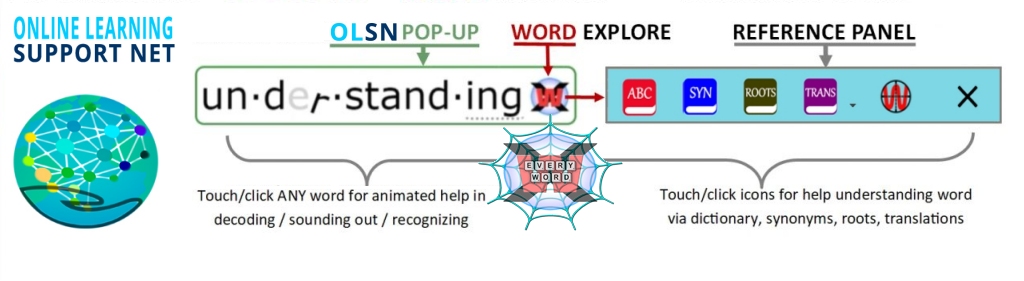 Note: Remember to click on any word on this page to experience the next evolutionary step in technology supported reading.
-----------------------------
Background:
David Boulton: Thank you for taking the time.
Robert Wedgeworth: Well, I appreciate your interest.
David Boulton: I’m very interested, extremely interested. I’m delighted to encounter somebody who’s working on the front lines of literacy in the ways that you are.
Robert Wedgeworth: Oh, good. Tell me a little bit about what you are trying to do and what you would like to know.
David Boulton: What we’re trying to do is to bring many different dimensions, different perspectives, and different ways of knowing into a learning dialogue. We want to help parents, teachers and the public in general understand how fundamentally important the process of learning to read is. To do that we are working to reframe how we think about it, both in terms of its importance and how we approach it, so as to develop more effective pathways through the challenges involved. So our conversations run from neuroscientists like Paula Tallal, to code scientists like Richard Venezky to government officials like Russ Whitehurst and Reid Lyon and Chris Doherty. And, of course conversations with children and adults who have reading difficulties. We want to include as many perspectives as we can. We want to learn from every person that has an authentic and unique voice. We want to bring them together into a distributed conversation and then reflect it back to the public in a way that will really help form a different social frame of reference for how we all think about reading.
Robert Wedgeworth: I see. Okay.
David Boulton: So having said that, you’re on the front lines of dealing with how to help struggling readers all over the world. I mean, not just the United States, not just the English language, but all over the world. What I’d be interested in is, first, some background on you and ProLiteracy. Could we start with a brief sketch there, and follow it with: what is your distinctive lens? How is it that you see this? How is it that you define illiteracy and its causes? Then we can go from there into more specific questions.
Robert Wedgeworth: That sounds fine to me.
Personal Background:
Robert Wedgeworth: I am by profession an academic librarian. I was educated as a librarian. It’s the only career I’ve known up until the time that I came to work in the literacy movement. I’ve worked in a number of public and academic institutions in the Midwest and on the East Coast, including Brown University, Columbia University, Rutgers University. I was Executive Director of the American Library Association in Chicago for thirteen years. I was the university librarian at the University of Illinois in Urbana Champaign for eight years.
After I retired from that position in 1999, I was asked to come onboard as a member of the board of directors of what was then Laubach Literacy International. Within a few months I was asked to take over the position as president and shortly thereafter I reached the conclusion that I needed to merge the two predominant adult literacy organizations in the country, Literacy Volunteers of America and Laubach Literacy International.
ProLiteracy:
Robert Wedgeworth: So the merger of the two into ProLiteracy was accomplished as of August 2002. It represents the largest nongovernmental literacy training organization in the world, including about 1,200 affiliated local literacy-training organizations across the United States in all fifty states and the District of Columbia. We also operate training programs in fifty developing countries, in Africa, Asia, Latin America and the Middle East, where we do literacy training as well through nongovernmental partner organizations.
David Boulton: How many adults are you currently serving?
Robert Wedgeworth: In this country, we serve something like 200,000 adults, using about 120,000 volunteers. Over the next three years, we will serve more than a half million adults and their families in our international network.
Literacy Statistics:
David Boulton: Excellent. How many people have literacy related difficulty in life? What kind of numbers are we talking about?
Robert Wedgeworth: Well, if we look worldwide, last year when the Director General of UNESCO made his annual statement on the occasion of International Literacy Day in September, he had some good news. The good news is for the first time in history over half of the women in the continent of Africa are literate. But that’s the only good news you can see in those worldwide statistics, because we’re still talking about almost a billion people in the world who either cannot read and write or have very low literacy skills.
In this country, the current estimates of the extent of adult low literacy are based primarily on the surveys that were taken in the early 1990’s. At that time we estimated that there were about ninety million adults with low literacy skills, about half of them at the lowest level that we would determine literacy skills. In our State of Literacy Report which we issued in November of 2003, we estimated that those numbers are likely to increase sharply, primarily due to the rates of the immigration, due to the rates of students who are dropping out or being pushed out of high school, due to the growth of the number of offenders in our system who are diagnosed with low literacy skills in state and federal prisons, and other factors as well.
NOTE – In January of 2006 we interviewed Mr. Wedgeworth again to get his comments on the national assessment of adult literacy (NAAL) report released in late 2005:
Robert Wedgeworth: An estimated 93 million adults out of a total adult population of around 221 million are at basic literacy levels or below basic. People who are below basic literacy levels can’t carry out the everyday functions that they would normally pursue in American society. It means that they can’t read a bus schedule and see how to get across town. It means that they can’t use most of the self-service ATMs. It means that they can’t fill out the average job application to try to get a job or get a better job. Those who are considered at basic literacy levels are still operating on a very rudimentary level in terms of math skills and in terms of reading capabilities, being unable to draw simple conclusions from reading a column in a newspaper or reading a newspaper editorial that may be comparing candidates in a local election. (Commenting on 2005 National Assessment of Adult Literacy Report)
Misperceptions:
Robert Wedgeworth: There are still too many people out there who do not believe that we have as many functionally illiterate adults in this country as we do.
David Boulton: Yes, there seems to be quite a number of people who believe that the reading crisis is being pumped up as part of covert strategy to commercialize education.
Robert Wedgeworth: Except for the fact that we’re getting too much corroboration coming back from different sectors of society.
David Boulton: Yes.
Robert Wedgeworth: From the health care industry, from the…
David Boulton: Prisons.
Robert Wedgeworth: The prisons — as I point out in that paper.
David Boulton: It’s the correlation of all of these things that gives credibility and strength to this underlying assessment of the adult low literacy population.
Robert Wedgeworth: Exactly. That’s right. Back in the 1970’s when the U.S. Department of Education first surfaced the issue, and even in the 1990’s when they did that first national assessment, people didn’t believe those figures. In our State of Literacy Report we predicted that the next survey would show that the numbers of adults with low literacy skills will increase significantly over what the previous survey showed in the early 1990’s. There were many skeptics about those statistics, but as you know, there’s been substantial corroboration of those statistics since then coming from different quarters, coming from the prison system with the number of offenders who have low literacy skills and coming from the health profession.
There are several other factors that will contribute to those numbers increasing in the next survey. One is that we’ve had an enormous growth in immigration to the United States. And we know, because we frequently see the stories of immigrants who come, they work hard, they put their children through school, and the next generation does well. But this, based on the statistics and our experience, is the exception rather than the rule. Many of these families take two and three generations before they can move into the mainstream of American life.
Another fast growing area for us is teenagers who are now being subjected to these mandated state exams, and they are having difficulty or either they’re having anxiety about their ability to pass the state exams. So, we’re getting enrollees in our programs using our materials to help prepare themselves for those mandated exams.
Though the numbers of students who are dropping out hasn’t changed, the overall numbers are increasing by the number of students who are being pushed out. There was a major story in our local newspaper recently about push-outs. But what they failed to indicate was why administrators would be interested in pushing someone out of school who is not doing well. The motivation is that under the accountability rules that are associated with No Child Left Behind schools are penalized for students who don’t do well and don’t advance. So that if they have students who have other issues in their lives, like becoming parents at an early age, they have to work at night or they attend school sporadically, they’re encouraged to push those students out of school so that they don’t drag down the numbers that relate to the rest of the student body.
So, there are a number of reasons why these statistics are likely to increase before they decrease. We really have to address the problem of adult literacy head-on.
The Greatest Risk:
David Boulton: People seem to think, “We can’t have that many low-literate people.”
Robert Wedgeworth: But it’s like doing any kind of projection. Even if you cut the numbers in half, it’s still significant.
David Boulton: Well, that’s exactly our point as well. We just released an article I’ll share with you. The basic gist of it is what you were saying – if we compile a list of the things children’s lives are at risk for today: parental abuse, and the various developmental physiological and psychological disorders and add them all together, they don’t come anywhere near the risk children are at for becoming improficient readers…
Robert Wedgeworth: Right.
David Boulton: And all the dimensions of life harm that we associate with that.
Robert Wedgeworth: And all of the social problems they run the risk of becoming victims of as a result of not being able to negotiate this society.
Economic Consequences:
Robert Wedgeworth: The American Medical Association has a major effort now to try to support health literacy among their patients because of the increasing costs to the health system for people who don’t understand the prescriptions that they’re given, they don’t understand how to take their medications. They don’t understand the diagnoses that are given to them by their doctors and the instructions that are attendant to those diagnoses. It’s estimated that we spend over seventy billion a year unnecessarily for people making special trips to the emergency room or extra trips to the doctor because they failed to understand the health issues that they have to deal with in their lives.
David Boulton: I read a report that that referred to data from the American Medical Association, a report without substantiation yet, that hypothesized that in addition to the seventy billion or so you just mentioned, a significant percentage of our nation’s annual health care costs are spent on low literate people who aren’t taking care of themselves in variety of ways that more literate people do.
Robert Wedgeworth: Yes. It’s really difficult to make accurate estimates of the cost of health literacy, other than being able to record the number of times people show up at an emergency room for special treatment because they don’t understand their medication, or other unnecessary visits to the doctor. Others are estimates that are really hard to pin down. But we know that these other instances do occur. It’s simply at this point it’s difficult to estimate them with any accuracy.
UNESCO on Literacy and Longevity::
David Boulton: One of the things reported in the UNESCO report was the correlation between literacy and longevity.
Robert Wedgeworth: Yes.
David Boulton: The correlation between longevity and literacy was as strong as the correlation between longevity and anything else they measured.
Robert Wedgeworth: Well, yes, because just think about it on a very fundamental level. If you think about the number of people who die every year from famine, from not getting adequate health care and nutrition, and you compare that to the number of people who die from wars or terrorism, or some of the other things that dominate the headlines, these other quiet departures from life are not as dramatic as war or terrorism, but they’re certainly more deadly in terms of losses of human life. We know for a fact that we can teach people how to grow more crops and better crops. We can teach people how to engage in basic health and nutrition. This is what we do in our international literacy programs.
Adults in other countries, especially developing countries where life is so hard, people spend an enormous amount of time every day just being able to feed and clothe and house themselves. Just to invite a person in that situation to learn how to read just for the sake of reading is not going to make any impression on them.
So our literacy programs in developing countries are focused around problem areas of life: Health and nutrition, justice, human rights, environmental concerns, basic education. When people do understand how learning how to read and write will help them change the nature of their lives and the lives of their families, they’re more motivated to come to literacy programs.
It is their program. They decide, in each community, what will be at the center of their learning. If they want to, for example, improve the quality of the water that’s available in their village then we will teach in that context the importance of health related to the quality of the water. They learn the vocabulary related to water and pollution and the types of pollutants, and that sort of thing. They’re learning how to read, but they’re also learning how to deal with this problem, and how to dig trenches for latrines and other things that will keep the human waste from running into their source of water.
But they’re learning how to read and write in the context of a specific problem. It may be building a community center, or it may be some other community project that is of great importance to them; so that when they come to learn how to read, they’re not learning how to read and write in the abstract, they’re learning to read and write to use that as a tool to help them improve their lives. It could be to learn how to market fruits and vegetables that they grow in the market so that they won’t be cheated.
All of our international literacy programs are focused on literacy for social change, social change meaning acquiring basic skills that will help them change the pattern and the nature of the lives that they’re currently living.
David Boulton: Excellent. So you help to understand that this is a stairway, and step-by-step are the steps that they choose, that are most important to their lives as far as the context they’re going to move through.
Robert Wedgeworth: Exactly.
David Boulton: You are allowing them to make it relevant to their lives.
Robert Wedgeworth: Well, they determine what are the important things that they want to change about their lives, and how reading and writing can help them as a tool to change those circumstances.
The interesting thing about the international partner programs is that while the adults come to school, the beneficiaries are the children and other members of the family at the same time, because they go back and teach their children and other members of the family what they learned from us.
Outside the U.S., the larger proportions of the people who come to our training programs are women. This is consistent with UNESCO’s statistics, in that the larger proportions of people who are functionally illiterate around the world tend to be women. Part of this is cultural and a part of it is economic. In many cultures girls tend to become mothers while they’re still children themselves, and so they don’t get the opportunity to gain more schooling. For boys, they may have a little more opportunity, but they too have to go to work at an early age in order to help support the families.
David Boulton: I’ve got a couple more questions. But is there anything that you think is really critical, that should get heard, get out, be better understood?
Decoding and Comprehension:
Robert Wedgeworth: There are two things that strike me about the material that you sent to me. One is that like most orientations towards formal education, we tend to put nearly all of our resources into teaching children how to decode, and we put very few of our resources into what is the more critical step, and that is developing reading comprehension skill. And the only way you develop reading comprehension skill is through continuing practice with increasingly more difficult reading material. And so we teach people how to read, how to decode, that is, thinking we’ve taught them how to read, not recognizing that reading is comprised of two very difficult skills. One is learning how to decode, and the other is developing the reading comprehension skill.
David Boulton: Well, my sense is — and I appreciate diving right into this, is that these two are very related. First of all, “decoding” is a misleading term. I mean, you could say that it’s decoding in a phonetic language, but when you talk about a written system that has such letter sound correspondence ambiguities, what we are really describing is disambiguation. It’s a process of buffering up these code elements and working out the right sounds for them according to the context in comprehension and the rules of spelling. And as you know, it’s…
Robert Wedgeworth: But it’s the same. What I’m saying is: the difference between learning how to use a tool and developing facility in a use of that tool. What I’m saying is: we tend to put most of our resources into teaching people how to use the tool, and the other more critical part of it, developing that facility, we sort of assume it will happen. From our experience, most of the adult readers who come to us learn how to decode at one time or another, but they never really develop the reading comprehension skill.
David Boulton: I understand what you are saying.
Robert Wedgeworth: They never got the continuing practice, and that continuing practice with good habits that develops reading comprehension skill. That’s the reason I mentioned that point. I think it’s underemphasized constantly in getting the general public to understand that reading is a difficult skill to acquire, and it’s an even more difficult skill to maintain and improve.
David Boulton: Excellent. I’m in total alignment with you. I have a somewhat different language here that I think would be beneficial in our dialogue, but I don’t differ with you at all. I think you’re right on in promoting the necessity of comprehension.The question is what is the relationship between decoding and comprehension and…
The Role of Adults in Assisting Children who are Learning to Read:
Robert Wedgeworth: The next point I will make with you is a little different, because here again it comes out of our experience as an adult literacy organization; and that is, we underestimate the role that adults play in assisting children to learn how to read. In most cases when we think about that we think about adults helping children with their homework, helping them with their reading material. But children learn lots of things from adults that improve their ability to read and understand the world that doesn’t come out of books.
David Boulton: Right.
Robert Wedgeworth: There are many, many examples. When a child grows up in a home where they never see someone write a check, they never see someone reading a newspaper; unlike me, their fathers don’t sit down and teach them how to calculate batting averages so they can read the sporting page. Those are the kinds of things that are incredibly important.
Now, if you take this country alone, when we look at what we’re doing in trying to put the emphasis on teaching children to read, in most of the families these things can be successfully reinforced by the parents or the other adults around the children. But you have a fairly substantial number of adults and parents who are incapable of giving that kind of reinforcement to their children.
David Boulton: Right.
Robert Wedgeworth: And we know for a fact that a child who grows up in a home where the parents are functionally illiterate has about a fifty percent risk of becoming a functionally illiterate adult himself or herself. But that fact really hasn’t come through strong enough to get people to understand how important it is for us to attack adult literacy as a lever for being more successful with children’s literacy problems.
David Boulton: Absolutely. I am with you.
Robert Wedgeworth: So those are the only two points that emerge that I wanted to share with you, based on the material that you have developed here.
David Boulton: I appreciate your distinctions and your added clarification, and your call for more visible inclusion and presentation of those dimensions in what we’re doing.
Robert Wedgeworth: Yes. I think they add a different dimension to our understanding of how we address this critically important problem.
David Boulton: Yes.
Robert Wedgeworth: You’re not alone. It’s the general way we talk about learning to read and reading in our society. Based on your knowledge, you know that it is easier to learn how to read in some languages than it is in others and sometimes we don’t appreciate that difficulty for English speakers as well.
David Boulton: Well, we are pretty focused on English, not because we are not interested in all the others, but because of the unique challenges in English that I want to get attention on.
Robert Wedgeworth: Yes, yes. And in that sense, it makes those factors that I emphasize much more…
David Boulton: All the more critical.
Robert Wedgeworth: Important than it may be in other languages.
David Boulton: Are you familiar with Paula Tallal’s work?
Robert Wedgeworth: Yes.
David Boulton: Okay. Then she ties in, as well as a number of other people, with what you’re describing about the criticality of the developing environment of the child, with respect to the complexity of language in play, the frequency or speed of speech. There’s so many different things that are part of pulling the child’s attention and differentiation into language at such a level of sophistication and distinction and granularity and processing frequency and so forth, that they have a greater chance of taking off into the on-ramp of reading when they experience it.
Robert Wedgeworth: Yes. The problem that I see with those arguments, though is that for policy makers and leaders, it’s too abstract.
David Boulton: Agree. But I wasn’t trying to talk with them. I’m talking with you right now.
Robert Wedgeworth: Understood, yes. No, I’m fully in agreement with what you’re saying. But if we explain it in simple terms, then people have a better chance of understanding that dimension.
David Boulton: Absolutely. My favorite quote is Einstein’s: “Make everything as simple as possible, but no simpler,” in the sense that getting people to understand something at a level that doesn’t actually take them to the depth that’s necessary to function with it isn’t helpful — I’m interested in pushing that edge, let’s put it that way.
Robert Wedgeworth: Okay.
David Boulton: I appreciate where you’re coming from. As in my conversations with Dr. Whitehurst, and Dr. Lyon and other people, I understand that each of us is living in a different realm, and the language that we use, the conceptuaries we live and learn in, need to work together to identify where the fulcrums are to getting heard and to getting traction.
Robert Wedgeworth: Yes. And even though I spent most of my professional life with advanced researchers, scholars and university students, we still feel the impact of what doesn’t happen at the other levels of education.
Higher Education:
Robert Wedgeworth: I can remember the Chronicle of Higher Education did a survey, I think back in the 1980’s, a whole range of questions that they asked university and college faculty across the nation. There were only two questions that really stood out from the others in terms of responses and that is that the faculty generally agreed that they had to do things at the university level that they shouldn’t have to do. And of course, the obvious thing was remedial education.
David Boulton: Yes.
Robert Wedgeworth: The other thing was that they were saying that there were too many students who arrive at the university who aren’t prepared to do university work.
More to Reading than Reading:
David Boulton: Yes. Well, this comes all the way back to where we were earlier. Beyond the skill of reading as an extra brain information processing system – beyond reading as an external utility skill, there’s something deeper about the significance of reading, about how the infrastructure that develops in order to process reading leads to being able to be more self-reflexive, better able to process abstractions, and so forth, that we’re just beginning to understand.
Robert Wedgeworth: Yes.
David Boulton: And their poor educational performance is only partially because they’re unable to negotiate the code, the primary cause of this is children are learning to become pre-consciously ashamed of the feel of their learning.
Robert Wedgeworth: This is particularly a problem in African American families.
David Boulton: Yes.
Robert Wedgeworth: Having come from one, I understand it very well, because what we are finding is that the sons and daughters of some of my contemporaries who have grown up in middle class or even affluent communities don’t want to be seen as being knowledgeable.They deliberately hang back from excelling academically because they’re embarrassed.
David Boulton: Yes. That’s a different level of the shame mechanism than we’re talking about, but it’s connected.
Robert Wedgeworth: They’re ashamed or embarrassed of their learning.
David Boulton: Yes. And it’s not just an idea. I don’t know how familiar you are with the affect sciences, but we learn early on to become shame escape artists.Once we start to associate shame with the feel of a cognitive process, long before we’re even aware of it, we’re steering away from it.
Robert Wedgeworth: Right.
David Boulton: And so children are put into this situation where they are being confused in a way that’s radically unnatural to their brains and how they naturally learn to process reality. Their general response to that is to feel like there’s something wrong with them.
Robert Wedgeworth: Yes.
David Boulton: And that leads to this shame and wanting to avoid those processes that trigger it. And that generalizes to the state of the world.
Physiological Issues:
Robert Wedgeworth: Well, yeah. I do agree with that. But here again, I will say, that in all too many cases — and our experience reflects it from the adults this come to us — in all too many cases, there is a specific physiological or identifiable reason why people have avoided those situations.
David Boulton: Physiological?
Robert Wedgeworth: Yes. About sixty percent of the adults who come into our literacy training programs have some kind of learning disability.
David Boulton: How does that reconcile with the general consensus in LD research that only four or five percent of the population has learning disabilities?
Robert Wedgeworth: Because our programs are volunteer literacy programs. If you’re at a higher level of ability judged by the federal standards, you’ll generally go into a class that you either pay for or you can get for free that’s run by the school system or some part of the formal educational system. But ours is a one-on-one tutoring system, so as a result, even the adult basic education people refer their toughest cases to us. So, we’re seeing a concentration of the people, and that’s the reason that I’m saying that about sixty percent of the people who come to our programs have some kind of learning disability. It may be dyslexia, or it may simply be that they have an undiagnosed hearing problem.
David Boulton: Or an eyesight problem, something that’s creating a physiological substrate level of difficulty.
Robert Wedgeworth: Exactly. That when undiagnosed as a child, they engaged in behavior that the system reacted to rather than the cause and slipped through the system without people knowing that they had some physiological problem that kept them from learning.It really is stunning.
David Boulton: An important intersection here — the shame aversion we talked about earlier is so powerful, that when we talk to children that are struggling and that have crossed a certain threshold with shame, with respect to it, they are trying to avoid the shame by framing their experience in a way that takes them out of responsibility for it. So either ‘reading isn’t that important’, or ‘I’m stupid’, or they come up with some definition of what’s going on that they can use to escape the shame with. It’s very learning disabling.
Robert Wedgeworth: Okay. But that also comes into effect as they get older too, because what we observe in adults is that — let me lead you to a different area of research.
David Boulton: Good.
Consumer Behavior of Low Literate Adults:
Robert Wedgeworth: A new and growing area of research has to do with the behaviors of consumers with low literacy skills. Since our consuming public has substantially driven our economy in recent years, this is of great significance. For example, some of this research shows that adults with low literacy skills, even those with small children in the home, tend not to buy as many fruits and vegetables as they should, for simple reasons: It’s very difficult to make the abstract connection between these strange looking objects and the names that are listed above them, and then calculate how much it will cost to buy a half pound or a pound of this or that vegetable or this or that fruit.
What happens is that consumers with low literacy skills are not driven in their shopping behavior by what they want, they’re driven by being able to avoid any embarrassment at the checkout counter. And therefore, they tend to buy apples if the apples are bagged and priced, and they can afford it. They will buy tomatoes if the tomatoes are packaged and priced so they know exactly what they’re getting and whether they can afford it. They’ll buy head lettuce, but not loose lettuce or romaine or other types of lettuce, because the head lettuce is packaged and it has a price right on it.
So, these are very significant pieces of information for — and that’s just in the grocery store. Think about the kinds of calculations that they have to make when they’re shopping for clothes or shoes or for household products. How do you make efficient consumers from them, and how do you make them use their dollars effectively? This is a benefit to both the consumer and to the industry.
David Boulton: Obviously, yes, it would have to be.
Robert Wedgeworth: It’s not just about their inability to calculate or understand many of the aspects of a transaction that goes on with a consumer, but it’s because they overlay all of it with a risk aversion strategy that’s to avoid being embarrassed. (More “shame stories”)
David Boulton: Yes. Powerful.
Robert Wedgeworth: So that the most important thing is not that you get what you need when you get though that checkout counter. The most important thing is that you avoid being embarrassed by having more than you can afford to buy or appearing not to know what you’re doing..
David Boulton: Right.
Shame Avoidance:
David Boulton: Yes. I went through school trying to avoid being in the front of the class. I understand the shame avoidance, the attempt to be invisible…
Robert Wedgeworth: Yes.
David Boulton: So as to not trigger this shame which we’re so afraid of.
Robert Wedgeworth: Yes. And, we tend to focus on the adults’ lack of skills in calculating unit prices and things like that. But the most important thing is that they’re avoiding embarrassment.
David Boulton: Totally. That’s why the ground of the reading challenges, for us, is the relationship between this unnatural ambiguity overwhelm at the cognitive processing level, and this almost preconscious, affective response, which can quickly snowball into shame aversion.
Robert Wedgeworth: Right.
David Boulton: That’s at the core.
Robert Wedgeworth: Yeah. Basically what I’m feeding back to you is reinforcement of the theory that you have been discussing based on our on-the-ground experience with adults who are reflecting those same behaviors.
David Boulton: That’s excellent. Related to this, I noticed in the larger report that you put out last March, a section on how many people are hiding their reading difficulties, and not even talking to their spouse or kids…
Robert Wedgeworth: They blame themselves. It’s the cause of so much shame in their lives. They have elaborate strategies for hiding this from family members, from coworkers and others. You’d be amazed at how clever these adult learners are in disguising their problems with reading. Yet we try to get them to understand and shed their shame and realize that they can learn as well as other people as long as we address the specific problems that they have in learning how to read.
David Boulton: That’s a total alignment with how our theory plays out with respect to the relationship between affect, shame avoidance, and this unnatural processing.
Helping Adults and Children:
David Boulton: Let me take a couple minutes and step back up to give a bit more of a frame of reference for what we’re doing, and then we can see further where we might dialogue. I want to start by saying I totally agree with you, if we don’t help the adults — I mean, helping the adults that are in trouble here can provide us both a lens into a better understanding of the problem, the social economic implications, and perhaps most importantly, helping them provides high leverage, as I think I heard you say towards creating the environment that children need to have in order to have any chance of success at this…
Robert Wedgeworth: Right. And unlike the children, any investment that we make in the adult has almost immediate payback, rather than waiting ten, fifteen years to see how the child develops.
David Boulton: Right. And while I have total respect for that, it is tactical for me — my heart is with stewarding the health of the children’s learning.
Robert Wedgeworth: Yes, right. I understand. Agreed. But I’m just saying, for people who are looking at the practical side…
David Boulton: Right. Where’s the return on investment (ROI)?
Robert Wedgeworth: Yes.
David Boulton: The ROI is quicker to perceive on the adult side.
Robert Wedgeworth: Immediately, immediately.
David Boulton: Yes. We’re tracking. Good.
Robert Wedgeworth: We see that most conclusively in our international programs, where people make even modest gains in their ability to read, and that translates into being able to get a job, being able to help and guide their children, and being able to be more active in their communities
Essence of the COTC Project:
David Boulton: Excellent. We are trying to create a social thump that says: “Wake up. This is a radically unnatural, code-processing challenge that requires our brain to develop a kind of cognitive technology in order to deal with it. Richard Venezky, Thomas Cable, Naomi Baron and others in the orthography and spelling reform fields, have described the history of the evolution of written English as a story of ‘nobody minding the store’.
Robert Wedgeworth: Exactly.
David Boulton: So learning this code involves this incredibly ambiguous confusing relationship. Yes, once you have twenty years of experience using the code and a doctorate in pattern recognition or computer science you could argue: “Oh, it all makes sense.” But that’s a heck of a thing to say about what the experience of this is to the children and adults that are struggling with it. To them it’s incredibly confusing.
Robert Wedgeworth: Yes.
David Boulton: We are wanting to say that our children’s lives are at great risk because at this young, tender, immature emotional, still developing age, they’re trying to interface with an archaic invention that we haven’t paid enough attention to in terms of the ecology of its processing, in terms of how learnable it is for our children. It’s at that level that their lives are being almost fated, more significantly than anything else they’re at risk for. Even if you cut all the numbers in half, this is costing more than the war in Iraq and the war on crime and the war on drugs and everything combined.
Robert Wedgeworth: So where do you take that?
David Boulton: Well, first of all, it is a technology, so let’s get technological. Let’s understand it as a technology. Let’s understand the humans’ natural organic learning process as it’s trying to grow into and through this radically unnaturally ambiguous technological process. Let’s start there together. And we’ve got to bring in the emotions as far as the affect of interest, because without sufficient interest and relevancy there’s insufficient emotional-attention energy to go through this incredible challenge. We’ve got to reframe the context that it’s happening to reduce the propensity to go to shame. There’s two things here. There’s the unnatural ambiguity overwhelm, and then there’s their response to the shame feeling for being confused. Those two things, as far as we can see, are at the very center of how this problem is perpetuating.
Robert Wedgeworth: Okay.
David Boulton: All right. So relative to the confusion, as you know, people learn to name things relatively easy — this is a shoe, this is a dog, this is a cat, this is Mom, this is Dad. They have an image, they can name it. Most can easily name the letters. But between learning letter sounds and being able to read is an ocean of confusion.
So we are interested in two things. First of all, telling the story of this code. We are the children of the code. I mean, it’s the most significant technological invention in the history of humankind. It’s had more effect on the social, economic, scientific, political and mental infrastructure than any other technology ever.
Robert Wedgeworth: So is the ultimate objective of what you’re trying to accomplish simply understanding? And I don’t — when I say, “simply,” I don’t mean that it is simple.
David Boulton: I understand. Thank you.
Robert Wedgeworth: I’m just focusing on the ultimate purpose.
David Boulton: The ultimate purpose in everything that we do with this project is to move towards helping us all recognize the importance of stewarding the health of our children’s learning. How can we look at what we’re doing in terms of whether or not it’s stewarding the health of their learning? Because that’s the least presumptuous, most generally relevant thing in terms of our orientation that I think we can bring…
Robert Wedgeworth: Yes.
David Boulton: To our responsibility to the next generation. Yet,as we were mentioning a few moments ago, our social tendency is to focus on the children, ‘the fresh batch’, and try to correct for the problem with kids rather than help the people that didn’t get it, and that are going on from there.
Adult Literacy:
Robert Wedgeworth: Well, we’ve traditionally been an adult literacy agency. There are many organizations around the world, including the public schools and private schools that focus their efforts on teaching children to read. There are not very many who focus on teaching adults to read. Yet we know from our experience that many children go through the school system and never quite get it. We forget from time to time that reading is a difficult skill to acquire, but it’s even more difficult to maintain and improve.
David Boulton: One of the things that we’re doing is looking at the top reasons or challenges that impede or make it difficult for people to learn to read. Clearly, the kind of home language environment they grow up in is a major, if not the biggest, factor. When you talk about helping children, ultimately, if you run through all of the list of things that made it difficult for them or add to the burden of the implicit challenge of learning to read the code, it’s the environment they’re coming out of and whether the environment has sufficiently rich oral language, and whether or not the people in it are reading sufficiently to have the vocabulary that comes with reading, and to expose children to reading behaviors. So, your work with adults is a direct line to helping the children, too.
Robert Wedgeworth: Yes. We frequently are asked why do we focus on adults. We think adults are the key to literacy as a whole, not only as a whole, not only for themselves but for children as well. Children learn much of what they know from the adults in their lives. Clearly, learning how to read comprised of two basic parts. First you have to learn how to decode. In many cases, children have difficulty with that first step of trying to put together unique sounds with the combination of letters that make those sounds on the printed page. Many adults find when they are having trouble with their reading that this was a step that they didn’t quite master when they were children. They just can’t quite grasp the relationship between o-u, or t-h, and the sound that they’re supposed to make when they read that on the page.
But that’s only half of it. We know that good readers only become good readers by constant practice. So, it’s not enough just to teach someone to decode, because many of our adult learners learn how to read at one time or another, but either were not encouraged to read or didn’t pick up the reading habit, and therefore they never continued to improve building their vocabulary.
We know from extensive testing some of the research on children that shows us today that a child of even average ability, if they learn how to read, and they continue to develop this practice, enlarging the vocabulary that helps them understand and explain the world around them, can function almost as well as children with superior intellectual abilities. So it is really a key.
But above and beyond that, we also know that children who come from homes where the parents have low literacy skills have about a fifty-percent chance of being low literate adults themselves. So certainly that environment at home — it’s not necessarily the parents, it could be whoever is the principal caregiver, aunts, uncles, grandparents, who contribute to the learning of that child.
That’s the reason we see that focusing on adults gives you multiple beneficiaries. Our adults in our program are very good at encouraging their children to learn how to read and to stay in school. They stay in school far longer than the children of adult learners who are not enrolled in some kind of adult education program. So, our focus on adults has multiple beneficiaries, and we think it’s the key to any total literacy program. There is no literacy program we’re aware of that can have the kind of success that we would like without a parental component to it, or an adult component to it.
Our current program in the U.S. says “Leave no child behind.” We would say, “Leave no adult behind, and that will help us leave no child behind.”
David Boulton: Let’s leave no one behind.
Robert Wedgeworth: So, in effect, we’re leaving no one behind. There’s a common tendency for societies to write off a current generation with respect to a given problem and focus their attention on the next generation. Unfortunately, we have adults who have low literacy skills in virtually every generation, for various reasons. Partly because of learning disabilities, partly because of not learning how to decode, partly because they never gained the reading habit, didn’t have to use it as much as they might have in other kinds of occupations. So, we know that in every generation people fall out. Our effort is to try to see that we don’t leave anyone behind.
I think the most important point that we would make is that adult learners don’t come to us just with difficulties in reading and writing. Our learners represent some of the poorest people in our society. They have multiple issues in their lives. Many of them have long term illnesses that have prevented them from holding even the most menial job, if it involves physical labor. Many of them have other kinds of problems, they are ex-offenders or they’ve had problems with substance abuse. These are issues that they bring with them to their adult learning. And here again, as in our international program, they’re using our literacy programs to help them change the circumstances of our life.
The reason that I mention this is because everyone’s heartstrings are tugged by a child learning how to read. And in many cases, their hearts are hardened by the circumstances of the lives of adult learners. But they don’t understand that every adult learner has a relationship with a child. It may not be their own child, it may be a niece or a nephew. To the extent that they can contribute to encouraging that child to stay in school, to learn to read and write, that they can contribute that from their own learning, then we’re well ahead of the game. Even the child of the worst offender deserves to learn how to read and write and make their own way in our society.
David Boulton: Yes, and I think that cuts both ways, in that not only do we want it to be a positive example, we explicitly and intentionally don’t want low literate adults to be negative examples, where children are latching onto — use it as mechanism for defining themselves and avoiding the shame — “Well, reading is not that important,” “I’m stupid” — they’re finding reference examples in the world to identify with so that they can avoid the shame.
Robert Wedgeworth: Yes.
David Boulton: So it works both ways.
Robert Wedgeworth: Well, I used to make visits to high school classes, years ago. This was in the very early days of television and the students were telling me, “Well, reading will not be as important in the future as it is now.” And I would say, “But name me a television program that doesn’t begin with a script.”
I’ve also had a close relationship with children’s librarians all over the world. I’ve found them fascinating. I love children’s books. The work that they do is so important because apart from what children learn in school, it’s that additional reading and exploring of the world that becomes so important to them as they grow up.
Vocabulary Development and Television:
Robert Wedgeworth: One of the things that we know is that too many parents are willing to park their children in front of the TV. They said, “Well, there are lots of things on television that are educational.” And that is true, but what they don’t know is that the average prime time television program has a vocabulary content less than that of the average children’s book. That’s where the difference is. It’s that growth of vocabulary that improves their ability to understand what goes on around them. If they’re exposed to media that doesn’t improve their vocabulary, then they’re staying in the same spot.
David Boulton: Excellent. Yes, there’s a lot of corroboration on that point, and you said it very well.
Robert Wedgeworth: I once asked the director of one of the major TV networks what was the objective for his children’s programming, and he told me, “To entertain and not be harmful.” Later he asked me about the question and I said, “Well, I couldn’t imagine asking Charles Scribner, Jr. what was the objective of his children’s book division and getting an answer like that.”
David Boulton: Yes. The implicit goal of that response would be to sell advertisers.
Robert Wedgeworth: Yes.
David Boulton: Because that’s where everything in television comes from.
Robert Wedgeworth: Exactly.
David Boulton: Do as little harm as we can while making money.
Robert Wedgeworth: Exactly, exactly.
David Boulton: Yes, it’s pretty tragic.
School Mobility:
Robert Wedgeworth: Let me walk you through one more thing.
We consider it normal in American life for families to pick up and move from time to time because parents change their occupations. But we don’t consider what impact that has on the lives of children. If you recall the movie, Stanley & Iris, with Robert DeNiro and Jane Fonda, it’s the story of a mechanic who has low literacy skills, and Jane Fonda’s character takes on the task of teaching him how to read. She asks, “What happened to you?” He said, “Well, my dad was a traveling salesman, and I never stayed in school more than a few months at a time.”
I recently went to visit the office of a member of Congress with a young man from Long Island. He said that his family moved seventeen times within the same community during the time that he was in school, and he finally dropped out of school at the tenth grade. So school mobility has more of a debilitating effect on children than we’ve been previously aware of. We need to make parents aware of it. We do understand the need to change locations, but we also need for them to be well aware of the impact on children and the extra measures that will need to be taken to insure that they continue to read and write and learn on grade level. Apart from the psychological impact on the child, having to leave friends and teachers who know them to move into change circumstances, they just lose a lot in those changes.
Mobility is another factor that we use in supporting our contention that the statistics are likely to get worse before they get better.
David Boulton: Yes and you’re seeing all of these different roads leading to the center of this problem showing that in many respects, the pressures, the social components that have led to literacy problems in the past are getting worse.
Robert Wedgeworth: Yes.
Immigration:
Robert Wedgeworth: Immigration is not the problem. It’s just that we give promise of a better life to immigrants who move to the U.S., and we don’t live up to that promise. Immigrants have contributed enormously to the growth and development of the U.S. We are a nation of immigrants. But we need to do a better job of insuring that immigrants can make the kind of contribution they’re capable of making to our society.
David Boulton: Excellent, yes. Immigrants could have literacy training as a first step.
Robert Wedgeworth: They come frequently with good literacy skills in their native language, but having to adjust to dealing with the English language can be very difficult. English language itself is quite difficult. For example, if you take a language like Russian or Italian, there are only about thirty or so unique sounds that you can make with all the letters in their alphabet. In English, there are many more, over 100 unique sounds that you have to learn. This makes learning that language very difficult, especially for persons who are learning it as a second language. That’s one of the fastest growing areas.
David Boulton: You said nearly 100 unique sounds. The linguists we talk to about this — the general impression is that there’s between forty and fifty.
Robert Wedgeworth: No, it’s more than that. The number of unique sounds that can be made in English compared to languages like Italian and Russian that have very low numbers of unique sounds related to their alphabet — it’s more than double for English.
David Boulton: Okay. I’d like to follow up on your source for that, because that’s particularly interesting to me.
Robert Wedgeworth: Okay.
David Boulton: In fact, one of the things that’s always interested me is: How is it that a particular language has evolved to have more distinct sounds? And how it’s got to be this melting pot of differentiation of oral language systems. That’s a different question, I realize. But that’s particularly interesting, the lack of phonetic correspondence, the ambiguity between letters and sounds, and how many different sounds people have to juggle, and so forth.
Shame Inhibits Getting Help:
Robert Wedgeworth: The major challenge that adult literacy programs have had traditionally is, first of all, identifying those persons who can benefit from our services. Since adult learners go to such a great extent to hide their embarrassment about having low literacy skills, it is really difficult to reach them. This is one of the areas in which we are having to put more funds into research, put more funds into determining what kinds of messages we can get out to society that can release the kinds of embarrassment that our people show.
Because when they get to our program, that’s easy, because adults, no matter how poor their literacy skills are, have a story. Every adult has a story. We always encourage them to tell us their story, to get them to relax and understand they’re in a place where they can be helped. The challenge, as I said before, though, is how to identify them and encourage them to come to us in the first place. I must admit that we haven’t really found an effective way to deal with this, but we’re working on it.
David Boulton: It’s one of our intentions as well. I think we’ve got to reframe the general society’s perception of this reading challenge in order to detox the shame.
Like we were talking about in your experience with the adults and the research that you’re tracking, that the adult goes into the store, and they’re looking to avoid the things that feel confusing and that bring up the shame that they have about literacy, and so they’re kind of navigating around the things that are causing them to feel embarrassed or ashamed.
Robert Wedgeworth: Yes.
David Boulton: That’s happening at an unconsciously high frequency processing level.
Robert Wedgeworth: Yes.
David Boulton: So that when we talk about learning disabilities – like in the conversation with James Wendorf at the National Center for Learning Disabilities — it seems to me that we are creating an environment in which people are experiencing confusion, a kind of confusion that their natural biological organism has never dealt with before, and that they are developing a feeling about that confusion they don’t want to have. So they’re becoming averse to the feel of confusion, which just decapitates learning.
Robert Wedgeworth: Well, we’ve dealt with major kinds of difficulties in our society before, where people could accept that it’s not shameful to have a certain disease; it’s not shameful to have a certain disability. Somehow we have to get this across as it relates to literacy as well.
David Boulton: Excellent.
Robert Wedgeworth: Well, I hope it will be helpful. I mean, we have an on-the-ground perspective that’s separate and distinct from the scholarly and research perspective that you get from many people because we see these people on a regular basis.
David Boulton: That’s why we’re here and why we’re talking. That’s why we wanted to talk with you. That’s why we want to talk with the adults themselves, with the kids themselves, the teachers themselves, the parents — we want all the different dimensions to be revealed, because the thing that’s common in all these dimensions is artificial confusion and shame.
Thank you for talking the time to speak with us and for all your work to help people.
Robert Wedgeworth: Well, the only thing that I do is act as an advocate for the people in our network, because the real work is done by the volunteers. Our programs are mostly staffed by volunteers, the tutors. They are the ones who deserve most of the credit. Thank you for having me.