An Interview...
Dr. Marilyn Jager Adams – Thinking and Learning about Beginning to Read
 Dr. Marilyn Jager Adams is internationally regarded for her research and applied work in the area of cognition and education. Recipient of the American Educational Research Association's Sylvia Scribner Award for outstanding research, Dr. Adams' contributions include the landmark book, Beginning to Read: Thinking and Learning About Print and Phonemic Awareness in Young Children (co-authored). Dr. Adams has also written/designed three empirically proven instructional programs: on thinking skills for middle school students, on reading and writing for elementary school students, and on linguistic awareness for emergent readers and special needs students.
Dr. Marilyn Jager Adams is a brilliant and rigorous scientist with a fairy god-mother like passion for helping kids. The following conversation ranges from the history of reading to the emergence of phonemic awareness science, and from a discussion of the layers of ambiguity involved in reading to an overview of the unique processing challenges involved in learning to read. The following is a transcript of our first phone conversation. We also interviewed Dr. Adams on camera at her Soliloquy offices, in Boston (October 2004). We will append the following with the transcript of the video interview as soon it becomes available.
Note: 2009 - Dr. Adams has released her paper "The Challenge of Advanced Texts: The Interdependence of Reading and Learning". Click here to download.
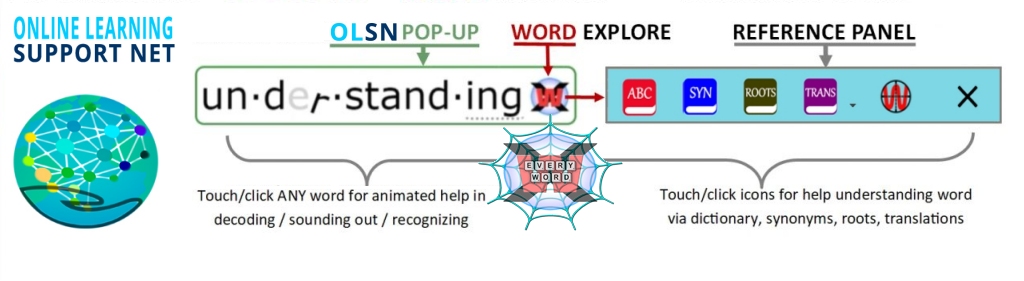 Note: Remember to click on any word on this page to experience the next evolutionary step in technology supported reading.
-----------------------------
Dr. Marilyn Jager Adams: I’m honored to chat with you. Tell me a little about your project.
David Boulton: Thank you. The honor is mine.
It seems that very few people in our society really understand how this code came to be the way that it is and the kind of artificial challenges involved in learning to process it. That’s one of the things that we really want to get at.
Origins of the Phonemic Awareness Revolution:
Dr. Marilyn Jager Adams: Do you know the history of Haskins Lab? It was begun by Caryl Haskins, who wanted to build a reading machine for the blind. He got a hold of Alvin Liberman just as Al was finishing his doctorate and said, ‘Would you do this?’ So Al worked and worked and worked and worked, and eventually he created a machine that would read text aloud. In the course of this, he basically had to invent everything he needed, starting with a way for the machine to recognize characters.
David Boulton: Sounds like an amazing parallel with Ray Kurzweil.
Dr. Marilyn Jager Adams: Yes, but the Haskins groups started on this project more than thirty years before Kurzweil. In the early 1950’s they even had to invent ways to tell the machine how to sound words out and to generate speech sounds electronically. Back then, there just wasn’t that kind of technology around to be begged, borrowed, or bought.
By the early 1950’s he had to invent ways to electrically generate phonemes for each letter, you know, the sound for each letter; which there just wasn’t that kind of information around.
David Boulton: So he would have been back in the days of analog oscillators to generate phonemes.
Dr. Marilyn Jager Adams: Yes, I believe Liberman started this in the mid 1940’s. So finally, I think it was the 1950’s when he got to the point where he could have a text read aloud. For example, given ‘Once upon a time…’ it would say things like, ‘Oh, unn, sss, uh, puh, nnn.’
He gave it to some kids to listen to and immediately got some terrific results. Then he found out the kids were cheating. He was so heartbroken. This had been his whole life at that point. He thought about it long and hard. And eureka! His insight, as he explained it to me, was, ‘Well, if people could understand text by reading it phoneme by phoneme, or understand oral language phoneme by phoneme, then they ought to be able to understand written text if you just spelled it to them. If that were so, then learning to read out to be easy. Yet, as we all know, learning to read is hard for nearly all children and extremely hard for some.’ In this way, Al Liberman came to realize he was missing some piece of the puzzle – and became determined to figure it out.
So it was Al Liberman and his group who gave us the enormously important insight that phonemes are not audible signals. Using their equipment they showed how phonemes are blended together and co-articulated in spoken language. Alongside, there was this burst of activity in the early 1960’s that showed, for example, if other stimuli came at you with the speed of individual phonemes that they would exceed the resolving power of the ear and come out as one big buzz – the idea that phonemes could not be heard, that they were not perceptually…
David Boulton: Distinct?
Dr. Marilyn Jager Adams: Entities, right. Basically, the individual phonemes – those little sounds that go with the letters of the alphabet – are not real. Or not in an acoustic sense, that is.
It turned out that Al Liberman’s wife, Isabelle, had earned her doctorate in psychology with him at Yale. Evidently, they were both exceptional students. When they finished school, she was offered a job at a fine liberal arts college in Connecticut, and he at the University of Connecticut.
The story that I was told was that the board of the college that had sought to hire Isabelle, gathered that August to approve the new faculty as they did each year. When the board looked at Isabelle’s appointment, they said, ‘Isabelle? We never met a gentleman named Isabelle.’ So the story goes, they decided it would be inappropriate for a lady to teach their students. However, being gentlemen themselves, they arranged an appropriate job for her in the Remedial Reading Department at the University of Connecticut. Now, of course, this must have seemed brutally unfair to Isabelle at the time. But, as it turned out, it was a great gift to all of us. Her job was to teach people how to teach reading and how to look for reading problems.
Meanwhile, Al was still back at Haskins working on his problem. In the 1960’s, he was preparing what could become a very important paper – his 1967 Psych Review article, Perception of the Speech Code. Not having word processors at the time, a common practice among professors was to give their papers to their wives to edit with red ink. Isabelle, being a very good wife and scholar, dutifully read Al’s draft. What Al’s paper said, in essence, is there’s only a single, well-integrated ballistic vocalization in the word such as bag. It’s made of three separate elementary speech gestures that are bundled into a single ballistic speech movement that results in a single, seamless sounds: BAG!
Isabelle realized that if phonemes were not acoustically real, then traditional phonics lessons must be confusing at least. So she went out to test this outrageous theory on a bunch of kindergartners. To do this, she made a list of two and three-sound words, such as go, peek, my, etc. The kids’ task was to just tap out how many sounds they heard in each word. She’d say, for example, ‘Low’, and the kids were supposed to tap one, two, and say, ‘Two.’ After each turn, she’d show and tell the children what the right answer was if they didn’t get it. She also gave them an analogous task where they were to count syllables (e.g., puppy has two syllables; bee has one; and so on).
Almost all the kindergarteners were fine on the syllable-counting task, which meant that they did understand the game, and they could count. Nevertheless, hardly any of them showed that they could hear or count phonemes. She repeated the experiment with first-graders. Again, they were fine with the syllables. In contrast, I think it was seventy percent of them who succeeded with the phoneme task. The rest just couldn’t do it despite the feedback she gave them on each attempt. If they didn’t get it in one or two trials, they never got it. They couldn’t answer. They couldn’t play this game.
So this is very interesting. It was the end of the school year. These kids had spent a whole year being ‘taught’ phonics through such questions as, ‘What is the first sound of the word bag?’ ‘ What is the last sound of the word bag?’ ‘How many sounds in the word bag?’ If these questions made no sense to the children, then what in the world might they have learned?
Again, Isabelle conducted these test in the spring, so she had to wait for the next school year to check the kids’ reading. Again, the fairy godmother steps in. Researchers are generally not allowed to fool with people’s classrooms in the first six weeks of school. During those first few weeks, the classroom teacher is very, very busy. She has to make sure all her students know the school routine, that they understand how they are expected behave themselves, that they know how to bring their lunchboxes, that they remember what they learned in first grade. Researchers are not welcome in the classroom until things settle down. So Isabelle had to wait until October, November to find out whether the kids’ performance on her phoneme counting activity might be related to their reading.
Now, there’s something you need to know about second grade. On the first day of second grade, when the kids come in the door, there are typically a few who are reading like champs. Most of the rest seem totally clueless! You almost want to step back and say, ‘Okay, raise your hands. How many of you had first grade last year?’ It’s like they never learned a thing! Now, learning to read is a little bit like learning a foreign language – the less well you know it, the easier it is to forget.
The ones who were really incredible readers at the end of first grade had been reading over the summer, and they’re fine. But the rest of them, it’s like learning a foreign language. They barely knew how, they haven’t done it for three months, and they’ve forgotten everything. So usually by the middle of October, those who actually learned something in first grade are up and going again. But when that point comes, you always find that there are a bunch who just still don’t remember, don’t show any evidence of having learned much of anything in first grade.
David Boulton: Particularly in relation to this phonemic discrimination. They’re not being exercised to make those kind of distinctions except when they’re in that situation.
Dr. Marilyn Jager Adams: Exactly. The one who are good readers at the end of first grade often ready by themselves over the summer, and they’re fine. But the rest of them need some serious review. Fortunately, it’s pretty easy for people to recover things they’ve forgotten given appropriate review. By the middle of October, those who actually learned something in first grade are up and going again. But when that point comes, teachers always find that there are a bunch who still don’t remember, who still don’t show any evidence of having learned much of anything in first grade. Some of those kids came with notes from their first grade teacher. But others did not. What’s going on? This has forever been the big mystery and huge tension of second grade.
At any rate, Isabelle didn’t show up until October or November. By that time, the kids who were going to get back in the saddle were back in the saddle. What Isabelle found was that virtually every single kid who did fine on her test was reading fine. She also found that every single kid who did badly on her test – now, remember, it was kind of all or nothing – was in deep trouble. Whether kids were reading in fall of second grade was just about perfectly predicted by whether they could count Isabelle’s phonemes at the end of first grade. The great mystery of second grade was solved!
So that was the original phonemic awareness thing. It was funded by Reid Lyon’s predecessor at National Institute of Child Health and Human Development. It was that that got us all thinking about phonemic awareness. We began to worry about it long before we quite understood what it was she was talking about. It’s like, are they trying to rote memorize their way to literacy, or did they get the logic of it? Did they understand how this works so they can think when they don’t know a word, to read or write? And so that was the phonemic awareness thing. If it hadn’t have been for that series of fairy godmother events we never would have been there
David Boulton: There’s a remarkable parallel in this story to Pat Lindamood’s story, also in the 1960’s. She came at it from a point of view of speech pathology…
Dr. Marilyn Jager Adams: Exactly.
David Boulton: And recognizing the same basic core distinction process difficulty, and then learning to exercise that as a way of helping people through it.
Dr. Marilyn Jager Adams: That’s right. So as it happens, this notion of the importance of phonemic awareness has actually been around before them. There are people in the literature who had figured it out long before and more than once. But phonemic awarness is so second nature to those of us who can read and write that it’s very hard to understand what people are talking about.
I didn’t get it until I wrote Beginning to Read: Thinking and Learning About Print. Feeling unsure of myself, I went out and played with kids. When you run into a kid who doesn’t get it, it’s so obvious.
For Al it was not kids, it was a computer that didn’t get it. No matter, whether it’s someone or something, the problem is so obvious when you see it. If you can get teachers in a situation where they’re watching kids, and you say, ‘ That! Right there! That’s what we’re talking about!” The teachers respond, ‘Oh, that! That’s a huge problem! Why didn’t you say so?’
Phonemes:
David Boulton: So you’ve got to focus them in some way so that they’re actually, first-person, ‘getting’ the distinction, rather than it being merely an abstract idea.
Dr. Marilyn Jager Adams: Where they see what it is. When you try to describe it academically it just sounds like something rare and esoteric. ‘Phonics without the letters‘ is the most frequent description I hear from teachers, which is not right at all. At the basic level, a better summary of phonemic awareness is can you pay attention to the sounds of words as distinct from their meanings? Given that, the next level is whether you understand that every spoken word can be conceived as a sequence of these little elements or speech gestures called phonemes, and that the letters represent those left to right?
David Boulton: Which is not natural. It’s an artifact of our writing systems.
Dr. Marilyn Jager Adams: All languages are made of phonemes, right? And they’re all made of roughly the same number?
David Boulton:We can look at languages and analyze them in terms of phonemes, but would we need to make these kinds of phonemic distinctions in our oral language environment to engage in oral language, or do they become necessary only when we’re trying to relate oral language to something that’s written?
Dr. Marilyn Jager Adams: That’s a good question. I hear where you’re going and the simplest little answer to your question is, yes. The real answer is phonemes are very human. They are our birdsong. In fact, there’s a literature that argues that every animal has a max capacity of forty to sixty calls. For us it’s phonemes. What’s different about us is that we developed this capacity to merge them, to co-articulate them, so that in effect we get many, many, more. We developed the capacity to use combinations and permutations of them letting each combination mean something different.
David Boulton: We’ve gone back and taken a look at the jaw and throat and tongue and teeth and the speed of articulation.
Dr. Marilyn Jager Adams: Right. If each phoneme is like the forty calls of a cat or the whale or the whatever, if each phoneme is like that, then what we’ve done is we’ve said, ‘Okay, forty calls is not enough, but we can have forty times forty times forty times forty…by merging them together to make words. And then we can have that times that times that times that by combining the words to make sentences.’ Suddenly you have an explosively powerful communication system, but only if you can have a way of packing and unpacking those basic sounds, and by doing it quickly enough to keep up with thought. If you’re going to say, ‘What I care about is a combination of these three units, which is different in this order from that order, or it’s different if this is the third one and that’s the third one,’ then what you have to do is have the information processing capacity, the speed to get all three of them in.
David Boulton: Right.
Dr. Marilyn Jager Adams: Which means that human beings also have to have the brains to unpack these strings of phonemes, too. So the challenge is both producing them and unpacking them, and the argument is that it’s the whole temporal lobe- that’s what’s special about human beings. That’s what we got. Co-articulation is what we got, combinations and permutations of our chose hoots and hollers.
Babies, by the way, have to very actively and deliberately attend to phonemes. They sit around going bah, bah, bah, bah, bah, right? But after not too much time, they don’t need to attend to the phonemes any more. They hear them effortlessly. From that point forward, the normal, natural thing for people to do is to focus their attention on the meaning, not sound. Human attention can only be focused on one thing. It’s like a spotlight. So the normal adaptive natural intelligent thing for people to do is to focus their attention on meaning. The trick with little kids, who have gotten so good at doing this that now they can hear lots of different voices, not just their mommy, and they can hear them over different media, and they can hear them without looking – they’re just incredibly good at it now, and now we’re asking them, please, to release their attention from meaning and put it back on the sound of the word.
There isn’t really a good way to explain that to children. So you have to devise educational activities that will engage them in doing that, and where you can see if that’s in fact what they’re doing, because until they can do that, the alphabetic game just doesn’t make sense because they’re trying to pay attention to meaning, and it’s not the way this particular game works.
David Boulton: Right. So this has something to do with whether or not they’re operating at high enough frequencies of distinction during the process of developing their oral language facilities and whether they, by virtue of learning to discriminate speech sounds, have already, implicitly, made the kind of phonemic distinctions that can then be used to map onto print. To the extent that they haven’t, we need to explicitly exercise the development of that. Is that what you’re saying?
Dr. Marilyn Jager Adams: Yeah, but all of this is cultural. So when you ask teachers how do kids learn the ABCs? They say, ‘By print exposure, by storybook reading, by environmental print.’ But how does one know that that one is a b? They’re stuck. Guess what? Somebody has got to tell you that one’s the b.
David Boulton: Right. But at that level, it’s a simple associational labeling thing like dog and cat and mom and dad and house, except that the visual image is this letter.
Dr. Marilyn Jager Adams: That’s right. So there is learning the image and the formation, stuff like that. But again, it’s something we know so well. We like to talk about having it just arise through exposure and we forget how dependent it is, how it is culturally transmitted. The first thing a teacher needs to do is to find out if a child knows the letters yet or not. If the child doesn’t yet know the letters, then we’ve got to teach them.
David Boulton: Right. Now the question: Should we be teaching them the letter names of the alphabet?
Dr. Marilyn Jager Adams: Of course.
David Boulton: I agree. A lot of people don’t.
Dr. Marilyn Jager Adams: Of course.
David Boulton: As Dr. Tallal and other neuroscientists will say, ‘the neurons that wire together fire together.’ It would seem that the more that we teach children to have an automatic response with a sound to a particular letter, the more that we’re setting them up for confusion later when that letter rarely means that sound.
Dr. Marilyn Jager Adams: Well, I like that idea in theory, and I have to say I’ve spent my time thinking about it. But in fact, these are the names of the letters, they’re the consensual names of the letters. They’re the names we use when we spell words aloud. They’re the names their parents know and teach for the letters. I do need to tell children what the names of the letters are sometimes and knowing letter names is very useful for young readers. Knowing your ABCs gives you an enormous leg up on learning to read and spell. The names of the letters are mnemonically very useful. There are only a few of them that are confusing, and they stick out, so even they are not much of a problem.
David Boulton: Right. But that’s a different level of confusion than what happens when these letters are blended together in words. Rather than being separated in time and space, as if they’re discrete entities with relatively stable sound associates, these letters have to read as groups and that’s when their letter sound correspondences break down. We’ve been trained to relate to letter sound correspondences as if discrete and separate in space and time, and that creates some confusions.
Dr. Marilyn Jager Adams: Well, again, I understand the argument. But in fact, there are many things in the world that have both a name and a function. The argument that their names will interfere with their function is only one more step in the argument that we should use the International Teaching Alphabet so no letter would have more than one sound. There is a name, and that’s different, and I think people are wired to know the difference between a name and a function.
I need to be able to say to kids, ‘Okay, these are vowels, these are special letters. One of the special things about vowels in English is that they have two favorite sounds, each one of them and it’s different from the name of the letter.’ I don’t want to have to say this is eh-ar-ee. ‘This is the letter e. It needs help to say it’s name.’ Or when they’re spelling you might say, ‘Every syllable has to have a vowel. Tell me which one you have in there.’ You can’t do it, then, by sounds because you can’t articulate consonants without sounds. That’s why they’re called con-sonants.
With sounds, right? Con is with, son is sounds.
It’s very useful and it’s socially easy. The kids like knowing and it just works. You can argue about it theoretically all you want, but it turns out that in the real world they’re useful as labels and they’re useful in terms of learning development. It’s socially, communicatively, consensually useful to know the letter names. They don’t get in the way any more than the names of things get in the way with their functions in other places.
Speed of Processing:
David Boulton: My understanding from talking to other researchers is that the decoding bottleneck comes down to matching up the right sounds to the right letters. One of the differences here is that in a lot of things human beings do, we have time to volitionally think about it. In the creation of this reading stream, in order for it to happen at the rate that’s necessary for attention to cohere and for it to be comprehensible, this process of getting from letters to the right sounds has to happen really fast; faster than they can think about.
Dr. Marilyn Jager Adams: Yes, it has to happen very fast.
David Boulton: So we’re talking about some kind of unconscious processing reflexes that have to…
Dr. Marilyn Jager Adams: That’s right. Wouldn’t it be a shame if every time you saw a silent e you said /eh/? Isn’t it nice to be able to say, ‘You know, that’s one of those helper things, that when you put that letter e on the end of a word then… – And not when you put that sound /eh/ — or would you call it /ee/? I suppose you could introduce it as /eh/, /ee/, or /silence/…,
What is so Confusing?:
David Boulton: I’m not pro or con. What I’m trying to do is understand what is it that’s so confusing and where the…
Dr. Marilyn Jager Adams: Oh, for the kids?
David Boulton: Yes.
Dr. Marilyn Jager Adams: If you look at the special education literature, you find that all children can learn their ABCs, provided they’re taught. It definitely needs to be assessed. You also find, by the way, huge differences in how well they know their ABCs when they enter school. In our voyeuristic studies, those differences in how well they know their ABCs continue to predict big differences in reading achievement throughout the primary grades.
David Boulton: I’ve heard some go all the way to the tenth and twelfth grade.
Dr. Marilyn Jager Adams: Yes, and if you can’t tell one letter from the other, then how are you going to learn the word? It can’t be done.
David Boulton: Implicit in that is somehow that if they haven’t got it by the first grade, they’ve taken off behind.
Dr. Marilyn Jager Adams: We can talk about that, too, because that’s a big problem.
David Boulton: When I have been with children that are struggling to read, and I listen to and watch their mind’s ‘stutter’, it seems to correspond to letter sound confusions in the code they’re reading.
Dr. Marilyn Jager Adams: Does it correspond to the individual letter sound confusions in the code they’re reading, or does it correspond to the collective letter sound confusions in the code they’re reading, or spelling word confusions? I think that that differs developmentally a little bit. See, if you get a lot of beginning readers who are truly — if they hit a word they don’t know, will stop and say, /k/… [makes kind of gurgling sound] ‘can.’ But when you get to the older readers, it’s almost never that they don’t know that p says /p/. It’s that now there’s this load of, ‘I have to read this word, I have to put it in this sentence.’ There may be many letters in this word. Good readers see whole spelling patterns. Have you talked Chuck Perfetti or Linnea Ehri, or any of those guys?
David Boulton: I’ve talked with Venezky.
Dr. Marilyn Jager Adams: Venezky – but not Chuck Perfetti or Linnea Ehri?
David Boulton: Right.
Dr. Marilyn Jager Adams: Okay. There are a couple pieces that you might want to tuck in your reading list. One is that it’s pretty clear from a whole lot of cognitive research that what the mature reader does, although it’s at the atomistic level, they’re looking at letters and looking at phonemes, those things very quickly — the connectionist theory is alive and well in reading.
So those things very quickly tickle each other and inhibit each other so that at the level of phonological response, they’re quickly responding with words and syllables. At the same time, there’s a grand circuit in there that goes in both directions; so if they get the phonology, it tickles the word, and as they get the word, it tickles the phonology, and as they get the orthography, it also tickles the word.
David Boulton: The more that they’re comprehending, the more it’s setting up an anticipation that’s narrowing the range of what will tickle.
Dr. Marilyn Jager Adams: Right and they are learning about spelling patterns and about the phonological patterns that they go with. So you really can trick them by putting letter sounds in funny neighborhoods, and very instantly and automatically, you really can disturb them by putting spaces between syllables where they don’t belong. You really can send out internet hoaxes, where you scramble the letters inside of words and say, ‘Look, they can read it anyway, so why teach them the inside letters of words?’
David Boulton: Yes, and there’s a difference between how a masterful reader can pick this stuff up and what’s happening in a still developing or struggling reader.
Dr. Marilyn Jager Adams: Yes, and that’s what I’m saying — that the quickness comes from a whole lot of interactive help that’s from the inside-out as well as the outside-in that’s based on all of this letter-sound experience that you’ve amassed so that it is automatic, so you recognize things. That’s the goal. You want to be able to recognize things rather than having to figure them out.
David Boulton: In addition to what I’m hearing you say about the relationship between the letter sound processing and the spelling or morphological unit pattern recognition, and then comprehension, is that all these things are inter-looping with one another to collapse the field to the particular word sound that they’re trying to read.
Eye Movements:
Dr. Marilyn Jager Adams: The other thing you might want to look at, David, because it’s kind of cool is — did you talk to any of the eye movement people, like Keith Rayner?
David Boulton: Keith Rayner is on our list and we have corresponded with him. (Ed note: subsequent to this interview we did interview Dr. Rayner)
Dr. Marilyn Jager Adams: To peak your curiosity, what it basically looks like is that the eyes are ahead of the mind in reading. Their job seems to be to collect the words and get them ready for the mind to buffer up so that you can read groups of words at a burst.
Good readers focus their eyes on each word in the text, skipping function words such as be, in, or to, if they need to or whatever. They use the peripheral vision to say, ‘Okay, the next word is coming, and it’s about that long, and I want to get my eye in about a third of the way.’ That’s how they use the visual information in the periphery.
But even when that peripheral word is physically located where you could have seen the letters had they been in the same word, the mind seems to say, ‘Don’t mess with them.’ So you get this wonderful tunnel vision just looking at each word at a time; which is just fabulous when you think about this horrible system of having to take a specific combination and permutation of these twenty-six stupid symbols that look just like each other, of which you only use fifteen.
Rayner’s done so much good stuff there. What we do learn, as in any other perceptual task, is what kinds of things go together and that makes life much easier for us. So when you look at the older kids who are getting that wonderful expression of yours, ‘mind stutter,’ they don’t have the patterns built, they don’t have enough orthographic substructure, infrastructure, to do the automatic processing. The word is not in their vocabulary, so they don’t get the full duplex out, when they kind of sound it out, and nothing comes back.
David Boulton: Right. Which is magnified all over the world for everybody else that doesn’t have English as a primary language.
Vocabulary:
Dr. Marilyn Jager Adams: Right. ‘The boy kissed the ji-girl.’ That’s the way it’s supposed to work. But if the word is not in your vocabulary, you go, ji-uh-erl, jurl, jurl.
David Boulton: Right. So we’ve got whatever is going on at the decoding level, we’ve got comprehension at the other end, we’ve got to have…
Dr. Marilyn Jager Adams: Vocabulary.
David Boulton: The vocabulary has to be there.
Dr. Marilyn Jager Adams: Right.
David Boulton: And you’ve got to develop a pattern recognition system for disambiguating the relation to…
Dr. Marilyn Jager Adams: The letter patterns.
David Boulton: And all of this has to happen faster than you can think about.
Dr. Marilyn Jager Adams: Faster than you can think about. I can tell you from my own research that the kids really do a huge amount of predictings, so that helps them, too.
David Boulton: Or hurts them, right? Because misestimates in their predictions will cause them to tank.
Dr. Marilyn Jager Adams: Right. They’re not doing it on purpose, the good readers. But when they run into a word that surprises them, there’s this confused reaction.
David Boulton: Right.
Dr. Marilyn Jager Adams: You know, ‘In the factory they will can the beans? Will can? Will can? You can’t say will can!’ Things like this can blow their fuses.
Predication vs. Guessing Strategies:
David Boulton: We’ve got a lot of people out there that are still teaching guessing strategies, too.
Dr. Marilyn Jager Adams: Oh, no, you can’t — no. No, no, no, no, no.
David Boulton: Some are teaching guessing strategies.
Dr. Marilyn Jager Adams: Guessing is different from predicting, right?
David Boulton: Yes.
Dr. Marilyn Jager Adams: I mean, from the automatic predicting.
David Boulton: From automatic prediction, yes.
Dr. Marilyn Jager Adams: It’s sort of like in driving. There are an awful lot of automatic prediction strategies you have to use, but that’s very different from guessing.
David Boulton: Yes.
Dr. Marilyn Jager Adams: You’re supposed to use the information.
David Boulton: But some kids are being taught to scan around to find extra-orthographic information, too.
Dr. Marilyn Jager Adams: What Keith’s stuff shows, and this is what I think is so cool about it, is that it shows what the eyes are doing when you encounter any little typographic glitch in a word. The eyes are using all of that information in super abundance and in redundancy. Only through the redundancy does the visual system have the wherewithal to make sure that all of your brain has to do is focus on meaning rather than on the mechanics.
So this whole visual system, it just gets to the point where it’s taking every bit of information and saying, ‘It all fits, next chunk, it all fits, next chunk, it all fits, next chunk, got a snag here – pause and figure it out’. It’s so cool.
David Boulton: And the visual information, as you said before, is going into a buffer of some sort.
Dr. Marilyn Jager Adams: Yes, but it’s not just visual. It is getting instantly automatically translated into phonology and words and stuff like that.
David Boulton: But sometimes the phonological equivalent of the visual information can’t be determined in the word that you’re actually looking at, it comes down the road. So there has to be some buffering that’s happening that’s stretching out in time across a larger field than just the particulars that you’re looking at.
Dr. Marilyn Jager Adams: Right. So the eyes are a little bit ahead. But what you see when you look at those millisecond experiments is that if there are ambiguous words there, that the head cranks out all of them. You just have to figure out a way to probe within the time before it decides this is the right one, that’s the wrong one. So if it’s a bug, it cranks out insect, and it cranks out listening device, and it cranks out software infelicity.
If you put the probe in quickly enough you can see that it does, it’s just that by the time — within not very much time it said, ‘This is the one, kill the others.’ But then if you go and listen to the kids reading who are first of all, much slower, and not running — they’re just not running warp speed; they’re running on one or two pistons instead of four or six.
So then that’s when you get things like, ‘In the factory they will can, can will, can will, can — can’t say will can. Is it can or is it will? Come on.’ And you do see those things. In the data that we have now, we have tons of places where the kids flinch on usage errors, where the word that comes up is more frequently used in another form class, like, ‘Lewis and Clark wanted to sight new flora and fauna.’
Now, they know the word sight, — ‘What a beautiful sight.’ The sight of this, the sight of that — but as a verb? To sight? How do you to sight? I can’t do that.
Levels of Ambiguity:
David Boulton: All of these things you could say are different levels of ambiguity, right?
Dr. Marilyn Jager Adams: Right. For example, we have one where ‘The lions were walking up and down and switching their tails.’ And the kids, the weaker second grade readers, have to sit there and figure the whole word out. And they can read — even the ones who have words like switch — just take forever because they don’t get a full duplex on it. ‘Switch your tail, switch, switch? Switching what?’ But the good readers just plow right through it. ‘The lions are walking up and down and switching their t—‘ And then they go right back and go, ‘That can’t be right. Switching their tails with whom?’
David Boulton: Right. That’s because they’ve developed a certain solid inner reference for their prediction system about what’s right.
Dr. Marilyn Jager Adams: That’s right. But they did get so they could read that word automatically, and that check didn’t get there until after they’d done it. Whereas, the kids who are working on it, they needed the full duplex. It never got there when they were finished. Then there are the other kids who have to sound it out, and they just work. They work, they work, they work. It’s so much work, so much work to be a little reader. There are so many pieces that have to go together. Watch the body language.
Downward Spiral of Shame:
David Boulton: One of the things that we’re very concerned with is the role of affect in all of this from a point of view of interest and attention, but also on the downside, what we call the ‘downward spiral of shame.’ What happens when the children start to feel self-conscious about reading…
Dr. Marilyn Jager Adams: Oh, yeah! And that happens very quickly.
David Boulton: It implies a dissipation of processing resources, regardless of the emotional things that we say about it.
Dr. Marilyn Jager Adams: Forget the sublime explanations, people don’t like to do what they don’t do well. And kids are extreme human beings, you know? People like to do what they do well, and especially if it’s in front of other people.
David Boulton: But there’s no escape from reading.
Dr. Marilyn Jager Adams: Yes, I shouldn’t say people like to do what they do well — that’s not always true. But they really don’t like to do what they don’t do well.
David Boulton: We are masterful shame escape artists. We learn that very early, and all of us do it.
Dr. Marilyn Jager Adams: I remember when my firstborn came home from first grade one day and he said, “No, Mom, you don’t get it, because see, the girls like to read and write, but the boys don’t. The boys like to do math, but the girls don’t.” And I thought, ‘Oh, good, there’s two things I wasn’t really hoping you’d ever learn in the first semester of first grade.’
He read fine. It was just that they decided collectively the difference between girls and boys. He’s twenty now, so this was in the peak of whole language and the girls were writing books and illustrating them and binding them with yarn and stickers and all that stuff. I’m sure that the boys just said, ‘Hmm, can’t compete in this arena and not sure I want to. I’m going over here with the trucks.’
David Boulton: Which means, like you said earlier, ‘I’m going to go where I can feel good about what I’m doing and I’m going to move away from the place that makes me feel bad about myself.’
Dr. Marilyn Jager Adams: Right, and we can call them girls and us boys, and it works.
David Boulton: What’s generally animating the Children of the Code Project is our sense that a significant number of our children are confused. They’re drowning in ambiguity overwhelm, and they feel like there’s something wrong with themselves because of it.
Back to the ABCs:
Dr. Marilyn Jager Adams: Well, they aren’t — back to the ABCs. It turns out that I have this huge database from California; I mean huge, like four years, with 130,000 kids per year, kindergarten through third grade. If you go and look at entry of kindergarten, and you look at: Do they know their ABCs? (As is if I show them the ABCs, can they point to them and say what they are? You know, that’s an A, that’s a B, that’s a C, that kind of stuff.) It turns out the mode — and it’s a steep mode for the upper SES quartile — highest SES quartile is knowing 100 percent of the letters. The mode for the bottom SES quartile is zero. One is a J-shape function, the other one is a backwards J-shape function. Hardly any of the kids know just half of the letters. Those that do are on their way, you know. Most of them know all of the letters or none of the letters.
Those are modes. Even in the high SES group, there’s the peaks: one is at 100 percent, and the other one is at zero. You get in the first grade and say, ‘Okay, I’d just like you to write about what you did over your summer vacation. Don’t worry about how it’s spelled, just spell it as it sounds, blah, blah, blah.’ When I taught whole language, one of the things that made me craziest about it was this basic thing like ABCs. In kindergarten we said it was ‘developmentally inappropriate to teach them,’ and in first grade we assumed they knew them.
David Boulton: It’s pretty bizarre.
Dr. Marilyn Jager Adams: Kids don’t raise their hand and say, ‘Excuse me, I’m a little shaky with my ABCs. Could we review H, I, J?’ They don’t do that.They might write a story with all Ts, and it’s up to you to notice that in some other way that gives you a really good view of what’s going on.
David Boulton: There’s a couple people I’ve encountered that cite you as a case for the idea that the most important thing to do in reading is to get kids to write the ABCs in forty seconds in kindergarten.
Dr. Marilyn Jager Adams: I never said forty seconds.
David Boulton: Okay.
Dr. Marilyn Jager Adams: I will say that if you do it right, then learning those ABCs is the only part of the whole darn reading challenge that represents a significant rote memorization task. You simply have to rote memorize them. Unfortunately, most of them rhyme with each other, and those that don’t have names that don’t make any sense in terms of their usage, right?
I mean, it’s the W and the H that have no rhymes. They rhyme with each other, they look more like each other than anything the kids have had to learn before, right? They just look like each other. And it matters not only that you know each one, but it’s going to be combinations and permutations. It’s just not a chore that’s designed for a crash course. The ABCs must be taught and they’re not hard to teach. But just make sure you have lots of time so they can really be learned.
Your kids were probably singing their ABCs by the time they were two or three, right?
David Boulton: Right.
Dr. Marilyn Jager Adams: And this was fine. Maybe they wrote J backwards until they were in second grade. Who cares? That’s not the issue. The issue is that kids have got to get those letters down pat at the level of recognition because I can’t talk about them if they don’t know which is which. I’ve got to get those down. Imagine if I’m a first grade teacher and I come in, and the kids don’t know their ABCs. I have this wonderful scope and sequence or set of state standards that I have to teach them with.
David Boulton: That is assuming that they do know.
Dr. Marilyn Jager Adams: Yes, by the end of the year. Then I have a choice. I can stop and teach the ABCs. They’re not designed for a crash course. It takes a lot of time to do it right and to make sure they’re there. And that’s at the cost of not meeting the schedule, the instructional schedule that I am on. Or I can short shrift them, and that’s at the cost of the kids not being able to meet the learning schedule that’s implied by my instructional schedule. I don’t have a choice. It takes a lot of time. But it’s the only thing. So just do it. Kids don’t mind, you know? They learn all kinds of things.
David Boulton: Yes, and in the long run, what’s going to harm them the most is not being able to get through this.
Dr. Marilyn Jager Adams: Right. The other part that — and I never said the forty seconds.
David Boulton: Okay. Nonetheless, the one strongest predictor of success is their facility with the ABCs as they enter their first grade.
Dr. Marilyn Jager Adams: Well, probably the single most unforgivable lapse is to not make sure that they’re comfortable with their ABCs, whether that means recognizing them, writing them, and/or naming them. You just make sure they can do it. Teachers can do phonemic awareness in the first three weeks in five minutes a day. Teachers can do a lot of stuff, but they can’t do anything with that, if the kids don’t know their ABCs; if they have to think about which letter a letter is.
David Boulton: There’s no way they can go on from there.
Dr. Marilyn Jager Adams: I don’t want to hear about rapid automatic naming tests and neural tests. The question is do they know their ABCs?
It’s so basic. After that the game is to get them to think and pay attention – learning at its best. But that one piece is rote memorization, there’s no question.
Processing ABCs into word sounds:
David Boulton: But in that sense, though the symbols are a unique kind of challenge, the idea of having a name or label for an object that we visually recognize is something kids are doing all the time.
Dr. Marilyn Jager Adams: All the time!
David Boulton: So that’s not so unnatural a challenge. On the other hand, if when they start to read, as they see a letter, it doesn’t have a particular sound, it has a range of sounds that need to be disambiguated in that buffer.
Dr. Marilyn Jager Adams: Right.
David Boulton: That takes time.
Dr. Marilyn Jager Adams: That takes time. The best leverage you have on time is good teaching. Good teaching is a game of conning the kids into believing that, A) they want to learn what you’re about to teach, and B) they can understand it. Once you got that, you’re okay. So don’t screw up, because you could lose it, right?
David Boulton: Right.
Dr. Marilyn Jager Adams: Yes, but then that’s why the business about systematic phonics instruction is really important. Still, I need to begin by saying right off the bat, I’m going to see if the ABCs appear okay. The other thing we’re going to do is we’re going to learn that these red ones here are vowels, because vowels are very special letters. We will hear that over and over and over and over again, that vowels are very special letters.
In addition to teaching the ABCs, I also like to teach them about vowels so they know that these are special letters. Most of the letters behave themselves quite well. The vowels don’t. And so I don’t want the rest of the alphabet to take a hit when the vowels are misbehaving, right?
David Boulton: I think the spelling reformers have said that the average consonant has nine different sounds and the average vowel has twenty.
Dr. Marilyn Jager Adams: Well, yeah. And then they should attribute weights by likelihood of occurrence, right?
David Boulton: Likelihood of occurrence at different stages of learning to read.
Dr. Marilyn Jager Adams: Right.
Back to Ambiguity:
David Boulton: I agree. But doesn’t all of this translate back in to ambiguity. How much ambiguity is involved and what’s the task at hand?
Dr. Marilyn Jager Adams: That’s exactly right. That’s why there’s the big deal on systematic teaching because what you want to convince the kids of is that there’s a system here. That’s why inventive spelling is so wonderful, because it’s a task by which you reinforce the message that, ‘Look, there’s a logic to this system. You can understand it. That’s your job. I’m going to give you examples. I’m going to illustrate through examples of how it works, and then I’m going to ask you to please use the lessons we’ve learned through those examples and generalize them. I’m not going to teach you every word in the language, I’m going to teach you how it works and give you examples, and then you’re going to take it from there.’
If you can get the kids to do that, then they’re so much better entertained, plus you can assess better because you’re not looking at whether or not they rote memorized what you just said; which kids are very good at doing if they feel like doing. And they might not feel like doing it. But if they feel like doing it, they can parrot you very well without understanding a word you say. But if you’re asking them constantly to transfer, to generalize — you know, ‘Okay, so we just did cat, can or hat, bat, and rat. Now, what do you think this word is? M-a-t, what could that be? Or, f-a-t, what could that be?’
I guess I’m also a little bit concerned in this business about the state’s definitions of systematic instruction. For example, Texas and California in particular have just defined decodable text strictly at the level of individual letters. You know, ‘All the words in here, all the letter-sound correspondences in this text, individual letter-sound correspondences, have they been taught before?’ And you look at that and you say—
David Boulton: That’s only one level of the confusions.
Dr. Marilyn Jager Adams: Letter sounds behave differently in different environments. If you’re doing systematic phonics and you’ve only gotten up to L — suppose you do letter of the day and you’ve only gotten up to L, and you ask children to write about their Halloween costume? Did you ever see a kid doing inventive spelling who only used the letters A through L? Never. You really want them to think. So if I taught cat, hat and fat, I do want them to figure out what sat is, you know?
David Boulton: And the point is to be able to generalize on any one of the letter sound combinations and understand the patterns.
Dr. Marilyn Jager Adams: Exactly. ‘I’m teaching you examples and you’re learning to think. Now, this is your job. This isn’t my job. You think. You think for you. I don’t think for you. I teach. But I watch to see if you’re thinking well.’
States like Texas and California define everything in terms of single letter sound, which totally gets people back into the1950’s. Even if they’re not thinking that way, the instructional materials come out in that SR Learning Theory kind of thing where everything is in a very closed system. But then the opposite side of having it defined that way is when you look at the decodables that get passed by the adoption committees. They start using letter sound correspondences without any consideration of number of syllables.
David Boulton: One of the things that we’ve developed was a way to look at the variations of — in other words, the number of possible sounds that a letter can make in a particular vocabulary set. We looked at the vocabulary lists, and it’s amazing to me how confusing the words are that are in these vocabulary lists.
Dr. Marilyn Jager Adams: In terms of letter sound correspondences?
David Boulton: And in terms of what you were saying, the number of syllables. What’s missing is an understanding of the levels of ambiguity-challenges involved and the question: ‘How can we help children step-by-step through being able to process these different kinds of ambiguity-challenges on the road to reading?’
Dr. Marilyn Jager Adams: Exactly. At the first level there are these consonants, then vowels. You’re going to do the short vowels, and you read them left to right, and sound them out, and that’s the way the word goes. Fine.
Now we have these long vowels. How will we do this? Remember, these vowels are very special letters, but they need help to say their names. So then you do the — thank God there’s the final e convention. It’s pretty straightforward and very generalizible, because you can do lots of contrasts to make them think, and make them think about which sound they’re hearing and if it’s a this and if it’s a that, and real usage, because the vowel diagraphs really stink. I hate them, you know?
That’s another case where there’s just no substitute for visiting it. This isn’t going to come through experience. I can’t tell you how many curricula I’ve picked up where they say, ‘Okay, we’re doing long /ee/, so let’s teach final e. The magic e thing, and let’s teach ee, ea, and ie, and maybe final y, too. Why not? It says /ee/, too.’ So they present all those things. I hate this. Then instantly after presenting these as single letter-sound correspondences, they give the children a dictation test and count them wrong.
How are the kids going to know when to use ee and when to use ea? If they could do this, why would you have needed to teach this lesson? Don’t put the ea in the same lesson; just do the final e and get that done with all the vowels. Once we have the contrast down, we’ll work on the other ways to spell long vowels.
Convince them. Keep the con game up. There are lots of things you do as a grownup. Like you teach them that they have to say please to get what they want. And you know what? That almost never works in real life. You still teach them to though.
You want them to have these basic frameworks, like the alphabetic system, like, ‘Vowels need help to say their name, this is one way they do it. Here’s another way they do it.’ When they get to second grade, the kids who are coming along will say things to you like, ‘Uh, this shouldn’t be begin, this should be bejin, ha ha. This should be jiggle, not giggle, ha ha. This should behave.’
They think that’s very interesting. So there’s give and have and glove. Next?
It’s parenting. It’s about conning your children.
History of Alphabetic Reading:
David Boulton: When we step back from this, it looks like what we’re talking about is that for the first 2,500 years, or up until 500 years ago or so, the majority of use of alphabetic writing and reading was nearly phonetic.
Dr. Marilyn Jager Adams: Until when?
David Boulton: Well, in the case of English, the writing system didn’t really develop until around 600 years ago.
Dr. Marilyn Jager Adams: Right. Because it was inventive spelling. I mean, that was the idea, right? People couldn’t read very fast back then either.
David Boulton: Right. But it’s point was to be kind of slow, code-cued, speech.
Dr. Marilyn Jager Adams: It was the only way to do it, right?
David Boulton: Right. But the point is that the kind of confusion that somebody had to learn to deal with in order to read was a different kind. Like Plato said in the days of the Republic, “Once we learn the letters of the alphabet we can read.” It’s a matter of saying them fast together.
Dr. Marilyn Jager Adams: Right.
David Boulton: That was it.
Dr. Marilyn Jager Adams: You want to understand, just listen.
David Boulton: No internal assembly required.
Dr. Marilyn Jager Adams: Right. I think that the flipside of that coin is that until we invented the printing press and had a compelling economic reason to spell the same word the same way — remember, this is before halogen bulbs and glasses, right?
David Boulton: Right.
Dr. Marilyn Jager Adams: Until that, we really didn’t develop this cult of people who read so rapidly. It wasn’t until the end of the 19th century that people started saying, ‘Oh, the natural way to read is silently you can go so much more quickly’ — or that people began to publish novels and things like that. Because when you couldn’t read fast enough every book has sort of a shelf life. If you don’t finish that book or that article within a certain amount of time, you’d have to start over or put it in the compost pile.
It seems to me that historically the evidence is also there that until we developed canonical spellings for words, so that you could develop visual recognition to complement and do that cortical handshake with the phonological and lexical identity of the word, we really didn’t have enough of the redundancy to be able to do this very rapidly.
David Boulton: To read at the speed that we now take for granted.
Dr. Marilyn Jager Adams: Right.
David Boulton: But what you’re talking about is ten or twenty generations that’s been involved in this.
Dr. Marilyn Jager Adams: But really it was a technological accident that we decided to spell the words in their proper way, right?
David Boulton: Well, if we can say that that’s their proper way, right?
Dr. Marilyn Jager Adams: Well, we decided. It’s simply: Why is it this way? Somebody decided. Whether it was Daniel Webster, Samuel Johnson or someone else – somebody decided.
David Boulton: There’s William Caxton, the printer and those kinds of stories.
Dr. Marilyn Jager Adams: Yeah, but somebody decided. There are people who decided. France is still re-deciding, right? They had a re-decision three years ago. They changed a bunch of spellings. They didn’t change as many as they wanted, because there was a social outcry. And Roosevelt — remember when Roosevelt wrote his state of the union speech in inventive spelling?
David Boulton: One of the most interesting stories is the breakdown of the spelling reform movement in 1906 because Theodore Roosevelt issued the order to government printing to adopt their reforms. Newspapers depicted and spun the effort as being a money making scheme designed to benefit Carnegie.
Dr. Marilyn Jager Adams: What? The other part is that I don’t want to figure these words out — it’s like feeding meters. I don’t want to figure these words out. I recognize them. Don’t undermine me. I learned how to read already. So if only literate people really even have a voice in government, then that’s not a good campaign platform.
David Boulton: It’s like, ‘You want us to change all our libraries because some kids are having trouble reading?’
Dr. Marilyn Jager Adams: That sounds hilarious, really.
The New Challenge:
David Boulton: What we’re talking about is a relatively brand new technological challenge that requires the brain to develop processing modules that it otherwise never had any natural need for.
Dr. Marilyn Jager Adams: Right, it’s so hard. Just watch those little guys. All that wiggling and squirming they do turns out to be a characteristic of any multimodal task complex, multimodal task with time pressure. ‘Not only do you have to do this, but you have to make it work with this and this and this and this and this, and get them all together, and you’ve got this long to do it, because after that you’re going to have to start over, because you don’t know what the word is.’
David Boulton: I think there’s a lot of good arguments for our development of the capacity to do such complex multiordinal, multimodal tasks. It’s been an outgrowth of the kind of conditioning that’s happened to the human brain, the looping back through culture that originated with writing and reading.
Dr. Marilyn Jager Adams: We’re good, aren’t we? It’s pretty amazing.
David Boulton: Well, except for when we look at the number of children that are suffering from difficulties associated with this process.
Dr. Marilyn Jager Adams: That’s right. Now, while I do think that it’s good having a fixed spelling, and I don’t think they’re going to reform the English spelling, most alphabetic languages are either vastly more orderly than English, such as Spanish or Finnish, or they have diacritical marks. Now that you have computers, you really could mark the long and short A’s and the silent letters and the diagraphs in beginning reading. It’s not the same typesetting problem as when they tried the International Teaching Alphabet Experiment.
David Boulton:Absolutely. I totally agree with you. I wouldn’t mind having a conversation on this as a separate subject because I’ve spent a lot of time on the point that you’re describing now.
My sense in the long run is that there’s two things that are fundamental here. One, we’ve got to reduce and unfold more carefully the ambiguity that children are challenged with on the stairway through learning to read. Number two, we’ve got to detox the shame. We’ve got to create a situation where the children feel like, ‘Hey, you know what? This is an unnatural thing to be doing. It’s tough. I wouldn’t feel ashamed if it took me a long time to figure out how to program a remote control at five years old, or do some other complex technological things.’
Dr. Marilyn Jager Adams: Right. At the same time, I think that even if it were really straightforward, like if we had ten letters, and they all were perfectly behaved, some kids would just do it far more easily than others. It would be harder for some than others, and that’s just the way life is. That’s the way walking is, learning how to walk. Remember when your kids had to learn to walk or swim? At least one of them must have worked harder than the other, right?
David Boulton: You’re right. One of the differences is that in almost every form of natural learning that human beings do there’s real-time feedback informing their extension and differentiation.
Dr. Marilyn Jager Adams: Well, but it’s also the case for things like walking or swimming or playing baseball, some kids just get up and do it like magicians. We don’t know where they got it, while some kids really have to work. It turns out that how hard it is for them to learn has nothing to do with how well they’ll do it once they’ve learned. They may be on the swim team, even though they didn’t want to get that nose under water for the longest time.
But in reading we have all these self protective labels, like ‘minimal brain dysfunction’, ‘brain damage’, ‘the parents’ fault’, and stuff like that. If they’re slow in learning, instead of giving them the support, we ask them to share the blame, when it’s just normal. It’s not quite fair. And once you put them in school, we do have kind of a rigid pace there.
David Boulton: It seems to me that if their lives are going to be virtually all but fated by how well they come into learning this artificial to their nature technological processing skill, that we ought to do everything we can to meet them in a way that will optimize their ability to learn their way through this.
Schools:
Dr. Marilyn Jager Adams: I agree. But, we do a horrible job with that in our schools. We may have a reading specialist or a reading recovery teacher who is going to take care of that fifteen percent that need special help in a well-funded school. Now, I’m not going to argue that she can do everything that need be, but that’s a much better ratio than what we have in schools where we have kids who don’t know their ABCs, kids who don’t speak English, kids who don’t know how to listen to what I call ‘broadcast language’… where it’s not directed specifically at them, but they have to figure out from what the teacher is saying, what it means for them.
We have kids who are just dying for attention in other ways. And so while the issue of making sure that people understand what’s involved in learning to read and how to look for what to expect — what are the most likely difficulties, and what order along the way, and what you need to teach and what you need to look for and that kind of stuff, those things are all critical, but it’s still a case that — I personally think that twenty-five to thirty kids to one human being is hopeless. When you talk about the performance gap – an awful lot is the have/have-not gap.
David Boulton: There’s no question that children that grow up in a language environment that’s rich and complex and moving at a higher pace are going to be pulled into having a greater processing capability as a base to take off into reading with.
Dr. Marilyn Jager Adams: There’s no question. There’s also no question that if their parents thought that their kids weren’t learning to read or that their teachers weren’t behaving themselves, they would go in and complain. Even if only ten percent in your school do, the principal and the teachers still live in fear of these parents. ‘My kid comes home and she says that every day this is what they do in class. Is this true?’
David Boulton: It’s pretty spooky. Often when my daughter comes home I can’t believe how radically confusing they make the steps of progress. Children are struggling with that confusion.
Dr. Marilyn Jager Adams: But you will either teach her yourself, or maybe talk to some parents about getting a different book, or maybe you guys will complain at a PTA meeting, or maybe in a conference. That’s not true for many parents.
David Boulton: That’s why the system has to care.
Dr. Marilyn Jager Adams: It’s even worse than that parents don’t know how teach them at home. If it doesn’t make sense they’ll probably think that they’re the ones that are stupid rather than it doesn’t make sense. It’s a huge license to be able say, ‘That doesn’t make sense. That’s a dumb way to do it.’ I mean, that’s a real liberty that we get from education, right?
David Boulton: The whole experience evokes the way they feel about the whole thing.
Dr. Marilyn Jager Adams: Right. ‘I had a teacher like that,’ maybe is the most critical thing you can say.
David Boulton: That comes back to the shame piece for us. We’re talking about a radically unnatural processing challenge and the context of it is causing the children to feel like there’s something wrong with them. It just seems so insane.
Dr. Marilyn Jager Adams: Right. One way to look at our urban schools is that they’re our control schools.
That this is what we’re able to do in the absence of that help from parents before, during, after, alongside, directly, indirectly; this is what our schools are able to do in and of themselves. Yet it is for precisely those children that we invented schools. It’s not for the children in Chevy Chase. We would never have a public school system if we thought that everybody’s mother was Abigail Adams, you know?
David Boulton: Right. That brings us back to: how do we meet these children in a way that’s going to actually work for them and guide them through a stairway, through these confusing processes in such a way that doesn’t fold back on them to be this general indictment of themselves as being stupid?
Learning :
Dr. Marilyn Jager Adams: Well, you have to understand, don’t you think? I think this is totally doable. What is learning? Learning is building new relations between prior knowledge. So if I want them to learn this, I have to make sure they have all the pieces, because you can’t build relations between pieces you don’t have. I have to make sure that when we’re building any one of these relations they’re paying attention to the relation that I’m trying to get them to pay attention to, and understanding it correctly.
David Boulton: Which comes down, ultimately, to whether or not the system that’s trying to teach them is aware of where it’s not working, relative to the kind of confusions they’re experiencing inside that framework you’re describing. We’re either kind of magnetized to our theories or we’re actually paying attention to what’s confusing them and meeting them on the edge of that confusion and helping them through it.
Dr. Marilyn Jager Adams: That’s right. I think that’s enormously difficult with thirty kids in the class. ‘Okay, I have thirty kids in the class, so that’s two minutes a kid per hour if I’m not doing whole class activities.’ That isn’t going to work.
David Boulton: A lot of people blame the teachers. I’m amazed that they step up to the challenge they do.
Dr. Marilyn Jager Adams: Oh gosh, and so many of them are so incredibly great. It’s unbelievable.
There’s a suit, by the way, in Massachusetts you might want to know about called the Hancock Case.
David Boulton: Tell me about it.
Dr. Marilyn Jager Adams: The poor schools of Massachusetts collectively sued the state. They said, ‘Okay, we love the standards,’ (and Massachusetts has tough standards). But they said, ‘We love the standards. We really like knowing exactly what it is the kids ought to know and be able to do by each grade. We think they’re well done. We just think that’s great. We also love the accountability. We want to know objectively how we’re doing. But what we can’t do is, we can’t get our kids to those standards in the same amount of time unless we have extra help.’ And of course, they have less money because we tax by township in Massachusetts.
David Boulton: Unfortunately, it’s the kids that need it the most who’ve got the least amount of resources helping them.
Dr. Marilyn Jager Adams: That’s right.
David Boulton: So how do we structure the system to create incentives so that we’ll pull resources and people to where the kids are that need it the most?
Dr. Marilyn Jager Adams: That’s right. Did you know that, for example, France, programmatically, heuristically, algorithmically, allocates inversely to SES when it’s allocating funds to schools? Most of Europe does. That’s a very important thing that we do just the reverse of. We put the most money in those schools that need it least. If you want people to rise to a challenge, you have to make it possible. Otherwise they’ll just say, ‘I hate this,’ and they won’t do it.
David Boulton: Which comes down to the granularity of the steps, and how clear they are, and how they can get first-person verification, validation of this for themselves rather than living in somebody else’s model as a robotic extension.
Dr. Marilyn Jager Adams: Right. And feedback, not just on how well am I doing, but where do you need the extra help?
Stewarding the Health of Learning:
David Boulton: What heartens me the most in my travels is that underneath all the differences and disagreement that I experience about what’s the right way to teach reading or the right way to think about it, it seems to me that I’m continuing to be in contact with people who really do care.
The way I break it down is that I think that we all come to generally agree, whether we explicitly use the same language or not, that given any multigenerational view, the most precious natural resource on earth is our children’s learning and that our most important job as adults is to steward the health of their learning.
Dr. Marilyn Jager Adams: That’s right. This is the entitlement we want everyone to try to exploit.
David Boulton: What’s more important than the health of your…
Dr. Marilyn Jager Adams: All parties want to…
David Boulton: Exactly. This is my sense of the miraculous intersection, because whether you care about the children as bots for the machine, or you care about their human potential, you arrive at the same place, which is how they participate from the inside out. The health of their learning is at the core of how they’re going to serve the system and how they’re going to grow to be who they are.
Dr. Marilyn Jager Adams: But what we said our goal was with public education was that that every human being would have the right to choose. But they can’t choose what they can’t do. If they want to choose to sit on their thumbs – that’s fine, they can choose that. But they can’t choose what they can’t do.
David Boulton: But it’s not a choice to sit on your thumbs unless there’s a bunch of other options to be considered. And so often it’s shame avoidance.
Dr. Marilyn Jager Adams: On the shame avoidance thing, one thing you might want to look at just to make people feel really bad, that I think is a real heartbreaker, is the ‘Be all you can be’ ads.
It turns out that the majority of the recruits until Reagan changed the bill so that he only recruits when he’s having a war — the majority of the recruits were getting thrown out in six weeks because they said, ‘Well, guess that’s all you can be.’ Because they couldn’t read or write.
Isn’t that awful? You can’t even join the Army. Reagan changed it when they started closing bases and stuff. They stopped enlisting so many kids. But those statistics are around.
What we want when you finish is for everybody to say, ‘Yes! This is a team sport, and we can do it. It’s not the kids’ fault, it’s not the parents’ fault; it’s not the teachers’ fault; it’s simply a team sport.’
David Boulton: Yes. The purpose of coming up underneath this from the history is to put a frame of reference on the way that we think about it today that leads back into: This is a technological challenge, this is not something that we’re at fault for, other than for not paying attention to the underlying technology here. So to get rid of it being a matter of fault, and to give hope to the different polarities that they don’t have to be wrong to be in agreement.
Dr. Marilyn Jager Adams: That’s right. And people really are clinicians. If we could give them a little insight as to what’s different. It’s not that those kids are lazy and stupid. It’s not that those teachers are lazy and stupid.
David Boulton: We got to stop making everybody feel at fault for their view on this thing and get underneath it to a place we can agree on and learn together from.
Dr. Marilyn Jager Adams: That’s right.
David Boulton: It’s been a delight to talk with you. Thank you.