
An Interview...
Dr. Timothy Shanahan – The Personal and Social Implications of Literacy and Literacy Instruction
 Dr. Timothy Shanahan is the Chair of the National Early Literacy Panel, President Elect (2006) of the International Reading Association, Member of the National Reading Panel, Director of the Center for Literacy, and Coordinator of Graduate Programs in Reading, Writing, and Literacy at the University of Illinois at Chicago. He received the Albert J. Harris Award for Outstanding Research on Reading Disability and the Milton D. Jacobson Readability Research Award from the International Reading Association. He is a member of the American Educational Research Association, National Council on Research in Language and Literacy, National Council of Teachers of English, National Reading Conference, and the Society for the Study of Reading. Additional bio info
Dr. Shanahan is an internationally recognized reading researcher with extensive experience with children in Head Start, children with special needs, and children in inner-city schools. During the course of over five hours of conversations, spread across three interviews, we found Dr. Shanahan to be an open minded and well rounded literacy expert whose driving passion is to serve children and families. He is without doubt one of the least partisan and most noble champions of children and literacy we have encountered. The following transcript is from our first telephone conversation. The transcript of our video interview will be appended as soon as its available.
Video: Literacy is Everywhere
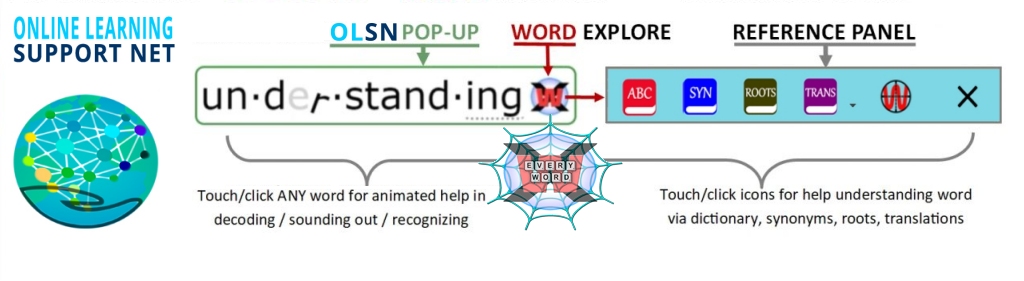 Note: Remember to click on any word on this page to experience the next evolutionary step in technology supported reading.
-----------------------------
Introduction:
David Boulton: It’s a great pleasure to talk with you. You seem to be somewhere in the middle of a big fire.
Dr. Timothy Shanahan: Sometimes it seems like that.
David Boulton: So much disagreement and dissent going on around reading related issues and what we can trust and what we can’t trust about the information that is gathered. You seem to be pretty well situated in the midst of it.
Dr. Timothy Shanahan: I seem to be right in the middle of it and I guess that’s a good place to be. I see my role in lots of ways trying to settle it down.
David Boulton: It needs that. Maybe we could start with you giving a biographical sketch of yourself and on how is it that you come to this work. Tell us about your passion and motivation to work in this field.
Personal Background:
Dr. Timothy Shanahan: I came to it initially as a public school teacher. I was a former first grade teacher. I actually started tutoring kids in reading when I was about 18 or 19 years old and got interested in it and started taking some classes and ended up becoming a teacher. That’s sort of how I got here in the first place. I guess what really impassions me is I just have a very strong belief that we haven’t succeeded in giving this literacy franchise to enough people and at a high enough level to many people. I really think we need to do something about that.
Literacy and Civic Participation:
Dr. Timothy Shanahan: Within Western society, full participation in the society is really dependent on literacy and I just don’t think that’s available.
David Boulton: Both instrumentally and cognitively/emotionally.
Dr. Timothy Shanahan: Absolutely. I often, in my speeches and classes, use economic examples. But reading is part of civic participation, it’s part of enjoyment, it’s part of social interaction, it’s part of religion. It doesn’t have a narrow meaning in terms of what I’m talking about. It’s actually got a very broad set of implications and clearly we have a large percentage of our citizens who either don’t have literacy, which is fairly rare, or have it at too low a level, which isn’t rare at all.
David Boulton: We could say that how well children learn to read is all but fating to the unfoldment of their life.
Dr. Timothy Shanahan: Absolutely.
David Boulton: That’s kind of the place we meet. This is not like anything else. This is a class unto itself. We think that a pretty radical social reframe of the whole idea of reading has to take place. You’re connected with this at a high level, with the NRP oversight of the nation as a whole, and also grounded in a very specific concern for the well being of people.
Dr. Timothy Shanahan: I think that’s a fair description. I think that’s what literacy work really is. It has both societal implications in terms of the fate of the nation, what kind of society are you going to live within. It obviously also has that very personal, individual issue of how are you going to think, how are you going to take part in civic life and so on. I think the social and personal implications are always there and I certainly think about both of them a lot.
David Boulton: In our work we make the distinction that it doesn’t matter whether you care about the spiritual or emotional well being of the children of humanity or whether you care about the social economic participation of human ‘bots’ and their economic productivity and really don’t care about the individuals, you still come to the same place.
Dr. Timothy Shanahan: Absolutely. And that’s why I get kind of bored with the accusations that politicians are supporting literacy only for economic reasons. It really doesn’t matter. What we really want all systems set up towards is making sure that people are getting more literate. Obviously, more literate means different things. If we’re talking about a third grader it might mean just raising his traditional reading level. If we’re talking about an older student or an adult you very well might be talking about using literacy in an entirely different way than they’ve ever used it before or using it to drive a kind of thinking that they never or rarely engage in. As far as I’m concerned, anyone who wants to increase literacy, I’m on their team.
David Boulton: That’s how I feel, that’s why we’re talking. Let’s spend a moment and ask: what is reading?
What is Reading?:
Dr. Timothy Shanahan: Reading, to me, involves some kind of an interpretation of written symbols. Being able to grasp linguistic information that somebody else has put out there in written form, that you can actually make sense of that. More than that, that you can actually think and act with it. I think that for me kind of captures it.
David Boulton: So, you just made a distinction that underlies the distinction between basic and proficient in a way. On one hand, the kind of instrumental ability to interface with this technology that we might call basic, and then at another level that you’re able to move through it with such fluency that you can think with it, that you can apply it rather than just having words cued into your mind.
Dr. Timothy Shanahan: Absolutely. It is both of those things. Again, this is one of those places where people get in fights over which is it.
David Boulton: It’s both.
Dr. Timothy Shanahan: If you can’t interpret those symbols, whatever form they might take, then you can’t do the other. And if you can only interpret those symbols and can’t think or act with them, then it’s kind of an empty skill. Why would we put much social money behind making this happen?
National Perspective & Immigration:
David Boulton: It might help you read the street signs, but it’s not going to empower your learning to travel in the directions your life is needing. Tell me about the state of reading in America as you assess it from your position with the National Reading Panel and as a member of the International Reading Association – share with us your national perspective of this.
Dr. Timothy Shanahan: It’s a little complicated, but essentially I look at it and say in terms of what schools have done, we’re probably pretty equivalent to where we were thirty years ago. Things haven’t gotten any better. Likewise I could say they haven’t gotten any worse. We’re probably doing about as good a job as we’ve ever done in dealing with the teaching of literacy. That’s probably both a victory and a defeat because on the one hand we’re managing to teach literacy as well as ever but we’re doing it under more difficult circumstances. For example, we have a lot more people in this society who have to learn to speak English while they’re learning to read and the fact is we’re doing that and still maintaining the literacy levels.
David Boulton: So, you could make one comparison and say the people coming into the country that do not have English as a primary language is a greater number percentage than there has been historically.
Dr. Timothy Shanahan: In terms of numbers, we’re going through the largest immigration we’ve ever gone through. And this is a nation that prides itself on being a nation of immigrants. You go back thirty years ago and that door had just been kicked open again. Schools in 1971 had very small numbers of second language kids relative to what they have now.
Nothing Wrong with These Kids:
Dr. Timothy Shanahan: There’s nothing wrong with these kids who are English learners. These are wonderful kids. There’s not a problem with the kids. The point is trying to teach them to read in the same amount of time that your teaching them to read and learn English simultaneously. The second task is tougher.
The schools have managed to do it. You look at 1971 literacy levels and you look at 2003 literacy levels and you come away saying man, there’s no difference. We’ve held the line. Our schools are terrific. And there’s truth to that, that’s not a fake picture.
The problem with the picture is that it neglects the other side of the equation and that is how does this look from the kid’s angle? The way it looks from the kid’s angle is that there has been a kind of inflation that’s set in with regard to their literacy level.
Literacy Inflation:
Dr. Timothy Shanahan: Look at it this way. Let’s say in 1971 you had a thousand dollars and you wanted to save it so you hid it in your mattress. You put it away and you’ve held it now for thirty years. No one stole it and now you take out that thousand dollars and you want to spend it. It buys a whole lot less than it would have in 1971. That thousand dollars has lost value because currency has inflated over the last thirty years. Sort of the same thing has happened with literacy. Having 1971 literacy levels, just like having 1971 money, isn’t such a great deal. And the reason for that is because of two things: 1) the incredible growth of technology and 2) the internationalization of our markets and our world.
David Boulton: The shrinking job base for low-literate labor.
Dr. Timothy Shanahan: Absolutely. In 1971 if you weren’t very good at literacy, you just didn’t do well in that for some reason, not a problem – you can go out and build a car. You can go into a sewing mill. You’re going to be able to go out and support your family. You’re going to be able to socially participate. It’s not going to be a big problem because you have other skills. You can show up on time, you can work, you can do manual labor. Those kinds of jobs still exist, it’s just that now their high tech jobs. You want to build a car – no problem. Can you handle the computer codes that drive our robotics? The answer to that in far too many cases is no. You want to be a mechanic, that’s fine. Where did you get your Bachelor of Science degree?
We go out and do interviews with people working in different job categories and you’ll talk to people, for example an auto mechanic, and it has gotten so complex that, in fact, the notion of hiring somebody who is uneducated who is just good with machines – that doesn’t happen anymore. Those days are gone. You want to be a truck driver – there will be a computer in your terminal, in the cab of your truck that will essentially allow you to do things like track inventories and book trips. . In other words, it’s no longer true that being a truck driver, a mechanic, or an auto assembler are low education jobs anymore. Medicine, insurance, banking, education and law and so on – those were always high education jobs.
So, what’s really happened is we’ve shrunk the number and percentage of blue collar jobs and more importantly we’ve turned those blue collar jobs into higher education jobs. What that means is if you don’t have literacy skills at a higher level than kids did in 1971, the economic return on your work won’t be as great and, therefore, you’re not going to live at the same standard that your parents lived.
That’s the tension we’re caught between. The schools are doing at least as good a job, probably a better job, than they ever have, but kids aren’t getting enough literacy to do as well as we have done.
David Boulton: Especially when you consider the dilution of the increased percentage of children that need extra literacy support given their lack of English native language.
Dr. Timothy Shanahan: That’s our situation. It’s an incredible tension where parents and politicians and media are demanding a better job be done with our kids and the schools are saying we’re doing as good a job as we ever have and we’re working really hard at it. People are getting angry at each other.
But the real key here is, we have to remember, we’re doing as good a job as ever, we haven’t lost sight of anything. The schools haven’t failed us. But we’re asking them now to do more than we have in the past and that probably means we don’t want to give them a kick in the pants, we want to try to help them along and make sure that they can succeed with this big, new task.
David Boulton: Well said.
Why is Learning to Read so Difficult?:
David Boulton: Why is learning to read so difficult?
Dr. Timothy Shanahan: I’m not sure we entirely know that. Certainly, one very small group of kids has something that doesn’t quick work right in their brains in terms of picking up this kind of information. They don’t do it that easily. That doesn’t mean that they can’t learn to.
David Boulton: They’ve got a neurobiological disadvantage of some form. Now you’re talking five percent or so?
Dr. Timothy Shanahan: Yes, it’s probably relatively small. People have always argued something between one percent and about twenty percent. It’s probably about three-to-five percent, some place in the middle. There clearly are some kids who, for whatever reason because of the way their neurological systems work, don’t pick up this information easily. They need special teaching and even with that they will probably learn more slowly or have more difficulty than other kids.
But of course the numbers of reading problems that we have go far beyond that. There are so many children, certainly more than three-to-five percent, who struggle to learn to read. Obviously, their struggles are much more with whether they’re being taught, how well they’re being taught, and what they’re social situation is doing to support them – both at home and in the school. I guess the easiest way to sum it up is we’re not doing as good of a job as we need to do as parents or as teachers and that obviously has to change.
David Boulton: We said earlier that the process of how well children learn to read is all but fating their development in life. About three-to-five percent of children have some neurological disadvantage taking off in the process. The rest of the children that are struggling are struggling for a variety of different reasons, but effectively it has to do with how we as adults are building ‘on-ramps’ into reading that will actually work for them.
Dr. Timothy Shanahan: No matter what the reason why they’re having trouble, it’s so important in their lives that we as adults find ways of overcoming whatever those problems are. Whether that is some form of a special kind of education or extra education for kids who have learning problems, but also our willingness to adjust what we’re doing for all the kids as we see aren’t succeeding; and being really vigilant about that. Not letting kids slip through the cracks. Not failing to notice when Johnny is falling behind. There’s nothing sadder than seeing a youngster who maybe doesn’t have a major problem, but nobody has done anything to help sufficiently.
Racial Inequities & NAEP:
David Boulton: Right, just drowning – not being met in this confusion. The NAEP report – eighty-eight percent of fourth grade African-American children are reading below proficient. The trajectory continues, eighty-four percent of African-American children leaving the twelfth grade are still below proficiency. The general aggregate is sixty-four percent of the nation’s children are below proficient in the twelfth grade.
Dr. Timothy Shanahan: One estimate of it from those figures is the typical African-American high school graduate is leaving school with a reading level that is comparable to the reading level that an eighth grade white student has. That’s the average. Now, of course, averages are just that. You have African-Americans that perform not only high above the African-American average, but who perform above the white average. But when you look at the two groups the differences are huge and those differences are certainly connected to family income and financial resources.
They’re likely a product of any number of racial bias and inequities in our society, both current and past. It doesn’t much matter if you’ve made things more equal in terms of access right now if past inequities continue to operate. If you happen to live in a poor neighborhood even though your mom now has a job what that might mean is you go to school where the teachers are less likely to be certified, you go to school where the amount of instruction in a given day is probably less than other schools, and so on and so forth.
The big differences in terms of what we provide to our children really do make a big difference in terms of achievement. If we look at some of the international reports that compare our kids with kids in other countries, we obviously have big economic inequities in our society and those are mirrored in the big differences we see in reading attainment. If we look at other countries that have less economic diversity, they have less diversity of literacy attainment. The variation is less. The two things are connected.
2000 Florida Election & Reading Difficulty:
Dr. Timothy Shanahan: One aspect of this that I had personal experience with was one of the newspapers asked me to analyze the votes in the 2000 Florida election. Obviously, media attention was directed to the hanging chads and the failure of the machines to record people’s votes. The thing that is interesting is that in Florida there are probably more counties that are using paper ballots than machine ballots. One of the newspapers said let’s look at the paper ballots and see how we did there. Florida lost even more votes with paper ballots than machine ballots, and they lost these votes primarily because people couldn’t make sense of the directions.
Florida lost lots of votes because many citizens couldn’t do the simple reading tasks on the ballot. They would spoil their vote by voting multiple times for different candidates. Even this basic franchise of whether you get to cast a vote is connected to literacy. You’re less likely to go and try to vote, but if you do try, you’re more likely to fail and your vote will be lost. We’re almost fifty years beyond the Supreme Court saying there wouldn’t be any kind of a literacy bar to vote in this country.
David Boulton: Of course there’s going to be. Even if you get around the instrumental simple part of it, you’ve got the deeper issue of whether somebody is a competent participant.
Low Literacy, Civic Participation & Health:
Dr. Timothy Shanahan: Yes. In fact, one interesting analysis done with adults who are low in literacy is that low literacy individuals are less likely to read a newspaper than a high literate person. But, of course, these folks could still participate by getting information from television and have radio. There’s absolutely no reason why a low literacy person wouldn’t be able to access a lot of the information that is available over those media.
Except it turns out that lack of literacy has an isolating effect. What happens is low literacy people are less likely to watch informational shows on television, they’re less likely to watch news, for example, than other kinds of television.
David Boulton: How can they navigate?
Dr. Timothy Shanahan: Exactly. They just don’t pay attention to stuff like that which means, they miss out on information about the candidates and elections and so on, but they also miss out on the large amount of health information that is on television news and so on. They don’t find out about the free pap smears down at the clinic. They don’t find out about the new statistics on smoking. They don’t find out about how to take care of their children better. And so their kids are at greater risk in all kinds of ways and they themselves are at greater risk.
David Boulton: We’re trying to pay a lot of attention to that. The underlying connection here is both a lack of the instrumental ability which would allow them to navigate a field of options, and also an aversion to being intellectual that comes as a consequence of this shame.
Low Literacy, Isolation & Shame:
Dr. Timothy Shanahan: Yes. In fact, one interesting analysis done with adults who are low in literacy is that low literacy individuals are less likely to read a newspaper than a high literate person. But, of course, these folks could still participate by getting information from television and have radio. There’s absolutely no reason why a low literacy person wouldn’t be able to access a lot of the information that is available over those media.
Except it turns out that lack of literacy has an isolating effect. What happens is low literacy people are less likely to watch informational shows on television, they’re less likely to watch news, for example, than other kinds of television.
David Boulton: How can they navigate?
Dr. Timothy Shanahan: Exactly. They just don’t pay attention to stuff like that which means, they miss out on information about the candidates and elections and so on, but they also miss out on the large amount of health information that is on television news and so on. They don’t find out about the free pap smears down at the clinic. They don’t find out about the new statistics on smoking. They don’t find out about how to take care of their children better. And so their kids are at greater risk in all kinds of ways and they themselves are at greater risk.
David Boulton: We’re trying to pay a lot of attention to that. The underlying connection here is both a lack of the instrumental ability which would allow them to navigate a field of options, and also an aversion to being intellectual that comes as a consequence of this shame.
Shame Avoidance & Dependence:
David Boulton: Sometimes it’s so powerful and fast and operating before those kind of rational reasons to just be an avoidance. One of the dimensions that we’re trying to bring to this is our work with emotional scientists and cognitive scientists and neuroscientists and bringing together just what is going on here. There’s no question human beings generally do not like to feel shame. We learn very young to become escape artists.
Dr. Timothy Shanahan: Absolutely.
David Boulton: We’re being put into circumstances, with this learning to read challenge, in which day after day, week after week, month after month, in some cases year after year, we’re forced to do something we’re not good at. It’s not like basketball or sewing or music or other things that are an option –you can’t avoid it. And these kids are developing a shame aversion to the feel of their own learning.
Dr. Timothy Shanahan: Absolutely. And when they become adults it ends up becoming a part of the social reality of their lives. It’s not just harder to learn then, but emotionally that whole network that builds up around you makes it tougher. So, if you’re that low on literacy what usually happens is you have to find somebody you can depend on. I might not want the whole world to know, but maybe my spouse knows that I am illiterate or maybe it’s one of my older kids, but nobody else does. What that does is it builds a dependency. If I were especially low on literacy and my wife knew it she would do certain things for me to take care of me and make sure that I’m okay. But what happens to the relationship when I decide this is terrible, I have to go learn literacy, I’m going to go enroll at the local library program or whatever. How much does that threaten the partner who has come to depend on my dependence?
Quite often when an adult who is really low on literacy goes off and becomes literate it leads to divorce. There are many cases documented where women are beaten or abused in various ways, either verbally or physically, certainly emotionally, because the partner who is depended on doesn’t want to give that up. The reason you’re going for literacy classes is because you want to get away from me.
Even when it’s a child who is the one who is being depended upon, the children get quite angry. It’s like mom wants to leave me or mom doesn’t love me anymore and that’s why she’s doing this. The trick is to catch this thing early enough so we don’t get to that point where there are those kinds of problems in people’s lives. That is essential.
Stairways to Literacy:
David Boulton: That brings us back to the core purpose of all of this. We’ve touched on the social, civic, democratic participative processes; in our conversations with Whitehurst and Doherty we touched on the hundreds of billions of dollars involved every year. We’ve touched on the psychological interior shame aversion implications of not being able to read, and the obvious academic implications relative to reading as the gateway skill to reading to learn that is so important to education and to subsequent economic opportunities. We can come at this from all these different dimensions and it comes back to we need to build an effective stairway for these children to get into reading.
Dr. Timothy Shanahan: Absolutely.
David Boulton: So, let’s go there for a moment.
Dr. Timothy Shanahan: Sounds good.
David Boulton: Let me set up this one question for you if I could. One of the major things that seems to be at the base of the polarities or the dichotomies is that, on the one hand, without the experience being consciously meaningful there is insufficient interest to power the engagement process. Without comparatively meaningless, unconscious assembly construction, decoding, disambiguation and projection from this lower level up into consciousness – there is no meaning.
Dr. Timothy Shanahan: If we’re talking about teaching here, certainly one fundamental notion that would need to be stressed is how complex literacy is. Frankly, it’s that complexity that you have to introduce to kids. It’s not we’ll work up to the complexity. We actually start there.
I guess for most kids the beginning would be kindergarten or first grade, in terms of formal teaching being introduced into their lives. Some kids, of course, get that at home, some kids get it in pre-school. But the greatest number get it when they’re probably about five or six when it comes to literacy. Certainly there’s a notion that, somehow, if we just teach the code, if we just teach kids the letters and what the sounds are, and teach them those entry level skills then everything will be fine.
But, frankly, our best programs don’t really do that. Our best programs teach those entry level skills, but they’re simultaneously introducing kids to the idea of reading; the social, meaningful aspects of reading. And so, they’re dealing with comprehension or thinking with text when kids are five and six. They’re doing that right along with teaching them the letter sounds and teaching them how to recognize those first words. It’s not an either/or.
Vocabulary, Fluency, Comprehension & Writing:
Dr. Timothy Shanahan: From the very beginning we have to teach a whole variety of things to kids. In fact, in terms of what I tell teachers or how I organize things in schools that I work in, is that there really are four big things that have to be addressed with literacy instruction.
One of them has to do with words. Initially, you’re talking word recognition. You’re talking all those phonics skills and letters and stuff like that. Eventually, that goes away and it becomes about working with word meanings, working with vocabulary, building up kids’ knowledge of academic language. That’s one piece if it.
The second piece of it is what’s come to be called fluency, which really means you cannot just recognize words, but you must string those words together so that if you read a text aloud it would sound like language. The words would be grouped properly. You would have the emphasis on the right ones.
David Boulton: And it would be flowing at a pace that is consistent with our attention, our natural flow of listening.
Dr. Timothy Shanahan: You’ve got it, exactly. So, that’s an important piece and we work on that piece all along until kids get to some high enough level that we’re satisfied.
The third piece is really working on comprehension and thinking about text. Teaching kids how to think about text, but also engaging them in some of those intellectual conversations that you’re talking about.
But right from the beginning you can have a really interesting conversation with a five year old about the ideas presented in the children’s book. And so, getting them engaged in that grand conversation early on and all the way through is pretty important. And of course, that means learning different discourses, that means getting exposed to different kinds of text, and really different kinds of worlds.
And then finally, knowing how to compose your own text. Knowing how to write, knowing how to communicate so that you’re not always in the role of just interpreting other people’s ideas, but you’re able to put your own ideas out there.
I think all four of those things have to be taught all the time. If you go into a first grade classroom you should see all four of those things getting a fairly substantial amount of time, each one. If you go into a twelfth grade classroom you should be able to see all four of those things happening. And if they’re not, we’re probably not doing the full job of teaching literacy and the scores aren’t going to go up and the kids aren’t going to be able to participate in the ways that we’re talking about.
The Code:
David Boulton: Excellent. There’s no question that it requires a very carefully balanced, ideally on a per-child basis, on-ramp through these different domains that you spoke to. Now, let’s take the relationship amongst these pieces because while we can say they’re relatively autonomous behaviors and functions, they’re all implicitly integrated at a level underneath them all. We’re talking about a radically, unnatural, artificial code processing challenge.
Dr. Timothy Shanahan: An invention.
David Boulton: Yes. An invention that is 3500 years old and that for the first 2500 years of its rise to become the ‘OS’ (operating system) of western civilization, it was largely phonetic. It degenerated through ignorance and neglect during the collision between the Latin and the English to develop these letter-sound confusions. It’s already radically unnatural to be a code processor, but you could argue that that’s just a high speed naming and blending process. In its original incarnation, see a letter, say its sound, blend it together fast and its code-cued speech – no problem. But now, because of all the confused letter-sounds there’s this ‘internal assembly required.’
Dr. Timothy Shanahan: Absolutely.
David Boulton: Which is an entirely different challenge than the human brain evolved to deal with.
Dr. Timothy Shanahan: Absolutely.
Certainly, you can abstract these, we can talk about them separately, you can teach them separately, but ultimately they have to come together. It doesn’t do you much good to be able to just read a list of words. Or it doesn’t help you to be just fluent, or even to just be able to think clearly. All of these things have to get linked up and instruction can play a big role in that, in terms of tipping kids off to what’s really going on here.
For example, say a high school teacher brings in a scientific text for the students to read and does some work on the word meanings so that youngsters can interpret those words and understand the meaningful parts of those words because our language is morphemic, that is that words are made up of meaningful parts. The word cat refers to an animal that has certain characteristics but then you put on that additional little piece, that S, all of a sudden you’re talking about more than one of those animals. Combining meaningful parts becomes pretty important in vocabulary learning, and so the teacher teaches that but then also makes sure that the kids actually can read this kind of language. The students still might not understand what that discourse should sound like. The teacher might read some of it aloud to the kids so they can hear what it should sound like.
More importantly, at the level we’re talking about, the teacher engages the kids in trying to read this like a scientist would. It isn’t enough that you can just pull the information out of a text. Different groups of people read in different ways and scientists are going to look for certain kinds of information. They’re interested in certain kinds of relationships among the ideas in a text. Somebody has got to tip students off to that.
David Boulton: Right. This presumes that the underlying processing engine that’s projecting this word stream into consciousness…
Dr. Timothy Shanahan: Is there.
David Boulton: Is there, yes.
Dr. Timothy Shanahan: It’s intact and has been taught.
David Boulton: And it’s functionally efficient enough that it’s not dissipating the processing resources needed to reflect on and think about the meaning.
Dr. Timothy Shanahan: What that depends on is kids who have been taught to interpret the letter-sound correspondences and how to use those proficiently to decode and spell early on.
Brain Capacity & Speed of Processing:
Dr. Timothy Shanahan: One of the things that is so critical is that our brains only allow so much stuff to go on at one time. The faster and easier you can do some tasks, the more room you have to do other ones. So, this notion of if I can recognize the words quickly and easily then when that other person starts asking me these scientific questions I can struggle with that, I can really focus on that. I’m not going to be so tied up with phonemic awareness and phonics – is that a /f/ sound? I mean, they’ve lost it by then.
David Boulton: One of the things that we notice is there is a very definitive, first-person, observable correspondence between the articulation stutters of a struggling reader and the code confusion that they’re actually encountering at that part of the stream of reading.
Dr. Timothy Shanahan: Oh, no doubt about it. And so again, all four of those things need to be taught and they need to be taught at all levels. If students don’t learn to recognize words and decode, and to turn the letters into language, all the rest of the process is at great risk.
David Boulton: Right. This is one of the differences that we explored with Reid Lyon – it’s often called the alphabet principle or the alphabetic insight; as if there was some principle to grasp, after which this processing would work.
Dr. Timothy Shanahan: Right.
David Boulton: Which doesn’t seem at all an appropriate way to think about it. What we’re talking about is faster than consciousness, unconscious processing reflexes that have got to recognize a letter and put it into a kind of buffer space where it’s got to reside, hanging in time, while other information comes in and is applied from other sections of the brain to disambiguate that letter’s actual sound rather than its field of potential sounds, and assemble a recognizable whole word for comprehension to pick up and move with.
Dr. Timothy Shanahan: That’s exactly right. What you’re describing is incredibly complex and it almost sounds so complex that it would be unteachable. The fact is that it’s very teachable.
David Boulton: It’s very teachable. Yes, I think so, too.
Dr. Timothy Shanahan: The key here is a lot of what the students have to come to learn, they have to learn to do unconsciously, so quickly, so easily that they don’t have to pay attention to it. That said, when you start out you have to pay a lot of attention to it and the instruction has to be fairly explicit about what’s going on here.
More than a Principle:
David Boulton: Absolutely. I’d like to circle back to that, but before we move there, the other thing that seems to be missing is some discussion about the spectrum between basic and proficiency.Most people would say that people below basic have not gotten the alphabetic principle with the caveat we just put on it.
Dr. Timothy Shanahan: For the most part that’s true.
David Boulton: So, then we could say that the people below proficiency may have gotten an instrumental ability but it’s not all happening fast enough to create transparency and an ecology of processing that will leave enough energy left over for the subsequent processes to comprehend and act on. So, code processing runs the spectrum.
Dr. Timothy Shanahan: Absolutely. It’s not just knowing it (the code), it’s knowing it at a level and speed and facility that allows you to automatically, without conscious attention, fire these routines off.
One of the things that’s remarkable about it is when you look at what it is that somebody must do. If you do some kind of a logical analysis of print, and map how that would go into the brain and use what we know about how much information the eye can pick up at a time, and so on, you’ll come to a picture of people able to look at every letter, see these patterns within words and know what that means in terms of their sound values and turn that into oral language and then interpret that in a way that they would oral language. It’s fairly linear, it’s fairly straight-forward and it seems like, oh okay, let’s just teach kids those patterns and let’s teach them the relationships and it’s going to be fine.
Written Language is Complex:
Dr. Timothy Shanahan: But when you actually look at it, the language is much more complex than anything that we would ever try to teach. The fact is that there are many more patterns in the language, there are many more sound relationships with the letters that we don’t ever get to simply because you don’t need to. The most elaborate phonics program don’t teach more than sixty to one hundred patterns and sounds.
David Boulton: The the spelling specialists that have looked at this say that we have 1100 ways to spell forty-four sounds with twenty-six letters.
Dr. Timothy Shanahan: Yes, and we teach maybe 100 of those ways. And it works for most people. And the reason it works is because your brain is pretty fabulous. What instruction is doing in this area, it appears, is it gives us clues to how the entire process works.
David Boulton: It’s an approximation that you can reach in and grab.
Dr. Timothy Shanahan: Yes. It says to you there are patterns here, there’s a system here – we’re going to show you how some of it works… watch for it, pay attention.
David Boulton: Which says that instruction, then, should really be about learning strategies to move through the confusion.
Dr. Timothy Shanahan: Absolutely.
David Boulton: Rather than mechanical patterns that we press into you.
Dr. Timothy Shanahan: Exactly. So, for example, instead of teaching an absolute sound for a particular letter, because letters, of course, are associated with different sounds in different contexts – what I might do is teach you a particular set of relations for this and then say to you, ‘Now, look, let’s practice this with real words and what I want you to do is make sure this word makes sense. You try it one way and if it doesn’t come up with a word that makes sense, try it the other way.’
Decoding Requires Complex Processing:
David Boulton: What we’re describing, then, is ideally we’ve got to get into sync with the child’s actual confusion which is different than our models of instruction, which is different than our literate-adult-centric view of this code.
Dr. Timothy Shanahan: Yes. It does mean actually recognizing that these things are not just done simply, they are done in a fairly complex way. And that even really young kids have very complex minds and great intelligence and are able to think in terms of making sense of the most basic features of the code.
We often talk about the comprehension aspects of this thing being the high levels, but the fact is when we really get down to what kids are doing with the code, it is high level cognitive processing. These kids are thinking and inventing and doing wonderful things on the basis of our instruction. In a way it’s mysterious and magical. I think literacy, even in its most basic aspects, is something that is not for the faint hearted. It is really something that is intellectually challenging for a five year old.
David Boulton: We come all the way back to where we started now and what we’re saying is most of our children’s lives are all but fated on all of these dimensions as they work their way through an unnatural artifact which is radically, unnaturally confusing on account of our neglect of it.
How Our Written Language Became so Complex:
Dr. Timothy Shanahan: And on account of the way we move around, we combine languages, we borrow from other languages, and so on. We build things into our language that add great complexity.
It’s certainly true, for example, if you go back to the early invention of literacy, the initial coding had to be fairly simple, matched to the language as it was. But languages evolve, people move around, people in one village start pronouncing something a little differently than they used to. Inventions come along and you have to invent new words. People travel and cross language borders, so now you don’t just have Greeks or Romans, but you have French and English and Spanish.
David Boulton: Yes, and in the case of English you’ve got Danish and French type setters working with a language that they don’t have enough fonts for with the printing press.
Dr. Timothy Shanahan: Exactly.
When We Fail We Blame Ourselves:
David Boulton: This is the point. Our children, our world, hundreds of billions of dollars and most of our children to some degree are suffering entering into a virtual reality, a technologically created virtual reality that we call reading.
Dr. Timothy Shanahan: If they don’t succeed they lose forever.
David Boulton: The first thing that children who are struggling sense and come away with is that there must be something wrong with them.
Dr. Timothy Shanahan: I think that’s true. I think most of us, if we fail at something, don’t blame the teacher or the book or the school. We blame ourselves.
David Boulton: Now we’ve come to why we need a radical social reframe here because the shame is in itself disentraining to the cognitive capabilities necessary to process the code. (see Shame Stories)
Dr. Timothy Shanahan: Emotionally you pull back, you’re less sure of yourself.
David Boulton: But even before that level of macro behavior, we talked about processing bandwidth. If you go from self-transparency in code work to self-consciousness, you just cut down the amount of processing bandwidth you have down dramatically. We’ve got to create gradual paths through the ambiguity that are as shame free as possible.
Dr. Timothy Shanahan: And that, to me, means more teaching, more early teaching, better teaching, greater attention to creating both home and school literacy environments that are supportive of kids understanding the importance of this, but also learning how to negotiate it. It means investing in our children’s lives probably to a greater extent than we do now.
Microsoft Software Analogy:
David Boulton: You know, if Microsoft put out an operating system that 70% of the users couldn’t use or that was keeping them from ninety million potential customers that could use it but that weren’t able to use it, and they were losing hundreds of billions of dollars a year because of it, they would be trying to understand how to tune the user interface to make it work. It’s a technology, after all. With our writing code, we act as if the problems are all in the minds of the users.
We Know Enough to do Much Better:
Dr. Timothy Shanahan: As challenging and complex as teaching reading is, the reality is we do know how to do it to a great extent. Go into a typical suburban classroom and look at what the average six, seven, eight year-old child and I guess what I’d have to say to you is they do pretty darn well. Still, not as well as I would like, but pretty darn well.
David Boulton: And yet, we’ve got these national statistics, that to the extent that even if you cut them in half, fifteen to twenty million children’s lives are being mangled because they’re not going through it well.
Dr. Timothy Shanahan: But my point is simply that it’s clear that we know how to create the kinds of environments, the kinds of social relationships that actually lead to relatively high levels of literacy. I mean, I would even argue that if you go back fifty years and compare where we were then with where we are now, we’ve improved a bit.
Essentially, I think we have pretty clear notions of what to do. We haven’t had the political will, in many cases, to make sure these conditions are there. Think of those statistics you shared on African-Americans. The statistics on Hispanics aren’t as dark, but they’re not wonderful. They’re right in the middle between whites and blacks.
But what you’re talking about is that we have insights about how to teach the code, but we are not getting that into certain neighborhoods. You go into New York City, Chicago, Philadelphia, Los Angeles, Houston, and Miami and so on, and you say, ‘Wow, we’re failing.’
You go into the more well-to-do suburbs and you say, ‘Wow, we’re really making sure that these kids get the kind of teaching that works and it’s paying off for them.’
Quite honestly, we’re not making sure that those things are available for everybody. This isn’t a lack of knowledge, it’s a lack of will.
David Boulton: Although there’s an argument over who’s knowledge to base action on that’s pretty pervasive.
Dr. Timothy Shanahan: Well, there is an argument over that, but that’s where someone like Reid Lyon and I will end up being very close allies because the fact is essentially we would both say, ‘Why don’t we go on the empirical evidence on what the best things to do are.’ We have a pretty strong sense of at least what some of those things are that give kids an advantage. If you teach certain things or you teach in certain ways or you teach certain amounts, the fact is kids do better. And so why don’t we make sure that we do those things to the maximum with everybody?
David Boulton: I appreciate that and I appreciate how you have, from what I’ve read, stayed above the fray in this argument, calling people to participate with one another rather than getting into the rancor that can happen in this ping-pong game between opposing views and I really respect that.
Thinking Bent Around the Code:
David Boulton: And, with respect to the general perception, the way that we think about reading, how much, when you think about our whole language strategies or phonics strategies, how much of the time, effort, cost and all of our thinking about all of this is bent around the code? Is bent around the internal structure of the ambiguities in the code.
Dr. Timothy Shanahan: Well, all the phonics arguments are certainly tied to that. And so much of the argument against teaching phonics is really an argument that the system is too complex to learn through any kind of systematic, explicit teaching, therefore, we should just expose kids to it and they’re brains will figure it out.
David Boulton: Which clearly does not work.
Dr. Timothy Shanahan: Which clearly doesn’t work. But given that you understand how complex the code it, you can at least appreciate why somebody might make such an argument.
David Boulton: Right, but when you look at the arguments for phonics in the way that we’re doing it… I mean, people like Venezky have, run powerful computer models and developed a kind of pattern map to show the structural units of morphemes and phonemes and how they’re distributed across our language system and so we have this very complex way of thinking about all of this on the other side of it.
But when we look at it from the perspective of a child coming up into it, how do we meet them step-by-step-by-step through the confusions in a way that’s keeping it consciously meaningful while their in the exercise of unconsciously automating the code processing required for it?
Dr. Timothy Shanahan: In a way, you partly answered your own question. It’s doing those two things simultaneously. It’s introducing them initially to those simplest aspects of the code and increasingly complex aspects of the code while you keep the emphasis on meaning, while you keep the kids focused on what the benefit of this is.
Those people who allow themselves to say, ‘Well, we have good statistics that says teaching phonics gives kids a benefit, therefore, we should teach phonics.’ They often go so far with it as, therefore, we should only teach phonics. Well, that’s not at all that the research says.
A typical study done on phonics instruction doesn’t look at phonics all by itself versus something else. It looks at phonics embedded in a system of reading instruction that does some of what you’re talking about: it focuses the kids on the meaning, it focuses the kids on the notion that this has some social use in their lives. So that what the youngster is getting is, yes, phonics instruction, but it’s phonics instruction in the context of these other things – writing stories and letters to each other, sharing books with each other, talking about the stories and making sense of them and talking about them. It isn’t that for the next two years we’re going to just work on letters and sounds and everything is wonderful.
David Boulton: Pound out these reflexes as if these reflexes are going to form in the vacuum of any interest in what’s going on.
Dr. Timothy Shanahan: But I’m afraid that what happens with some of the folks that fight so hard for phonics is that they fight so hard for it that they lose sight of some of the other pieces. And of course, then that makes other people fight back even harder and vice versa. In fact, I think the argument itself does damage. As soon as certain people hear that you’re pushing explicit phonics, and I do push explicit phonics as it clearly gives kids a benefit, as soon as you do that, however, there’s immediately a counter-fear by certain educators that that’s all you’re going to do. And so, oh my goodness!
Phonics is a Code Patch:
David Boulton: My sense is that phonics is a code patch.
Dr. Timothy Shanahan: Yeah.
David Boulton: Phonics developed in the 1600’s when after the printing press started to kick up a rise in who could be literate, teachers found out that kids couldn’t read even though they knew the letter names and they said we’ve got a problem. And this thing evolved over time to be this kind of bridge to make up for these confusions that had gotten into the code.
Dr. Timothy Shanahan: Certainly that’s a big piece of it. Also, there was all of a sudden an economic benefit to expanding the franchise, to letting more people in on it.
David Boulton: Sure. It became socially important to have more people reading and they weren’t reading because of the confusions that had crept into the writing system and phonics was one approach to dealing with it.
Dr. Timothy Shanahan: Exactly.
David Boulton: Then the whole language comes up in the 1780’s when people are saying these kids are being mindlessly, rote, mechanically drilled through these phonics exercises and they’re burning out – it’s not working. And so this oscillation is going on.
Taking the Code for Granted:
David Boulton: But it seems to me that all of these things take the code for granted. As if the code is this unchangeable thing – let’s not even think about it. In a conversation with Reid Lyon, I said, “What we’re saying in effect is that the majority of our children, to some degree, are having their lives all but fated by how well they learn to interface with an archaic technology.”
And he said, “Well, by archaic technology, if you mean lousy teaching.”
And I said, “No, I mean the code itself.”
And he said, “Well, we’re not going to change that, I’m sure.”
Then Dick Venezky and I had a fantastic exchange for an hour and a half or so in Washington and in the course of it basically what we came to was that there was this systemic rationality that could explain the code variations, or the majority of them.
Dr. Timothy Shanahan: Yes. If you get to the syllable level depending on which set of words and which computer program you can get between about a ninety to ninety-seven percent consistency.
David Boulton: Right. But now we go back to the five year old child in school.
Dr. Timothy Shanahan: (Laughing) That isn’t a computer.
David Boulton: That isn’t a computer, that doesn’t have this adult knowledge looking down on it. There’s a picture of Dick on his website on the peak of a mountain looking down on everything.I said that’s a perfect image of your relation to this code. But the kids are underwater.
Dr. Timothy Shanahan: Right.
David Boulton: What I am saying, that seems really important to me, is that there’s stuff going on in that code that we’ve kind of shut off paying attention to and have wrapped our whole approach to teaching and thinking about reading around accepting. I think we’ve got to open it up and blow it up and see it better.
I just see how many hoops we’re forcing these kids around because we won’t look hard at the code. There’s no question that all of the things we’ve been talking wouldn’t be as difficult if the code wasn’t so radically confusing.
Dr. Timothy Shanahan: Well, we have these odd things. I know one that Dick Venezky taught me about was the spelling of the word of which you can track back to one scribe who made a mistake and we happened to use his text. Of was never spelled that way before that error. The spelling of the /V/ sound doesn’t appear as ‘F’ in any other word in the English language. It was shear accident and we can trace historically the accident, and yet we still spell of as o-f. And we give kids no sense of how to deal with that little problem.
There certainly have been attempts over time, as I guess you know, to give kids a simplified code to learn from.
David Boulton: ITA’s (International Teaching Alphabet), simplified spelling approaches and so forth.
Dr. Timothy Shanahan: Both in English and in other languages, yeah.
David Boulton: Yes, from Ben Franklin and Noah Webster to Melvile Dewey. I don’t know if you’re aware of Theodore Roosevelt’s role in all of this. He really messed everything up by trying to institute by presidential order spelling reforms that created an enormous backlash to the idea of touching the orthography.
Dr. Timothy Shanahan: Webster tried it with the dictionary; people have tried it with their teaching systems.
David Boulton: I think it brought Charles Hockett, the great linguist before Chomsky to say that ‘It’s easier for people to change their religions than their writing systems.’
Dr. Timothy Shanahan: It seems to be. There was Robert McCormick here in Chicago changing the spellings in the newspapers thinking that was going to fix it. But the spelling system has been pretty impervious to those attempts with the exception of Webster who actually made a little headway.
David Boulton: Fifty changed spellings, I think, or something like that.
Dr. Timothy Shanahan: He certainly came up with some American English spellings that differ from the English-English spellings. But beyond that I don’t think people have made much headway.
Reading is a Virtual Reality:
Dr. Timothy Shanahan: David, what’s your background?
David Boulton: When I was an entrepreneur in my twenties I formed a company that made robots that made the initial plated discs used in personal computers. By the time I was thirty, I was winning the game ‘the guy who dies with the most toys wins’ but miserable about it. I went on a learning binge I guess you could say. For the past twenty years I’ve been involved with companies like Apple, where I designed the electronic campus, Pacific Bell and Boeing where I did reengineering thought work. So, I’ve done organizational structure work and organizational distributed learning.
But my heart has always been with kids and how it is that we unfold this world in a way that they can learn their way into it without such collateral damage to their consciousness, the infrastructure of their processing, their abilities to learn, and to their psychological well being. I’ve come to view reading as the interface between what’s natural in human learning and what’s artificial. It’s a virtual reality.
Dr. Timothy Shanahan: I think that’s a lovely description to it. It really is a virtual reality, it is a matrix.
David Boulton: Yeah, and look at the effect of it. It’s stunning.
Dr. Timothy Shanahan: Absolutely. Both good and bad.
David Boulton: Yes, and I don’t want to throw the good out. That’s why even with all the confused spellings one of our first acknowledgments with Venezky is ‘I agree with you’, the ambiguity in the patterns between phonology and morphology work to the advantage of exercising our verbal capacity for intelligence. No question about that. It’s just, what are the consequences of this radically unnatural confusing challenge, so early in development, on the development of children?
Dr. Timothy Shanahan: What it means is leaving somebody out.
David Boulton: Yeah, it’s leaving a lot of people out. And it’s ultimately costing us all, both in terms of the rampant suffering, the crime, the lack of democratic participation – all of the things we’ve been talking about.
Dr. Timothy Shanahan: Sure. And again, like any problem there are multiple solutions. Some of them turn out to be more elegant than others or have side effects you don’t expect. Certainly the notion of how do we enhance instruction is one way of approaching the problem. Another way of approaching the problem is maybe we can find something wrong in these kid’s brains and we’ll be able to fix it.
David Boulton: That’s the thing that Reid Lyon is tracking on, right? Ninety-five percent of the kids are instructional casualties.
Dr. Timothy Shanahan: I think one of the fears that some people have about formal systems, solid phonics instruction for instance, is the fear that instead of giving kids the sense that there’s a diversity of ways of decoding particular words, different patterns, instead of getting them set for that, instead it gets kids set to the notion that it’s absolutely consistent and easy to negotiate, we teach them that it is straightforward and simple.
David Boulton: Which sets them up for more failure and more shame.
Dr. Timothy Shanahan: Yeah, and I do think at least some of those folks who are opposed to too much phonics instruction are worried that you’ll teach kids a simple code instead of the complex code. And you’re going to give them a mental set for doing this the wrong way, and like you say, it will just set them up for more failure. And I think it’s a legitimate fear given the complexity in the code.
David Boulton: But that comes back to being an adult issue and how we teach and whether or not our emphasis in teaching is suggesting to the child that there is some coherent system that they’re supposed to understand as a basis for doing this.
Dr. Timothy Shanahan: Very much like I started out on the political end of this, I honestly am willing to see any combination. I don’t care which of these wins, I care…
David Boulton: That the kids win.
Dr. Timothy Shanahan: Yeah. My bottom line is I’m interested in any of these solutions only because one of them is likely to win, or some combination of them is likely to win.
Emotional Reaction to Ambiguity-Overwhelm:
David Boulton: I think it’s critical to reframe and detox the shame. The two most critical things to me are to unfold the ambiguity in ways that help the child learn strategies for resolving the ambiguity. What seems to me at the core of the problem is ambiguity overwhelm and a negative to self emotional response to it. (see Shame Stories)
Dr. Timothy Shanahan: Yes. I think that’s accurate. We have to address it. I obviously try to address it instructionally. I think we all see at least some ways we can do a better job through teaching. Reid Lyon pushes certain things and I would push some of those same things. On the other hand, I think most people just don’t pay enough attention to the amount of instruction that we’re giving kids.
Quite often the arguments become about how we teach, but if you go into these poor schools you usually find that the kids get very little instruction. This isn’t a case of is it phonics or should we be teaching vocabulary or what about spelling and how about morphology? The fact is that they’re not getting much of any kind of teaching.
David Boulton: It’s so critical that we improve the efficiency of instruction by reducing the ambiguity they’re struggling with and detoxing the shame they’re experiencing while creating a meaning rich environment for them to learn these associations.
Dr. Timothy Shanahan: That’s right.
This is a Societal Problem:
Dr. Timothy Shanahan: It is interesting how politicized all the arguments get and how territorial people get on all of these things. I honestly believe that comes from knowing parts of it and not having the overall picture of it. I can’t imagine where else it would come from.
It’s one of these deals where we can quibble about all of these things. This is one where my notion is full speed ahead on all fronts. This isn’t a case of well, if you do that then we can do this. This is not that kind of a situation. We have a very big problem. These kids have a very big problem. Both on a societal level and an individual level and we’ve got to find a way to solve it. My kids can read at a very high level and they’re going to be living in society and trying to function with a bunch of folks that can’t do it and that’s going to lower the quality of their lives.
David Boulton: Yeah, they’re going to pay for it.
Dr. Timothy Shanahan: They’ll pay for it in terms of whatever economic costs there are for social programs, but they’re also going to pay for it in terms of political divides that exist. They pay for it in terms of lost opportunities that those low in literacy could have contributed. They lose in all kinds of ways. This is such a big problem. We really need to not be territorial about our solutions.
I’ve bet my career on the instructional solution. Not because I think the others don’t have value or can’t play out or might not work.
I just think we have to quit playing the games.
David Boulton: Yes! Well, this has been a great pleasure. Thank you so much for taking the time to talk with me. I really appreciate how you conduct yourself and where you’ve situated yourself in the grand landscape of all of this. Well done.
Dr. Timothy Shanahan: Thank you, I appreciate that. I’m just trying to get it right.
David Boulton: Yeah. That’s a lot.
Dr. Timothy Shanahan: It turns out to be a lot these days, doesn’t it?
David Boulton: Well, I join you in that effort.
Dr. Timothy Shanahan: Yeah, it sounds like it. And I’m impressed with the cast that you’ve assembled; it’s certainly a very impressive group. I’m flattered to be thought of in the same loop.
David Boulton: I appreciate you being in that loop and I consider you to be one of the giants in the field in terms of your orientation and attitude to all of this, as well as your hands on the problem at both the national perspective and a local per child level – that’s where the wisdom has got to come from. So, thank you very much.
Dr. Timothy Shanahan: Thank you. I look forward to talking to you again.
Special thanks to Jennifer Ware for transcribing this interview.





Social Motivation and Superficial Arguments:
Dr. Timothy Shanahan: Yep. It’s both a technology and all the social relations that go around a technology.
David Boulton: Sure, all of the motivational factors are social.
Dr. Timothy Shanahan: Yes, and I guess one of the things that I look at is schools. Earlier we talked about this difference between where the parents and media and politicians look and they say, ‘Gee, the schools are failing. I can see they’re not giving kids what they need.’
And the schools are saying, ‘Wait a minute. We’re doing as well as ever and we’re doing it under tough circumstances. I don’t understand why they’re mad at us.’
The two groups are talking by each other.
David Boulton: Yes. I’ve had many conversations with people all over the spectrum, and it’s just unbelievable how the preoccupation with different facets of the argument keep us from going deep enough together to do something about it.
Dr. Timothy Shanahan: And so, the schools are saying, ‘Uh-oh. We’re not sure what to do and we don’t know if we have the resources to do it. We’re being asked to do something beyond anything we’ve ever seen, and we’re not sure what that’s all about.’
The parents and politicians are looking at them and saying, ‘We told them to make it better. They’re not making it better. Let’s raise the accountability stakes. Let’s put in more tests and more penalties for the schools if they don’t succeed.’
This is one of those cases where it just strikes me that the two groups are missing each other, although they are both telling the truth. We do need to raise literacy, but we have done a good job up until now. Let’s pay some attention to that and let’s make sure that we actually start arraying these resources more effectively.
If you go back historically, at least through the American history, what you’re going to see is literacy levels rose almost every generation. Right up until about 1970 where they reach a maximum. I think that the reason they haven’t increased much since is because if you really go back and track this as historians have done, what you find is that the amount of literacy instruction increased dramatically almost every generation, including through about 1970.
David Boulton: So, we kept appreciating how much more important this was and amping up to meet it better.
Dr. Timothy Shanahan: Yes, and so you bring in groups that hadn’t been included before. They let kids stay more years in school than before, and so on.
David Boulton: And you realize the priority of reading and shift the curriculum to be more supportive of it as a fundamental skill.
Dr. Timothy Shanahan: Exactly. At this stage it’s pretty close to 100 percent of kids go to school in the U.S. Of course, we still have a drop out rate, but when you look at the drop out rate, the typical drop out leaves by the end of eleventh grade. In other words, they miss a year of schooling. That’s really different then what existed at the turn of the beginning of the twentieth century, when the average white male in the United States was completing eight years of schooling. It’s a big shift.
So, we’ve gotten nearly to the end of what we can do just by adding years of schooling because no one wants to keep kids in school until they are twenty.
Our schools provide 180 or 185 days of schooling each year. But why isn’t it 220 or 240 or something like that? Or why are our school days only until 2:30pm or 3:00pm? Why aren’t they until 4:30pm or 5:00pm?
I think the argument is that such an effort to increase schooling would cost too much, and we’re not ready to shift resources into that kind of effort. So, in a way, schools are kind of being asked to do something that they’ve never done before – raise the literacy achievement, without adding instructional time. That is a puzzle that must be solved and I think the only way to really solve it is to go directly at it, to talk about it and decide how we can add time or enrich existing uses of time.
And so, part of the solution is going to be what if we enhanced the quality of education we give the kids within the resources we have now. That is, the stuff you were talking about or what Reid Lyon is referring to. Can’t we take these little kids and do a better job of teaching them literacy? Can’t we monitor it more closely? Can’t we use the absolute best research-based instructional plans that we’ve got to make sure that fewer kids fail? The answer to that certainly should be yes.
David Boulton: But that requires a different kind of dialogue. It seems that for a lot of educators, if it’s coming from Bush or it’s coming from the Department of Education then it’s being quickly dismissed as being Draconian, roboticized; an attempt at being commercialized. It’s job threatening. It’s all this stuff that’s coming with it.
Dr. Timothy Shanahan: Yes, that’s true. And that is horrendous because what it does is it politicizes an argument that really shouldn’t be. At this stage of the game we can’t afford to have it politicized in that way – for Bush, or anti-Bush, for Democrats, for Republicans. It’s for kids is the point.
What would we need to do? Well, we might not like the fact that the politicians have imposed more accountability. I personally don’t think we need as much of that as is now going on. On the other hand, they’re also putting in a lot of money for more professional development for teachers and more instructional time for kids, and for improved quality of instruction. And boy, I’m not going to oppose that. I’m going to champion that.
So, this is a really tricky thing and I think that the people in my role have a sacred responsibility to try not to just say things for political effect – you know, overstate problems, understate problems, make wild claims, take pendulum pushing positions just to make things go another way. I think our real responsibility is to try telling the public as exactly as we can what needs to be done, rather than figuring, well, if I overstate the problem they’ll put money into it and that will allow us to improve it.
No, I think we’re in a situation where we really have to tell people pretty exactly the things that need to be done. I’m afraid that isn’t what’s going on.
David Boulton: We’re coming at this without having any history of being on anybody’s team or in anybody’s camp, ideology or methodology. Our intention is to get underneath the ‘sides’ and foster the view that, ultimately, what we’re talking about is a human-technology-interface problem. We’re talking about a technology that we can trace the story of pretty well. We know how it developed and degenerated. When I say degenerated, obviously, there’s a great positive side – the ambiguity in the language has created a mind stretching exercise, which has resulted in powers of abstraction and abilities that we take for granted today that are a great benefit. But the downside, is that the ambiguity that children are being forced to process is pretty formidable.
Dr. Timothy Shanahan: I agree 100 percent. This is a time when people need to set these arguments aside and just go into a classroom, go into a school, go into a school district and start changing the kinds of things that need to be changed. When that happens, a really interesting thing happens. That is reading achievement starts to rise.
David Boulton: That’s why I hope that a deepening of our society’s understanding of the challenge of learning to read can transcend this social/political challenge.