An Interview...
Nancy Hennessy – Dyslexia is Personal – Think About What it Must Be Like
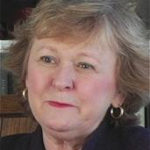 Nancy Hennessy, M.Ed., is an experienced teacher, administrator, diagnostician and consultant in both regular and special education. She served as the president of the International Dyslexia Association (IDA) from 2003-2005 and has developed teacher training programs and presented speeches throughout the United States. Additional bio info
"What must it be like to come to school everyday and school is going to be all about the thing that you don’t do well?" - Nancy Hennessy
Nancy Hennessy is a leader whose understanding of dyslexia is grounded in compassion and informed by her own first-person learning journey. She is committed to doing what can be done to reduce the suffering and release the potential of all who are touched by dyslexia. We found her to be elegantly, calmly, wise.
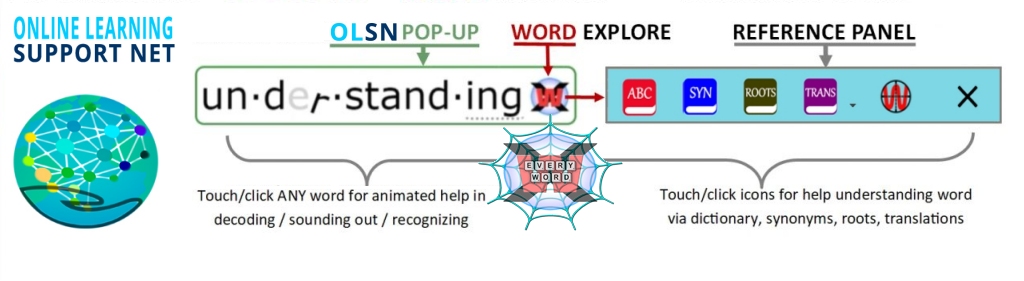 Note: Remember to click on any word on this page to experience the next evolutionary step in technology supported reading.
-----------------------------
Personal Background:
David Boulton: Thank you for agreeing to this interview .
Nancy Hennessy: You’re welcome. I’m pleased to have the opportunity to talk with you about something that I care so much about.
David Boulton: We’d like to start with a history of you. Let’s start with a sketch on yourself that you feel would help us understand how it is that you’ve learned your way into your work.
Nancy Hennessy: I began teaching a number of years ago. I came into teaching via the regular education classroom. I spent some years in that setting and kept thinking about students that I was interacting with who weren’t successful and what other route I might take that would allow me to meet their needs. I made a decision to go back to school to study the area of learning disabilities, special education. At the same time I began to look for an opportunity to work in the special education classroom and ultimately, ended up in a middle school with adolescent boys. Interestingly enough, at that particular point in time, even though I had a graduate degree in learning disabilities, I’d been certified not only to teach, but as a diagnostician, I encountered young men, adolescents, “ tweenagers” as we sometimes call them, who couldn’t read and I didn’t have a clue how to teach them.
I’ve often described my language arts class as a “behavior management class.” I remember trying to get through A Tale of Two Cities with the three guys in my group. I was using a text that was at a lower readability level, and when I think about it, that really wasn’t fair to them because I wasn’t giving them access to appropriate vocabulary and background knowledge, and so on. I was greatly disappointed that I wasn’t able to work with them in a confident way and that really made me think about where I might find some answers to working with children who weren’t learning how to read. I had in memory some other children as well that I hadn’t reached in the general education class. I always thought that was the special educator’s responsibility and I didn’t really need to worry so much about them.
So, I began to look for conferences and workshops that were being offered in the area and that’s how I connected with the then Orton Dyslexia Society, now the International Dyslexia Association (IDA). I felt as if I’d finally found a group of professionals who had a sense of how to reach these children. I became involved in the New Jersey Branch, ultimately becoming the branch president. I also pursued study at Fairleigh Dickinson University in multi-sensory structured language where I later taught and continue to teach occasionally. It is through these early connections that I initially came to know both the researchers and practitioners who have the answers to all these questions we have about dyslexia.
In the interim, as I pursued this issue, I began to realize I had dyslexia in my own family. This prompted me to further commit and become even more involved with the International Dyslexia Association. I have a brother who is dyslexic. My brother is about five years younger than I am and all through school he had difficulty. I was the older sister assigned to do homework with him and that was a dismal failure. Even then, I thought I wanted to be a teacher, so this was a disappointment. We began to think of my brother as being lazy or not very capable, although he is a very capable individual. It really wasn’t until I became involved with the Orton Dyslexia Society, now IDA, that we realized that Christopher, in fact, is dyslexic. We certainly have dyslexia in our family and one of Christopher’s sons is dyslexic as well.
So, it’s been a very interesting journey for me. It’s been a professional journey, in terms of wanting to be successful. All teachers want to be successful with their students and their competency is directly connected to their self-confidence. How they feel about themselves as educators is connected to whether or not students do well in the classroom. But it’s also been a personal journey. I really feel that dyslexia is very personal. And it’s not just personal for the individual who has dyslexia. It is for the parents, family, and educators as well. So, that’s how I arrived at being the President of the International Dyslexia Association.
David Boulton: Great story. I like the mix of heartful, first-person learning experiences. One of the things that we look for in talking with people is this difference between learning by accumulated inference and first-person, inside-out, motivated learning. That kind of learning makes such a difference.
Learning About the Learner:
Nancy Hennessy: When I work with teachers, I always ask them to bring the child into the room. I don’t think we can think about the teaching-learning environment without first thinking about the individual that we’re working with or attempting to serve. It’s really about the personal or individual’s story. That’s where the motivation needs to come from to continue to think through what we know, what else we need to learn, and also, how to work with the issue of resistance to change. We’re not able to change unless we have a reason for changing. I think the reason, again, comes back to the individual. So, bring the child into the room and think through why it is that you’re doing something.
I also am very fond of telling educators that I work with and train that I’m very impressed that they all want to learn. I’m very impressed that their brains are going to grow, but the reality is that doesn’t really make a great deal of difference unless that translates into student learning at the individual level.
David Boulton: Right. It seems that the teachers need to be equipped with this knowledge, but it’s not a substitute for them learning their way into making contact and differentiating their knowledge in relation to what the actual individual person needs.
Nancy Hennessy: Right. I think as we think about classrooms… classrooms are very challenging for teachers. When you spend time in school and you look at all of the demands that are placed upon educators, not just in the area of special education, but also in general education today, it’s understandable why they feel overwhelmed and are sometimes resistant to changing. And yet, if we were able to just back up and talk about our beliefs about teaching and learning, I really don’t know any educator who wouldn’t say that they have a firm commitment to educating every child. But with that belief system, with that commitment, comes a willingness to be open, all of the time, to the array of solutions that are available to us.
Again, it is personal. It comes back to the child, the individual, who has special needs or learning differences or who just needs a different environment within a classroom. It’s all about being prepared to meet the needs of those children that walk through the door. As I said earlier, I’ve worked in many different capacities across the grade levels. I’ve been a classroom teacher, a diagnostician and an administrator. So, I have different perspectives. And yet, what continues to ground me are memories from working in a kindergarten through second grade school at one point in my career. I remember the first day of school vividly. I never, ever forget this; those little bunnies, those little boys and girls, getting off the bus, and they’re so filled with joy, filled with enthusiasm as they walk through the doors. The principal of that particular school was an inspiring leader and she videoed each child as they walked through the door and then, she would show that to parents at Back-to-School Night. She knew the name of every single child that was in that school. There was a caring about how each of those children progressed and that’s what we really need to be about in education. We need to be about the fact that children come to school filled with joy and enthusiasm for learning and we have to keep that fire going.
I also worked in a high school setting, and that was a wonderful experience as well. The principal, in one of the schools in the district, was also an inspiring leader. There were approximately a thousand students in his school and he knew the name of every student in the school. So, all of this speaks to where do you get your energy from? What drives you when you work in school? It has to be the children that are in the school and a desire to meet their needs.
David Boulton: Well said. I’m sure you noticed in high school that the level of enthusiasm for learning was somewhat different than it was for the little ones coming to kindergarten.
Importance of Early Intervention:
Nancy Hennessy: Yes, hence the importance of intervening early on with children, particularly for those children who have struggled with reading or who have dyslexia. I’ve certainly seen the difference.
I can’t talk to you about this without seeing images of children. Immediately, what comes to mind is this little kindergartener, Ben, who is probably about twenty-five years old now. When he was in kindergarten, he was an at-risk child, in terms of reading. As he made his way through kindergarten Ben wasn’t acquiring sounds and the names of the letters. At his school, we were fortunate to have in place what would now be called a research-based reading program and it was available in the general education classroom. And so, as Ben moved into first grade, we placed him in that reading program. I vividly remember sitting at the reading table about two or three months into the school year. The teacher was working with sounds and letters, actually with sound cards, which have letters represented on them. The children were asked to attach sound to letters and then to blend sound together. And as Ben finally did that, he said, “Oh, I get it. Sounds make words.” Ben was on his way, right? He had been reached early on.
Then, I remember another child, Scott. I worked in a school district kindergarten through eighth grade that then sent their students to a regional high school district where I eventually worked. So I saw some of these children when they were little and then, I saw them, including Scott, when they were older. Scott’s reading needs had not been attended to and now he arrives in high school and he’s still not a proficient reader. Yet he’s a very capable young man. He’s very talented, very athletic, bright, and inquisitive; he could capture thoughts through oral conversation in class, but he was still not reading. While Scott may have appeared to be well adjusted, if you really knew Scott, you knew the pain that he was still feeling because he had not yet learned how to read.
I know quite a few of dyslexics, successful and not, and regardless of where they are in life, when they speak to you about school and what it’s like to be dyslexic, they can’t hide the pain in their voice. And so, the difference between intervening early on with youngsters or waiting until later is critical. And at the same time, I would not want anyone to feel that we can’t intervene later on. We can, and in this particular high school setting where I worked, we had a program for young men and women who had not learned how to read. We put in place a multi-sensory structured language program. We had options. So, while those students participated in academically challenging classes and many of them went on to a post-secondary setting, we were still attending to teaching them how to read. This certainly takes longer and there’s certainly more barriers. These students don’t have the same belief in themselves that they had earlier on. They’ve begun to doubt their capabilities. As you work with them in an appropriate program, as you allocate resources, and administratively we did that, you see a new person emerge. Yet, they still carry with them some of this pain because they weren’t like all those other little boys and girls who came to school and experienced the magic of reading which they should experience by the end of first grade.
My sister, who teaches first and second grade, loves the spring of the year because she says magic happens in the spring of the year. These little ones go home not knowing how to read, still “barking at the print,” as Jeanne Chall would say, and they come back the next day and all of a sudden, they’re reading! So magic happens. We need to make magic happen much earlier for these children. We can’t forget the adolescents and the adults, but we need to make it happen much earlier for them.
David Boulton: This dovetails nicely with the work of neuroscientists and other researchers, like Jack Shonkoff, who are studying critical and sensitive windows in early childhood development. There’s no question that neuroplasticity studies show us that we can remediate just about anything.
Nancy Hennessy: Right.
David Boulton: But the neurological and pedagogical efficiencies, the systemic costs, and the shame aversion that develops, all are working against us the further behind we get.
Nancy Hennessy: Right.
David Boulton: Nobody is a lost cause. We never want to paint that picture. But it’s really vital that we meet children earlier in the developmental sequence.
Nancy Hennessy: It’s so vital from a number of points of view. Certainly from the perspective of how children feel about themselves. Erik Erikson said “I am what I can make work.” And by age four or five, kids have a good sense of what they can make work. So, it’s vital from that point of view. It’s also critical that children have access to curriculum that they’re cognitively capable of. I think that any of us who have worked with adolescents have seen, over and over again, the effects of not having access to print. So these young men and women come to the middle school or a high school setting and they don’t have the vocabulary, they don’t have the background knowledge, they haven’t built the schema that really allows them to interact in an appropriate way with the content area information. If, in fact, they had that access to print, this would have been facilitated for them. This is not about their cognitive competence. It’s about the fact that they have a weakness, and that weakness hasn’t been addressed or remediated early on.
I would totally agree with you that all that we’ve learned from neuroscience is incredibly helpful for us as educators because it really allows for us to determine where we need to put our resources, where we need to focus our energy and what our curriculum needs to look like at an early age.
The other thing that happens as children get older, particularly when they enter high school, is where do you find the time in this academic setting, for instance, to address the remediation of reading difficulty? I mean, we have to do it, but where do you find the time?
Institutional Inertia:
David Boulton: One of my favorite conversations was with Alex Granzin, who is the President of the Oregon School Psychological Association. His point was “why don’t we just full stop?” It’s clear that children need science, math and social studies and they need all those other dimensions, but not having those isn’t anywhere near as important as being off-the-track on reading and how it connects to everything else. So, the idea that we can think of reading remediation as ‘parallel,’ rather than as ‘central’ until it’s working is illogical.
Nancy Hennessy: Well, it doesn’t make a whole lot of sense. If we actually ask our teachers, our administrators and our specialists to step back and look at the prerequisite skills that students need in order to participate in a content area then, reading is the very first skill, and then, certainly the ability to express oneself in writing. For the struggling reader, both reading and written expression are very often affected. So, how do they interact in an academic environment if they don’t have those skills?
And yet, I do understand, from having worked in schools, what the pressures and the demands are. We have high stakes testing. We have parents that want students to be in general education classes. We have administrators who are very focused on what’s the latest thing that they have to attend to in terms of policy. So, there are competing demands and sometimes we lose sight of what’s really essential.
David Boulton: Yes. There’s enormous institutional inertia working against the healthy development of the children in need.
Nancy Hennessy: There is. If you visit schools, and sit around the table at an administrative meeting, it becomes very apparent that the conversation is not necessarily about the individual needs of students, but more about policies, and political and community demands. Let’s take a look at and re-focus on what it is that we want every child to leave school knowing and being able to do. Schools very often will attend to this as they engage in strategic planning, and there will be a renewed interest and focus on these topics, but they soon get lost in the bureaucracy. And this is institutional inertia.
Yet, I have to say that being an administrator is a difficult task. They face many challenges and there are many good administrators. The differences in the schools that thrive, I think, are administrators that are leaders versus administrators that are managers, and who don’t forget about the leadership piece. Management is critical for the school to open every day, the buses to take the children to the right places, budgets to be balanced and so on, but it’s administrative leadership that’s so critical.
As we think about the preparation of educators, we talk a great deal about highly qualified teachers and there’s no doubt that’s important. However, I don’t think we talk enough about the preparation of administrators, both general and special education administrators. I think this gets lost sometimes.
International Dyslexia Association:
David Boulton: What I’d like to do now is step back for a moment and ask for an oversight of the International Dyslexia Association. How many people does the IDA serve? How many people are involved? After that let’s go down deep into reading and dyslexia and define some terms, and then hook back around into what are we doing about it in schools.
Nancy Hennessy: The International Dyslexia Association has a very proud history. The organization itself is over fifty years old and was originally the Orton Dyslexia Society. A few years ago, the organization became the International Dyslexia Association. We currently have over forty branches across the United States and some states have more than one branch. There are a few states where we don’t have branches, unfortunately, and we’re always trying to cultivate new branches so that we can serve constituencies across the country. We also have four international affiliates that we continue to work with actively, and one of our committees, in fact, is the global partners committee. We’re working actively to bring other national affiliates into our group. We certainly cultivate relationships with other dyslexia associations, such as the British Dyslexia Association, European Dyslexia Association, and so on.
The branches work at the local level and interact with members and the public through conferences, workshops, parent meetings, newsletters, and referral lines that parents or educators can call for information about dyslexia. The branch board members all volunteers and they work very hard. Many of them are educators and parents of dyslexics. Many individuals on our boards, at the local level, are dyslexics.
IDA has a national board, a headquarters in Baltimore, Maryland, and a small staff that supports our board. Much like our local branches, our national board is made up of volunteers, including myself. We have varied representation on the board: researchers, practitioners, individuals who are dyslexic, attorneys, individuals involved in business and politics, and so on.
The International Dyslexia Association has over 13,000 members. Our focus is to support research, disseminate information, and promote effective practice. We’ve been known for years as the advocates or supporters of multi-sensory structured language, which evolved from the Orton-Gillingham approach. Dr. Samuel Orton is an individual whom we look up to and whose work we continue to reflect on. Some of us are fond of saying, “Dr. Orton was right.” He was right in many respects, such as dyslexia being more widespread than originally thought, having a neurological base, explicit, systematic instruction being appropriate, and so on.
At the national level, IDA has an annual conference; we periodically have specialized conferences. We also have publications including our scholarly journal, The Annals of Dyslexia and the periodical Perspectives. We continue to publish and to develop materials that disseminate information such as, basic fact sheets and an educational outreach kit that can be used in schools and with parents to educate them about dyslexia. IDA solicits ands supports research proposals and we have special projects in place. For example, we’re developing a matrix that will give the public more information about multi-sensory structured language programs, how they can be used, and what are most effective for prevention, intervention, or intensive remediation.
This organization works very hard and certainly, we all learn a great deal as we work together. We’re working so hard so that the resources dyslexics possess can be liberated to benefit society. Our ultimate client is the dyslexic and their family. Certainly, many of our members are professional, but this is really about how we can benefit the dyslexic and their family.
Dyslexia and the English Language:
David Boulton: Tell me about the distribution of the population that has dyslexia in different countries or languages.
Nancy Hennessy: Dyslexia is prevalent across languages because it is a language-based disability and it really doesn’t matter whether it’s Portuguese, Italian or Chinese. Certain languages are more transparent than others. There’s more of a one-to-one correspondence between sound and symbol. But regardless of the language, because this is a neurological difficulty, brains are wired differently and the problem does persist across languages.
David Boulton: We’ve read studies that show that it’s highest in the English language.
Nancy Hennessy: Well, I think that’s probably true. When one begins to think about English, we can explain how our language developed and we certainly can explain the consistencies and inconsistencies of our language. In fact, when we teach a multi-sensory structured language program we talk to our students about what is regular in the language and what is explainable.
At the same time, we do have a very difficult orthography. We have forty-four or so speech sounds, dependent upon which linguist you’re reading, and we have twenty-six letters and we use those letters in many different combinations to represent the sounds. As you look at our language, originating from Anglo-Saxon and the influence of the Romance languages and Greek and then, ultimately, the influence of some other languages, one begins to realize the complexity of being able to decode, and encode (spell) words. But that’s really what multi-sensory structured language programs are about. They’re about looking at how the language moves from being regular to irregular. What are the patterns that we can explain to our students, not so that they memorize those patterns, but so that they internalize and become familiar with the different configurations that will represent the sounds in our language?
What is Dyslexia?:
David Boulton: What is dyslexia?
Nancy Hennessy: Dyslexia can be described in a number of different ways. Some of us are very fond of how Sally Shaywitz describes it. She talks about it as being a weakness in a sea of strengths; a weakness, specifically in language, in the phonological component of language. Others talk about it being an unexpected underachievement in a particular area. The International Dyslexia Association does have a formal definition for dyslexia that was co-developed with the National Institute of Health, and it is this definition that they currently use for dyslexia. That definition talks about the fact that it is a type of specific learning disability. It’s not the only type of learning disability there is, but a specific one that is language-based.
In fact, when we look at individuals who have language-based learning disabilities, about eighty percent of them have difficulty learning how to read. This is what happens with dyslexics. The difficulty is the result of difficulties with phonological processing, this ability to take in, manipulate, work with and then express language. When I described Ben earlier, I was talking about how he suddenly made this discovery that sounds make words. He was really lacking in phonemic awareness; an ability to work with and manipulate sounds so that we can put sounds together to not only read but spell words.
When we work with dyslexics and think about how we define dyslexia, we talk about this inability to decode and read words, not only correctly, but also in a fluent or automatic way. We also know, that for the dyslexic, there’s often unintended consequences because of a lack of access to print; the unintended consequences being diminished vocabulary, and background knowledge, which certainly then affects comprehension.
When I work with teachers, I always say to them, “Think about the child who can’t get through the words. They can’t crack the code, the alphabetic-phonetic code, that our language is made up of.” This is not about the child who reads things backwards or reverses letters. This is about the child who literally can’t get through the words. All of their attention is focused on reading the word, and they don’t appear to have any system for reading words, so they read them differently and spell them differently each time they see them.
What is Reading?:
David Boulton: What is reading?
Nancy Hennessy: Wow. What is reading? Well, reading is an exceptionally complex act. There are different models and different theories that tell us what reading is. Ultimately, reading is the ability to make meaning out of what it is that we read. That’s the end goal. But what goes into that is very complex. When we come to print on a page, we have to bring with us some capabilities in the phonological area. We have to be able to work with sounds, we have to have a sense of whether or not what we are saying corresponds to what we’re hearing. We have to have this capability to isolate sounds, to identify sounds, to put sounds together in order to read words.
We also have to bring with us this connection to orthography, to the visual pattern. This is another component of reading that influences whether or not a child is proficient. We have to be able to recognize the visual patterns, the letters that represent the sounds; we have to be able to recognize chunks within words such as prefixes, suffixes, and roots. We have to be able to recognize syllable patterns. That phonology and orthography connection really needs to be very tight so that what we’re able to do then is read words in a very automatic way.
Then we also need to bring with us our meaning processor. As I’m speaking to you I am thinking about McClellan and Seidenberg’s model in which we use a phonological processor for taking in the sounds of our language and working with them. Then we have an orthographic processor and we’re taking in the visual representations (letters and letter patterns) and making this tight connection. But, at the same time, we need to bring our understanding of meaning, our mental lexicon, our vocabulary to bear on what it is we’re reading. So, that also facilitates our ability to read the words. And then, we have to bring our background knowledge or schema, the context in which we see the words so that we can make sense of the passage or the text that we’re being asked to read.
It’s incredibly complex and it’s fascinating as an educator to think about the fact that underlying reading are all these different neural mechanisms that really have to be working somewhat simultaneously and together in order for us to read words.
David Boulton: Relative to this, we’ve begun thinking of reading as a ‘code instructed and informed virtual reality experience.’ It’s an artificial simulation of language. It’s analogous to the way a player piano plays music with a scroll – the phonemes being the keys and the roll causing the keys to play such that they create comprehensible music. That it overlays, but is distinctly different than our language processes in that it’s an interface to a technology.
How does that fit for you relative to your description? What I heard you describing was different aspects of its complexity. But as a phenomena, it seems that it’s an artificial reality experience that is informed and instructed by a technology.
Nancy Hennessy: You’re talking about the code itself. A few things come to mind as you say that. I begin to think about the fact that for so many years there was spoken language without the alphabetic code. Individuals, who lived on the earth long, long ago, had an oral tradition and were able to process language quite nicely and communicate with one another without having that alphabetic code. I have a colleague, the next president of the IDA, who talks about dyslexia as being related to social consequences. If we didn’t have to read, dyslexics would function quite nicely without this alphabetic code getting in the way.
In response to what you just said, yes it does seem somewhat artificial as if it’s been layered on and created (which it has). Certainly, our language is natural; we come into the world being able to speak and communicate with one another. You know that initially little babies make all of the different sounds. As Patricia Kuhl says, they are universal citizens they make all the sounds and then, they begin to cull out these sounds that match the sounds of their native language. So, I think I can resonate with what it is that you said. It is somewhat artificial, it is a technology and it’s been layered on to give us yet another way of communicating.
David Boulton: Depending on which anthropological linguist you talk to, or if you go the genetic route, or follow the anthropological evidence about the development of the jaw and teeth, it appears as if we’ve been talking for between sixty thousand and a million years. There’s a lot of fuzziness about exactly when, but it’s been a long time. The alphabet is 3,500 years old or so, and the particular kinds of confusions that are unique to the challenges of today are only a few hundred years old.
So, there’s an unprecedented processing challenge that learning to read involves that is unlike any processing challenge that the human organism has ever experienced before.
Nancy Hennessy: Or was designed for. It is fascinating to think about that and what if we used a different kind of communication. I always think about Norm Geschwind’s words. He asked what if everyone came to school and had to learn music, as the way in which we communicated, would we have some individuals that had dysmusica? I think reading is analogous to this. It’s something that we created in order to communicate in a written way and we weren’t designed to be able to do that.
That’s a very interesting thing for an educator to think about because that’s not the way an educator thinks about reading.
What is Reading Instruction Based Upon?:
David Boulton: Part of the mission of what we’re doing is to help reframe how we think about this.
Nancy Hennessy: I think the reframe is critical because, again, it brings me back to how we make good decisions about reading instruction or any instruction in school. What is that instructional decision based upon? Sharon Vaughn really speaks to this quite nicely. Is it based upon craft, a little of this and a little bit of that, we put it together and that’s our craft? And maybe, that’s not so bad. Or is it based on superstition and myth? You know, ‘We think that works, we’ve always done it this way and that’s the way we’re always going to do it.’ Or is it informed by science? Can science tell us something that we haven’t heard previously that allows us to deliver instruction in a way that is more suitable to the human organism that we, in fact, are?
I have a general education, as well as a special education background. I’ve been in public education for over thirty years. My last position was in general education as a director of professional development, so I’m very interested in how we work with teachers to keep moving them along a continuum of expertise. How do we move them from being a novice teacher to an expert teacher? As a result, I have a knowledge of other approaches to instruction that go beyond reading, like brain-based learning. Now some of that is still superstition and myth, but there’s some basis for it. There are some things that are beginning to emerge, even from that particular way of thinking, that we need to be attending to more in classrooms.
So, I think you raise a very interesting point. We talk about informed instruction, but what is that connected to and formed by? Certainly, it’s important that we use our clinical experience to inform our instruction. But we also need to look at the evidence, what science is telling us and also, what does the data tell us about how well students are performing.
David Boulton: Right, and how does all of that science represent a particular set of lenses. Science continues to improve what we can see, how we can measure and how we can translate research into practice. At the same time, how do we get out of the box and look beyond the current framework that science is investigating through?
Creating the Bridge Between Educators and Science:
Nancy Hennessy: And also, how do we create the bridge? I think this is the challenge. How do you create the bridge? The educators are going to go to school everyday and they’re going to stand up and deliver and do their job. And scientists go to the labs and do their job everyday. How do we create the bridge between the two?
David Boulton: Yes. That’s the distributed dialogue that has to happen so that these things aren’t so distinct and the teaching is the learning edge of the science and the science is informing what is unfolding through teaching in a mutually learning oriented way rather than a mechanical robotic way.
Transforming Professional Development:
Nancy Hennessy: Right. So, if we step back and think about that we really need to totally change teacher preparation and we need to change professional development.
David Boulton: I agree. This brings us back to where we were earlier, which is the difference between using a script to relate to a child, following a script that they don’t have a deep first person ground in understanding, and first-person learning to adapt whatever you to know to your learner’s needs. Otherwise, what are we modeling for the kids?
Nancy Hennessy: Right. How are we prompting them to go beyond the concrete, in essence? How are we prompting them to think about their world and then, self as an individual? How are we modeling an interaction that has to happen in terms of decision making and problem solving and all of these things that allow us to participate in a society?
David Boulton: Precisely. That’s what we mean by first-person learning. How does a teacher become an exhibitory of first-person learning in how she or he is conducting the class and in how they are tuning into to be maximally relevant for each child?
Nancy Hennessy: As you’re talking about this, David, what I’m coming back to and thinking about is the issue of educators being reflective about their practice. You made me think about this when you said “script.” Certainly, I do think in reading we need to directly and explicitly teach children, but we also have to be reflective about whether or not what we’re doing is having the desired effect for the child. And any educator who is meta-cognitive by nature, will always be stepping back and having this internal dialogue with themselves. It, in fact, would be so beneficial if they would think about modeling that dialogue for the children that are in their classroom.
David Boulton. Yes. Which is exactly what we’re learning makes the big difference in language engagement effect before four that sets all this in motion. It’s the same phenomena.
Nancy Hennessy: Right. Another thing just came to mind because of a conversation I overheard yesterday about not thinking that basals are the end-all and the be-all. They’re important, they’re tools, but they cannot alone guide the teaching that goes on in classrooms.
David Boulton: They’re scaffolding.
Nancy Hennessy: Exactly. Being able to step back and look at how your instruction is delivered and how you continue to scaffold for children this movement from a readiness stage all the way to a proficiency stage. How do we move children through those stages and what do the strategies and activities look like that allow us to do this? Now, you’re really talking about really ratcheting up the preparation and professional development of educators.
Whether we’re thinking about the individual who serves the child with dyslexia, remediates the child, the specialist in a clinic setting or the general education teacher, they have not been prepared to deliver instruction in the way that we’re talking about. They have been prepared to deliver instruction based on formula. And formula is fine, I’m not denying that. But, at the same time, they have not been taught to reach deeply into this repertoire they should have and probably don’t, in order to keep thinking about how they are meeting the needs of these different kids.
Teaching and learning is an incredibly complex act. If we look at the way the schools are structured right now, we’re not supporting the learning of our teachers in order for them to do what we’re talking about. If you just reflect quickly on what professional development looks like in schools today…
David Boulton: For the most part it’s training teachers not to be first-person learners.
Nancy Hennessy: That’s right. It’s drive-by staff development. It’s the one-shot deal. There’s no time for processing, there’s no time for thinking, there’s no time for application.
David Boulton: And yet, orientation is everything. How they’re oriented to what they’re doing is guiding everything.
Nancy Hennessy: Right. So, to change this is an enormous task. And I’m an idealist.
David Boulton: What else are we going to do?
More Than Anything, Everything Depends on Learning:
Nancy Hennessy: What else are we going to do? That’s exactly right. And what are we all about in schools if it isn’t to keep thinking about and searching for the solutions for these different kids? But, always that kid is at the center. That’s why I started by saying this is personal. It doesn’t matter to me whether you’re in the general class or in the special education class; it’s personal. It’s about the kids who walk through the door.
David Boulton: I’m really enjoying our interaction here.
We just did a seminar for the Council of New York Special Education Administrators, which lines up in a way similar to what you’re talking about. The first question I asked was what aspect about a child’s development is not fundamentally affected by how well they’re learning?
Nancy Hennessy: There is no aspect.
David Boulton: Right. So, what’s a higher objective or goal than stewarding the health of our children’s learning? In general, isn’t it our organizing, orienting reference for whatever it is in particular that we’re teaching?
Nancy Hennessy: Yes. One of the things that gets forgotten in schools connects directly to what you just said. It has to do with the emotional aspect of learning and how children feel when they walk into a classroom. What does it mean to create classrooms that are safe environments for children in which to experience and explore learning? We have a responsibility academically, but we have a much larger responsibility than that when it comes to serving the kids in schools.
Avoiding the Feeling of Confusion:
David Boulton: Yes. So far as we’ve had conversations with probably a dozen neuroscientists exploring the case for understanding the effect of affect on cognition.
Clearly we understand that the number of children that are affected by reading improficiency is huge. It’s a spectrum with dyslexia on one end and reading improficiency on the other. Reading improficiency is connected to children coming into this artificially confusing challenge and how the context of this challenge causes them to feel like they’re at fault for the confusion.
Nancy Hennessy: Right.
David Boulton: Just as reading itself requires faster than conscious reflexes to do the virtual reality processing, when children become pre-consciously shame averse to the feeling of confusion, because the confusion brings shame, they start to avoid it automatically. What happens to children who start to automatically avoid the confusion they experience? It decapitates their learning.
Nancy Hennessy: Yes.
David Boulton: And we’ve got this happening on a mass scale and it’s because we don’t understand the relationship between cognitive entrainment, cognitive tasks, and affect. In terms of the affect triggering and its disrupting and disentraining effects on whatever cognition is doing in the micro-time of sub-processing and the reciprocal effects that cognitive frustration has on our affects triggering.
Nancy Hennessy: Yes. At various times I’ve talked with educators, particularly those I was responsible for as a director of professional development, about this. The reality is I didn’t just do stand up and deliver; I did a great deal of facilitation and worked with mentors and all of the new teachers in the district. I told them, up front, “Sometimes your administrator has ulterior motives, kind of like having the hidden curriculum in the classroom that you don’t tell kids about, or a hidden agenda, but I’m being up front and there are no hidden agendas here. When I come into your classroom I’m going to look for what your classroom feels like, what the environment is like, whether or not you’ve created an environment in which those students feel welcomed, particularly adolescents, and in which they feel they can take a risk in terms of their own learning.”
Also, when I’ve worked with teachers in general, I’ve talked to them about stepping back and thinking about what must it be like to come to school everyday and school is going to be all about the thing that you don’t do well, that you have found difficult? If I said to you, “Come to school or come to work 180 days a year and eighty percent of the time I’m going to ask you to do the thing that you don’t do well, what would you do?” What would you do?
For me, it’s about the kids that misbehave, it’s about the kids who go to the school nurse, it’s about the kids who call home lots of times, it’s about the kids who don’t show up to school. It’s all about those kids. Their feelings are not always as visible in primary grades as they become in middle and high school. It’s really those kids that I was always most attracted to; the kids who were really challenging. I think you have to peel away these layers. They’re not coming to school because they don’t want to learn. That’s not what this is all about. What it’s all about is “the school” right now is not providing them with the support, the scaffolding that they need in order to learn and feel competent about themselves.
David Boulton: And they develop a number of compensations to deal with the pain and shame that they feel.
Nancy Hennessy: Yes. I have a keynote speech that I do and it’s called the “The Courage to Teach, Learn and Parent.” I look at the emotional experience from each one of those individual’s, (teacher, parent student), perspectives because we connect around emotion. This is a way to change behavior – when we begin to hear one another’s stories and understand one another’s perspectives. I delivered this speech last year in the southwest and I received a letter about two or three weeks afterwards from a gentleman, who is dyslexic and had just decided to come to the conference. He told me in the letter that he realized about ten years ago that he was dyslexic and thought he had, in fact, dealt with his feelings about it. He was an architect; he’d had a successful life and he had a lovely family. And yet, he cried throughout the speech and all the way home. The reason he did that was because I had raised those emotions he had submerged.
And I would agree with you that there are certainly individuals who experience difficulty with reading in school who are not dyslexic. They’re experiencing those difficulties for a number of reasons, including the curriculum being inappropriate and the teaching not matching what their needs are. There are number of individuals who are walking around with these feelings of inadequacy. Then, you begin to think about, this individual who wrote me and has contributed to society, but what has been lost in his life? And what about individuals who haven’t been successful? What’s that potential that we’ve lost because of these feelings of incompetency and inadequacy and so on, despite the fact that every individual has an area in which they can succeed?
David Boulton: We’ve talked with people that are exhibiting the shame because we think it is important for our general society to get a sense of how powerful this is. It’s also important to understand shame and what is going on at the shame-avoidance level and then go into the neuro-cognitive and show the effect of the shame on cognitive processes so that all three of these things link together.
Nancy Hennessy: Yes. That is so important and that’s a forgotten factor here. Those of us who work in this field, and those of us who know dyslexics, understand that. But there’s not nearly enough attention given to that.
I got this letter and I cried quite a bit when I read it because it was such a powerful reminder for me. The reason I do the courage speech is to talk about knowledge. I talk about knowledge connecting us and why we have to listen to experience, and so on. But I do it for just that reason. Because I want teachers to understand and I want parents and dyslexics to understand one another’s perspectives. And I tell the story of my brother. He’s the only one of us that didn’t go to college and he owns his own company. Up until five years ago, my mother was still saying she’d pay for his courses if he wanted to go to college. That tells you where my mother’s head was. She was also denying that he was dyslexic. I talk about what it was like for him going through school. He has a beautiful boat in Boston Harbor. You know the name of the boat? “Perseverance.” That has been the name of every boat he has owned.
I’m on the National Advisory Council for Recording for the Blind and Dyslexic (RFB&D)and there’s an individual who sits on that council with me who is dyslexic. The last meeting that I went to, I did IDA’s education outreach presentation for the advisory council. Some members of the RFB&D understand the blind population extremely well and they have representatives of the dyslexic population on their boards and councils and so on. But in terms of really understanding dyslexia… Well, this guy cried through the whole presentation. And that unwillingness, that reluctance to talk, that you’re talking about, that Jim Wendorf is noting, that’s the same kind of thing. It’s very difficult to have a deep conversation with adult dyslexics and even, adolescents because this is so painful for them. At the same time, I think it’s really important for us to remember that it’s painful for the parents. So, that parent perspective is very, very important. And it’s painful for many teachers as well.
I talk about myself in my speech because I was this teacher. If it weren’t for the International Dyslexia Association I would have never, ever found the solutions for working with kids. I still regret to this day, I can picture those three boys that I sat with in that seventh grade class. I know that they’re not proficient readers because I know nothing happened for them when they moved on to high school. We hadn’t put the program in place yet. I hope they ended up on a good path. I don’t know. But I feel guilty about those kids. So, this whole emotional piece, and the shame piece, is just critically important to talk about.
David Boulton: We agree. There is a tendency to talk about this as a consequential emotional development. But there’s a continuum here in which this is a participant in the cause of what’s stuttering the processing. This dropping in and out of self-transparency into shame, and the threshold of shame that is lowering the more and more difficulty somebody has.
Nancy Hennessy: Yes. How available do you make yourself to learning?
David Boulton: Yes. How available is learning? It’s not even going through you. It’s deeper than you.
Nancy Hennessy: Right. And what are your belief systems about whether or not you can even begin to engage in the task? Or what level of participation, if in fact, you do engage in the task, at what level do you engage because of this fear of failure? Certainly, not at the more abstract level.
David Boulton: That’s what we mean by shame avoidance, the degree to which people will avoid the uncomfortable feeling of confusion. We’ve interviewed people that tell us about the incredible strategies they’ve developed to avoid this. Robert Wedgeworth at ProLiteracy, though not talking about dyslexia per se, is talking about the consumer behavior of low literates who go into stores and the primary thing in their consciousness is getting out of there without getting embarrassed.
Nancy Hennessy: Right. Well, if you have a conversation with individuals who don’t read very well, they describe all sorts of avoidance behaviors. Or they describe compensatory behaviors in which someone else is doing it for them. For instance, marrying someone who is a good speller or having your wife make all of the lists or taking on positions in life that don’t require reading. Or for the adult who has literacy difficulties, seeking out assistance when reading is required for them to move to the next level professionally. Or in many instances, totally avoiding the reading issue :and not moving to the next level. So, the consequences are unbelievable in terms of this inability to interact with print and read.
The Continuum of Reading Difficulty:
David Boulton: Yes. It seems to us, if you look at the number of children that are below proficient, according to National Assessment of Education Progress (NAEP), even if you discount it pretty radically and you look at the number of adult low literates, as determined by the National Assessment of Adult Literacy, a convergence of information coming in from justice, coming in from medical, and other dimensions, we’re talking about close to 100 million people in the United States whose lives have been diminished, to various degrees, but significantly, because they didn’t get to a point where this reading thing popped through and became transparent.
Nancy Hennessy: Yes. Well, I think it relates to what we’re being told at this particular point. We probably have about thirty to forty percent of our kids that are at-risk readers. And out of that percentage, we have a smaller percentage that are what we would term dyslexic. Again, dependent upon the source, the number of dyslexics in the population, we see anything from five to twenty percent. I think the National Institute of Child Health and Human Development talks about five to ten percent. IDA’s literature talks about fifteen to twenty percent.
Regardless, even if we just settled on a middle number, let’s say ten in every hundred, that still leaves a huge number of individuals who are dyslexic, whose brains are wired in a different way, who have reading difficulty. Now, what’s the answer to that? Well, the answer is we need to change the way we address reading instruction in schools. We have to look at how we screen and identify those little kids early on, and I think we’re on the right track. We have some tools, we have some measures that we can now use. The problem is they’re not being used consistently enough across this country. Despite policies related to No Child Left Behind, Put Reading First, even the re-authorization of Individuals with Disabilities Education Improvement Act (IDEA), with reference to response to intervention, we still don’t have the capacity or the will to change what it is that we’re doing with reading early on. And so consequently, unless we make those significant changes, we’re not only going to lose the dyslexic, and certainly that’s my primary concern, but I’m also concerned about these other children, these other struggling readers.
David Boulton: NAEP says eighty-four percent of African American twelfth graders and eighty-eight percent of fourth graders are below proficient.
Nancy Hennessy: Huge numbers. At the International Dyslexia Association we’re very committed to dyslexics, but we’re not just committed to individuals with dyslexia. We’re committed to all individuals who have difficulty learning how to read. I think it’s notable that, in fact, we’re no longer the Orton Dyslexia Society. We are the International Dyslexia Association because we want to be more broad-based. We want to stay true to what our original mission was, but we think we have something to say about reading instruction in general and direct, explicit, systematic instruction. This is what we’ve been talking about for fifty years. We’re very grateful to the researchers and to Congress because they’re providing more of an impetus to address the needs of dyslexics. But we don’t want to forget about those other kids.
David Boulton: Excellent. This is where I wanted to go and I appreciate the way we got to this level with passion and energy. We’re talking about over fifty million children going through public schools and we’ve got sixty percent or more of them that are below proficient upon graduation. Some people say that NAEP is pushed up too high. But relative to the literacy requirements to be successful in the world today, it’s really arguable whether it is or it isn’t.
Nancy Hennessy: Yes.
Nation’s Greatest Challenge – Nation’s Greatest Learning Disability:
David Boulton: We talked to one of the architects at NAEP about this. The point is that when you look at the negative life consequences, not just in terms of the dis/enablement of not being able to read and acquire the interface to externally recorded knowledge, but in terms of the collateral effects that we’ve been describing: how they feel about themselves, how it affects their general ability to learn, when you look at the dimension of the population that’s having this problem, it leads us to the proposition that this is the greatest learning disability. It is disabling the learning of more people than all the innate neurobiological things combined. If we look at reading itself, it seems like it is the nation’s greatest learning disability.
Nancy Hennessy: Um hm. I think it’s the nation’s greatest challenge. I think if we don’t address this, what is it we’re going to address in our schools? If reading, in fact, is the key to success in all other areas in school, and it is, why are we spending so much time and attention on other things? Why isn’t it that kids, when they come to school… and they do need to learn math, so I don’t want to discount math, but why isn’t the greater percentage of their day spent learning how to read? Why aren’t we attending to what the science tells us we need to be doing? Why aren’t we using these measures to screen kids? Why aren’t we allocating dollars to professional development of our educators so that they can change their practices? It just seems to me that when we bring the child into the room and we talk about the child and we project out the future for that child… I don’t know any educator that wouldn’t want to try and do things differently. We need to put aside our personal philosophies about this and really look at what the evidence is telling us we ought to be doing for these kids.
David Boulton: Yes. One of the things we’re trying to do is co-register many different planes from the micro-time movements of brain functions and the neuroscience level to the 3,500 years of the evolution of the code, and how these two meet one another, while also considering the economic, social, social-pathological and psychological consequences for any one or all of us.
Nancy Hennessy: Yes. I think constantly bringing these on going consequences to the forefront is critical. It is what will make us think twice about how we work with children in our schools. It is what will ultimately drive us, I think. And again, I am the idealist. That’s why I’ve given time to this. This is a passion for me and it drives my life. My colleagues and I have often talked about this. Being involved in this field is not only professionally fulfilling; it’s personally fulfilling because it gives reason to life. What better reason than every child having this opportunity to learn how to read? We can’t participate in life if we don’t know how to read. It is absolutely essential.
Teacher Preparation:
Nancy Hennessy: I think it’s important for us to think about how we prepare our teachers and how we continue to allow them to develop. Our teachers generally don’t know how to teach reading. I think we have to step back and acknowledge, as administrators in school, whether we’re the general or the special educator, that we’re not going to accept having teachers come to us unprepared to teach reading; that we really need to wage a battle, as educators, so that schools of education, and schools themselves, allow for a change in the way that teachers are prepared, so that they have a deep knowledge of the reading and writing process.
It’s also about differentiated levels of competency. The general education teacher doesn’t necessarily need to know as much as the special education teacher as the specialist. But they all need a core foundation of knowledge to work from. I become very sad when I think about the fact that, in special education, where we have children who have dyslexia or perhaps, just reading improficiency because their needs have not been met in general education, that we, educationally and administratively, are accepting of the fact that our special educators come to us as generic special educators. They’re not specialists. They need to be specialists.
I really have a great deal of difficulty understanding why if reading is the major learning disability and if, it’s the cause of difficulty that prompts most children to be in special education, then why is it we’re accepting of generic preparation of special educators? Why aren’t we preparing them with a deep knowledge base of content, of pedagogy, to meet the needs of these students? I will tell you that when I worked in a high school setting, we hired content area teachers with very high levels of competence. When we were looking for a history teacher, we looked for a historian. If we were looking for a science teacher, we were looking for a scientist. When we looked for a special educator we looked, not for a specialist in learning strategies and reading and written expression, but rather a special educator from a general point of view. Now, that’s the base; that’s the beginning-to be a generic special educator. But then, we need to be thinking about how we layer on, to that generic preparation, specialties because these kids are special; that’s why they’re in special education.
Importance of Allocating Resources:
Nancy Hennessy: The second component of addressing the reading issue is administrators being willing to allocate the resources so that kids actually have availability of a continuum of options. Too often what happens in special education settings is, even if the teachers have that specialty knowledge, they’re working with students with different difficulties at different grade levels. The resources haven’t been allocated for those children to be scheduled in a way that teachers would be able to directly address those needs that need to be remediated. There’s certainly a need to work with students in other areas, learning strategies, to provide accommodations, to teach them about assistive technology. All of those things are important to support them in the general education classrooms. But the reality is, if the primary reason that they’re there is because they have a reading disability, why aren’t we allocating the resources to remediate that reading disability and doing it quickly enough that they’re not entering high school or even graduating from high school without knowing how to read?
David Boulton: Right. That was Alex Granzin’s point I loved so much, which was “why aren’t we pulling out all the stops?” Let’s stop and take whatever time and energy and focus it takes to ensure children get through learning to read.
Treating the Weakness, Not the Reading Difficulty:
Nancy Hennessy: Yes. The very first day that I went to school in this high school setting, I had a very good special educator approach me and here’s what she said, “We’re graduating kids from this affluent high school district that don’t know how to read. What are we going to do about that?” And I just wanted to shout, “Cowabunga!” because I could say, “I think I know what we can do about that” and we did do something about it.
Coupled with that comment was the child’s story. On the very first day of school, one of the special educators was not there. I went to that district as the Supervisor of Special Education and so, I had to teach her class. There was a young man in that class, fifteen years old, who still wasn’t reading and he said to me, “Are you going to teach me how to read?” Well, what could I say to him? “Of course I’m going to teach you how to read.”
If I had the knowledge and the skill set to do that, how could I not do that? How could I not respond to the teacher’s question? How could I not then work with teachers and provide for them or give them access to professional development that would allow them to meet those kids’ needs? But, too often what happens in special education is that students come into special education with a specific need, a language-based learning disability like dyslexia, and do we attend directly to what that difficulty is, what that weakness is so we can liberate them to use their strengths? No. What we do is we support them or accommodate them. And those things are important, that’s the second aspect of working with these kids, but we don’t attend to the very thing that will allow them to be who they can be.
David Boulton: I read someone’s comments, that I thought were really well said, which was that ‘special education is a place where kids learn to adapt to the fact that they’re failures.’
Nancy Hennessy: That’s an absolutely great quote. It’s all about how can we get around the weakness, how can we accommodate, how can we compensate? It’s not about “Let’s directly look at what the weakness is, let’s address the weakness and let’s build it for the student so that they can participate in this learning process.”
Early Language Development and Reading Challenges:
David Boulton: This has really been a fantastic interview as far as the energy and what we’ve covered. I want to go back to early development. I’m sure you’ve encountered the Hart-Risley work, and so with that as a backdrop, here’s what it looks like to us: there’s three major challenges, and this is not speaking to the neurobiological dyslexic, per se, but to the challenge of reading in general that a number of people, including dyslexics, are having difficulty with, and it’s exacerbating the difficulty for some more than others, which is we’ve got, on the one hand, a language foundation issue.
Nancy Hennessy: Right.
David Boulton: So, the amount of language that somebody’s exposed to, not just exposed to, but engaged in, is creating the exercise environment for phonemic differentiation. In addition, it’s creating the backdrop of knowledge and vocabulary necessary for the transcription system to play, and the kind of language that they’re exposed to is also affecting their self-esteem or affective threshold.
Nancy Hennessy: Right.
David Boulton: So, how ready they are relative to how well all that has developed is one major piece. Then there are the confusions engendered, the artificial forms of confusion, and the incredible speed with which they have to be resolved.
Nancy Hennessy: Right.
David Boulton: We’ve talked to Keith Rayner about the processing rates that are on average about twenty-five milliseconds a letter. So, it’s this incredible, artificial challenge associated with working out letters and sounds, and having to do it faster than we can possibly think about. Then, in the middle you’ve got this affective threshold that we’ve been describing, which is how much frustration tolerance does somebody have before they shame out and the whole thing collapses?
Nancy Hennessy: Yes.
David Boulton: So, you’ve got these three pieces coming together. For an awful lot of children, at least according to the Hart-Risley research, it’s looking as if there is a strong predictive link, even stronger than socio-economic status, race or any other dimension, between the kind of language exposure that they’ve had in the home and their struggle with reading. It’s what’s setting them up to be able to handle that confusion or not handle that confusion when they hit the wall with the code.
Nancy Hennessy: Yes. What do we do about that?
David Boulton: What do we do about that? First, this is different than saying it’s ninety-five percent instructional malfeasance, like we’re hearing from Reid Lyon and others. This is coming from a different phenomena.
Nancy Hennessy: That’s right. That’s very different. That really has to do with the home environment. When you look at where children learn language, where they become aware of print, book knowledge, and so on, it’s either in the home environment, or if they’re in a pre-school or a Head Start program, that also can nurture language development. It seems to me that we need to step back and rethink, as a nation, how we get children language-ready for school.Certainly, the influence of television and computer games and the fact that parents go off to work every day coupled with the fact that children are in daycare centers, pre-schools or nursery schools where the providers aren’t always very well prepared, really adds up to some significant challenges in terms of acquiring vocabulary, language; just the capability to play with language that we would want our little children to have.
As you were stating that question, something was running through my mind that would be interesting to take a look at. We talk about teaching kids how to parent, and some high schools have parenting courses or schools work with parents. I’m wondering how much focus is actually on language development, either in those parent interactions or even, as we look at adolescents and offer them these courses?
Because I’m a grandmother, I’m very cognizant of language, and continue to have conversations, with my own family, about when we have a conversation about an activity that’s happening, how do we have that conversation? We don’t have it with one or two-word responses. We elaborate and fill the conversation with beautiful language. We read books to children with academic language. They’re filled with language that we don’t hear in the conversation of an adult or on the television. Or when a child talks to us, we take what it is that they’ve said and we need to then build and elaborate on that. I think that most individuals don’t have the knowledge base that they need in order to build these language environments that will prepare children better for schools. I know it’s an on-going concern of many organizations and I know some of my colleagues, like Sylvia Richardson, are so concerned about the pre-school preparation of children. What does the education look like for those pre-school providers?
David Boulton: For the most part they’re more language impoverished than a lot of the homes that the children are coming out of and they don’t have the affective attraction to create the engagement in the same way.
Nancy Hennessy: Exactly. So, how do we find a way to interact or intervene with that? That’s really early intervention.
David Boulton: The other thing that we’re really interested in here is trying to co-register the economic information, like James Heckman’s work and Arthur Rolnick and George Farkas about the Coleman studies and where those have gone today that continue to show that eighty percent of the variation in performance in schools is really attributable to variations in homes.
So, given that, no matter what we do with universal pre-school, until such time as we fund it to a degree that the people that are actually interacting with the children are aware of these kind of issues and enveloping children and engaging children in the kind of language richness that we’re describing, there’s a limit to the effect we can have through institutions.
Nancy Hennessy: Right.
David Boulton: There’s a family effect that has a limit to it and we don’t understand where those boundaries are sufficiently well to organize our priorities.
Concern When Using Number Statistics:
David Boulton: Is there anything we haven’t talked about that you think we should discuss? We could drill into things a bit more deeply, but I appreciate your desire to stay away from numbers, and what have you, so I kind of skirted those.
Nancy Hennessy: I’m so concerned when we use numbers because (even if I look at the literature for our organization, which I think we will be re-writing again soon), the numbers fluctuate dependent upon whom you’re reading. I think when we think about dyslexia and learning disabilities, and I love the term reading improficiency, we’re learning more every day. Learning disabilities is a relatively new field and so is dyslexia. I think as the science informs our practice, we’ll have a better sense of what those numbers really are. I don’t want to underestimate the numbers because then people in general society might begin to say that it’s not much of a problem at all. It’s more of a problem than one perceives at this particular point, I think. And yet at the same time, I don’t want to nail it definitively.
Millions of Children At-Risk for Reading Failure:
David Boulton: But I want to suggest this: If you look at all the things kids born today are at risk for, the possibility of a physiological developmental issue, or a cognitive, neurological, psychological developmental issue, or even abuse, all the things we put stats on… if you add them together and then look at the number of children at risk for not making it to reading proficiency, the risk of having their lives harmed because they didn’t make it to reading proficiency is bigger than all the other things combined.
Nancy Hennessy: It’s huge. That’s a really interesting perspective because I tend to think very much in terms of dyslexia, or the thirty percent of kids. But when you begin to talk about all these different factors that play in, it really is a startling and very different way of looking at this and realizing how much more significant the problem is.
David Boulton: It’s not so much that I’m trying to get some exact number, but I think we need to create a magnitude of order shift in thinking about this that says, “Look, we’re spending all this energy and all this attention here (dyslexia/LD), and rightfully so, but we’re missing a really huge need over here.”
Struggling Readers Think it’s Their Fault:
Nancy Hennessy: You mentioned juvenile justice earlier. And as you begin to look at the percentage of incarcerated youth that are reading below fourth grade level, many of them probably not reading at all, and at what their life opportunity is going to be, what it has been to this point, and what it will be based on – not only the fact that now, they’ve been convicted of whatever crime they’ve committed, but that they’re still going back into society without the skills to participate in society. Or you look at the number of individuals with drug and substance abuse problems. How many of them are killing off the pain with drugs?
David Boulton: All these things are expressions of a social-psychological pathology that comes from having your trust in your learning and your interior flow destroyed because of an artificial confusion that you’ve learned to think is your fault.
Nancy Hennessy: Yes. Individuals who don’t read well do definitely think it’s their fault. This is why they won’t talk easily about it, because they carry the shame or the guilt. You can be with a group of adults and probably one or two out of ten don’t read very well, or don’t read at all, but they’re not going to “fess up” in the group.
Last week, I was on the phone making an airline reservation and I gave the woman my International Dyslexia Association credit card number and she started telling me about her life in school, her life as a dyslexic. I can’t get on a plane without sitting next to somebody that tells me their life story. I was just seated next to a woman who has a son in private school in Norfolk. He needs somebody to test him because he’s going to need accommodations in college because he doesn’t read fluently. He went through school and no one told her that he needed remediation. They just kept passing him on. He’s obviously bright because he’s going to college, but I don’t think his SATs were very good.
Another thing about dyslexia that is important for everybody to know is that we’re talking about a continuum (intelligence and degree of dyslexia). Margaret Rawsonsaid that dyslexics range the range in terms of intelligence. We’re not talking about someone who has a cognitive handicap, but we could be talking about someone with low average intelligence, or we could be talking about the gifted dyslexic. In fact, there are a number of individuals in our field, like Gordon Sherman, who are looking at the diversity of the dyslexic brain and the potential gifts… the abilities versus the disability that come along with dyslexia. I think that’s really critical for us because so often, what we do is we allow the disability to define the dyslexic. We can’t allow for the disability to define them because there’s so much more to an individual than that disability. And yet, we have to understand that this disability does influence all aspects of their lives.
David Boulton: Especially to the extent that it creates self-shame avoidance in relation to this because that’s going to generalize into a lot of other areas.
Nancy Hennessy: Right.
David Boulton: So, even though you might not want to associate it as defining it, clearly it’s not, yet, like you said, it’s influencing…
Nancy Hennessy: Well, it’s pervasive. The individual who succeeds is able to compartmentalize it. The individual who’s not so successful cannot compartmentalize it. But that’s not to say it isn’t always there. It is pervasive.
David Boulton: We’ve talked to people, particularly young adults, and we’ve been in tears while interviewing because of their painful stories of self-shame. One of them even said, “I feel like a waste of breath.“
Nancy Hennessy: My brother’s son, Keith, is dyslexic and he is now about twenty-six years old. When he was in second grade, the school team diagnosed him as having a learning disability and they held him back. When he hit eighth grade, he still didn’t know how to read. He was six-foot-five with a size fifteen shoe and had been held back. Not so good. The whole family came to visit me in New Jersey. I decided I was going to test him because his parents finally could talk to me about it. This is the shame – my brother wouldn’t let me test him. The family all went to the beach, then my brother came back and kept interrupting me. I finally said to him, “You and I are going to the beach. Let’s go for a walk and you’re going to talk to me about what this is about.”
My brother’s company manufactures microwave connectors and components for telecommunications. I don’t know what the heck they are, I haven’t got a clue, but he’s very visual, spatial, mechanical, the whole bit. He said to me, “I’m afraid you’re going to find that he has what I have. I’m really ashamed and I’m really guilty about this. I gave it to him. I don’t want him to experience what I experienced in high school where everybody thought I was a loser. And I’d love to go back and show all those teachers exactly what it’s like now.”
“Christopher, it’s not your fault,” I told him. We had to do the whole nine yards. “This is genetic. Yes, it’s familial. It’s neurological.” The whole bit. Finally, I was able to finish the testing and recommend using the Wilson Language System. Well, Keith went to the Wilson Center and the story is fine now.
The shame is more than vital. How you get everybody to understand that it’s as vital as it is?
Translating Rocket Science of Reading into Common Knowledge:
David Boulton: In our interview with Louisa Moats she talked about the main problem being that our society doesn’t understand this.
Nancy Hennessy: Yes.
David Boulton: That’s number one. So, on the one hand I’m in total alignment with her. On the other hand, I think that trying to make rocket science out of it takes us in the wrong direction. We’ve got to make this sidewalk, street-level common knowledge switch about this.
Nancy Hennessy: Yes. Well, I think her point about rocket science is well taken from the perspective that teaching reading isn’t easy. And that’s the way we treat it right now.
David Boulton: That I agree with. But we need to translate from the rocket science into a sidewalk-level, commonsensical thing that people can understand without necessarily becoming rocket scientists to be able to teach it.
Nancy Hennessy: Right.
David Boulton: And I think that comes by creating a really compelling, thumping, re-orienting, co-registration of all these different planes and then conducting teachers into new kinds of first-person experiences.
Nancy Hennessy: Yes.
David Boulton: That’s part of what we’re really working on designing. Thank you so much for taking the time to talk with us.
Nancy Hennessy: Good. You’re welcome and thanks for the opportunity to talk about this.