An Interview...
Dr. Guy Deutscher – The Evolution of Language
 Dr. Guy Deutscher, is a professor with the Department of Languages and Cultures of Ancient Mesopotamia at the University of Leiden in Holland. Dr. Deutscher is the author of a number of scholarly articles and the highly acclaimed book: "The Unfolding of Language: An Evolutionary Tour of Mankind's Greatest Invention". The Unfolding of Language won the Susanne K. Langer Award for Outstanding Scholarship in the Ecology of Symbolic Form (2006), administered by the The Media Ecology Association.
The Unfolding of Language is a stimulating, informative and immensely readable account of language change and evolution, which will appeal both to the professional linguist and to those interested in understanding more about why language is the way it is. - From the Book Review in AMERICAN SCIENTIST (Jan-Feb 2006 issue)
Of all the characteristics that differentiate us from the other animals, I think most people would agree, quite instinctively even, that language is the fundamental thing that makes us qualitatively different. - In the Beginning Was the Word
In Greek, or Latin, for example, once you could view the letters, you could read, you could get the sound. For Greek and Latin, there was almost a perfect match, and what happens in English today is there's still the pretension that it's a system representing sounds, but in fact, it isn't the case anymore. - Unique Processing Challenge
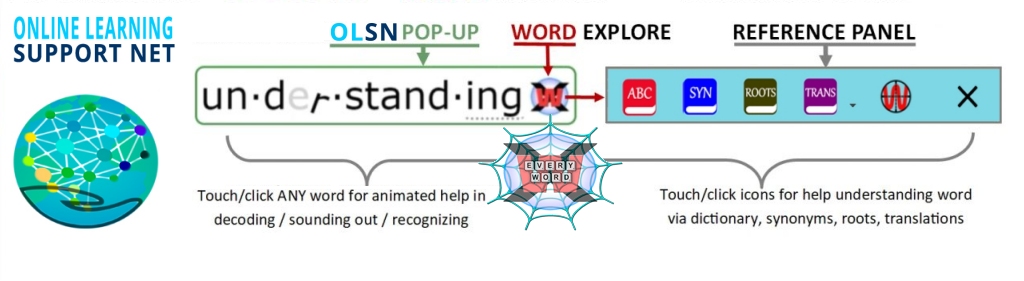 Note: Remember to click on any word on this page to experience the next evolutionary step in technology supported reading.
-----------------------------
Personal Background:
David Boulton: Your book is a fascinating piece of work.
Dr. Guy Deutscher: Thank you. That’s nice to hear.
David Boulton: Yes, it’s so wonderful to have an accessible volume that helps put into perspective the language we’re so immersed in and so often take for granted.
Dr. Guy Deutscher: Yes that was precisely my aim so I’m quite happy if it actually works.
David Boulton: Let’s start by asking you to give us a thumbnail of why you do the work you do. In other words, what’s going on inside of you personally that drives you to do this kind of research and learning?
Dr. Guy Deutscher: Actually, this is something I say in the beginning of my book. I tell an anecdote about trying to learn a bit of Latin when I was a child and not quite understanding where it all could have come from. That’s a true anecdote. Since I was a child, I have always been fascinated by how that amazing thing called language could have come about and who might have been there when it all happened. I used to ask: was it some sort of prehistoric assembly of elders who decided on all these incredibly complex conventions? Of course, I knew that wasn’t the case, but I just had no idea how it could have emerged otherwise. That was really the main question I wanted to answer when I started studying linguistics and language. So I suppose it has been driving me ever since.
David Boulton: That’s wonderful. I’ve found that many people who do extraordinary work are propelled by something deeply personal to them, often times by an experience they have had early on, which set them on the path of their inquiry.
Dr. Guy Deutscher: Yes and secretly I was writing the Unfolding Language) to myself at the age of 17 or 18, because I couldn’t find anything or anyone that could answer my burning questions. So in some sense, I’m closing a cycle there.
In the Beginning Was the Word:
David Boulton: One of the things, which first struck me after somebody sent me the link that introduced me to your book, was the statement: “mankind’s greatest invention.” Without having read anything about the book, my immediate response to that statement was, “this is the invention that created mankind.” It wasn’t something that mankind created, but rather it created mankind. And then, when I got your book, I found you were coming from the same place.
Dr. Guy Deutscher: Yes, that’s right and of course, when I call language “Mankind’s greatest invention” that’s tongue-in-cheek somewhat, precisely because of what you’ve just said. Language was not an invention like the wheel, or E-mail. As I say in the book, language is what made us human in the first place. So it was our greatest invention, except it wasn’t invented. Of course, some people might wonder why I say that language, of all things, is what made us human. I don’t think there’s an objective, or true answer, here, because there are clearly lots of things that differentiate us from all other animals. So it must be to some extent a subjective decision about what we feel is absolutely most special about us. Still, of all the characteristics that differentiate us from the other animals, I think most people would agree, quite instinctively even, that language is the fundamental thing that makes us qualitatively different. We can also say that without language, we simply couldn’t have achieved everything that we have done.
Learning Together:
David Boulton: It seems pretty clear that language is our species most distinguishing attribute. However, it seems there’s also something that’s showing up just before language, which is the human ability to learn together. I believe it has somewhat mediated the emergence of our use of language.
Dr. Guy Deutscher: The ability to learn together? Do you mean to transmit knowledge from generation to generation?
David Boulton: Yes, and from person to person – from being to being. It is our learning together, which in some ways is driving the emergence of language. It just depends on what we think is driving the use of language and where we say early communication interactions between primates crossed the line to becoming language between humans.
Animal Communication – Human Language:
Dr. Guy Deutscher: We know today that primates can communicate in a much more sophisticated way than we ever imagined. The famous pygmy chimpanzee, Kanzi, is perhaps the best example. But, there is still a huge gap between the most sophisticated things we’ve seen chimpanzees doing and what every human child is doing. Obviously, that is something that involved long evolutionary and historical processes. But, we have very little to go on when we try to reconstruct this process, and of course, there have been hundreds of proposed scenarios for how it would have happened.
David Boulton: Are you referring to Proto-languages evolving?
Dr. Guy Deutscher: I’m referring to the scenarios that have been proposed for what came before language, and what were the sources for the first words: from gesture to language, and from music and rhythm to language, etc. But, it’s very difficult to tell which of these is right, because we have so little evidence. It’s also very difficult to put a precise limit and say, this is where language began.
A Relatively Recent Development:
David Boulton: Yes. I don’t mean to go too far into this, but it would seem certain precursors are necessary to produce rapid articulate speech, as we think of it today. Given the FOXP2 gene study, and the anthropological findings that reveal when the necessary changes in jaw, teeth, and tongue came in, there seems to be a 50,000 to 200,000-year window or something like that, during which language sprouted forth.
Dr. Guy Deutscher: That’s right. But, even these studies are not conclusive. I think what you’re referring to concerning changes in the jaw and tongue are the studies about the lowering of the larynx. We have a much lower larynx than chimpanzees, which enables us to produce a much wider range of sounds. Anatomically modern humans, in other words, humans with precisely the same anatomy as ours, have been around for 150,000-200,000 years, so that gives you a certain kind of limit.
David Boulton: Right. Well, when we talk about roughly seven million years of human evolutionary history, or whatever that number is, ‘language’ is still a relatively new blip on the map.
Dr. Guy Deutscher: But we have to qualify these limits a little. It’s true that hominids with a higher larynx had a much narrower range of possibilities to produce sounds. But the fact that our ancestors, say, 500,000 years ago couldn’t produce the vowel ‘ee’ doesn’t tell us that they had no language at all. We simply don’t know whether they had language, and how much language they had.
David Boulton: Right. Yet, there seems to have been a period in time when language itself was being “selected” and our structure started to adapt to producing language. There seems to be a sort of window in which the production of language became more apparent to us in the anthropological record.
Dr. Guy Deutscher: Around 70,000, and according to some new studies as early as 100,000 years ago, there is the emergence of ‘symbolic artifacts’, things like ostrich-shell beads that are clearly there not as utilitarian tools, but as decorative elements. Many people believe that when you find such symbolic artifacts, you can assume a symbolic language. So if they are right (and it does sound on the whole fairly plausible assumption) then language was around for at least 70,000 years. But it is terribly important to stress that there’s no direct evidence for anything to do with language before five thousand years ago.
David Boulton: Which is when language began to be written.
Dr. Guy Deutscher: Yes.
Self-Talk (I Am…):
David Boulton: Right. OK. Let’s move on from here. I think on the one hand, we’re saying, what really makes us human, in the ways we most appreciate human-ness today, begins with language. Everything is built on language. What is most interesting to me about this progression is that there must have been a time when language was more of an external utility, a communication mechanism/medium, rather than the kind of internal, self-reflexive, self-talk, which makes our consciousness so different from anything that has ever existed.
Dr. Guy Deutscher: I agree entirely. The only thing is, how exactly did that transition occur? I don’t believe we will be able to pin it down.
David Boulton: Right, and without needing to date it scientifically, and without bringing any kind of religious charge to this, it’s interesting that there’s the biblical notion of; “in the beginning was the word” – that a connection is there, somewhere.
Dr. Guy Deutscher: Right. I think we instinctively feel it, and it must also reflect, in some sense, a historical reality that will forever be a mystery.
Recently Speaking:
David Boulton: So, we aren’t able to pinpoint with accuracy the ‘dating’ of some kind of ignition point to this. This wasn’t a singular event, rather a gradual emergence, so as you say, we really can’t tell when things happened. Nonetheless, there is something that we can say about how language bootstraps itself into greater complexity, how it’s grown if you will, which is really the core of your book.
Dr. Guy Deutscher: That’s precisely what I tried to do, yes. I concentrated on the part of the story we can make reasonable conjectures about, tried to start from a point where we already had some simple words.
David Boulton: We can make inferences based on how it looks today.
Dr. Guy Deutscher: Precisely, that’s why I decided to start there. From this starting point we can, based on what we can see today, actually build fairly plausible scenarios about how complex language evolved from a very simple beginning. The stage I choose to start with, which I call, “Me Tarzan”; is undoubtedly already human, because by that stage you have the basic ability to describe things, even if they’re very, very simple things. So I start with the most rudimentary materials of language and try to show how, we can extrapolate the processes that we can see in operation in the historical period back and see how the complexity of language has evolved.
David Boulton: That’s an interesting approach to the process. So a social-cognitive inertia plus evolution of memes view of how language is differentiated?
Dr. Guy Deutscher: Yes, it’s the process by which ideas or conventions emerge, not because someone decides on them consciously, but, through the act of communication itself. So, it is the evolution of memes, if one wants to speak in those terms.
David Bouton: As perhaps being driven by the economy, expressiveness, and analogy, which you address in your book.
Butcept:
In your book I really liked what you termed “short cutters”. They reminded me of my daughter, who once came up with the word “butcept”.
Dr. Guy Deutscher: To mean?
David Boulton: Well, it was both the word “But” as in warning that a difference is coming, and the word “Except” and she contracted them. I’ve always marveled at how little children develop these incredibly intelligent word fusions out of parts of other words they hear, which demonstrate the very principles I think you’re referring to.
Dr. Guy Deutscher: That is really a wonderful example. So, yes I think the three main driving forces for change are economy, expressiveness, and analogy making. Economy is ultimately just laziness, manifested mostly in pronunciations, trying to pronounce as little as possible, and as little as you can get away with.
David Boulton: So, it’s not trying to optimize as much as it’s trying to take the path of least resistance.
Economy:
Dr. Guy Deutscher: Yes. Of course, no one tries to optimize consciously. No one sits and looks at the whole system and thinks, well, we have a redundancy here; we have a word that’s too long there, let’s do something about it. It’s sort of like free-market economies. Things happen through actions people do individually when trying to address very immediate concerns. So, you just instinctively know you don’t want to put any more effort than needed for your conversation partner to understand you.
David Boulton: It’s built into the process of trying to keep the flow going.
Dr. Guy Deutscher: Yes, and the resulting changes come through continuous negotiations that are for the most part unconscious. If you go a little bit too far in economizing, your partner will not understand you, and you will have to repeat it. So, the next time you won’t go quite as far as you did. There is always that negotiation between the speaker and the hearer. But, if you economized and you were understood, you will turn that into a habit. The result of this, over time, is a sort of constant drive towards optimization, towards reduction, and making the code more efficient.
David Boulton: Right. On a different level, it is somewhat reminiscent of Einstein saying, “make everything as simple as possible, but no simpler” in terms of the ecology of the dialogue and the conversation.
Dr. Guy Deutscher: Yes, that’s right. Of course, if that were the only thing around, words would just always get shorter and shorter and shorter, and things would be incredibly efficient, but possibly quite dull also.
David Boulton: Dimensionally constrained.
Expressivness:
Dr. Guy Deutscher: Yes. But, there are other driving forces, because of course; we also have this expressive urge – we want to extend our expressive range or say things in a more forceful way, creating greater effect, which drives us in the other direction – towards maybe using more words, or using words with stronger meaning.
David Boulton: Or differentiating more complexity by using words that stretch the edge of communicating with the person we’re with.
Dr. Guy Deutscher: Yes, that’s one manifestation, precisely.
David Boulton: So, we’ve got expressiveness resulting in some expansion, and the economy, conserving against it, in a way.
Dr. Guy Deutscher: Yes, I try to describe it as the cycles of expansion and reduction, where expressiveness builds new or longer or more complex phrases, and then economy (or erosion) gradually reduces them. Erosion checks the excesses of the expressiveness, and vice versa..
David Boulton: Almost like speciation.
Dr. Guy Deutscher: In what sense speciation?
David Boulton: Well, it seems like animals migrate and adapt and become different. But over time the animals will breed back into each other in ways, which end up with a greater base of strengths surviving, rather than just the variations developed in their local extremes.
Dr. Guy Deutscher: Yes, that’s right.
Analogy:
David Boulton: So, in addition to these two…
Dr. Guy Deutscher: …there’s analogy, which is trying to make order out of that whole mess. Analogy is the instinctive need to find as much order as possible, especially by children, in order to cope with learning the language. When you learn language as a child, you have to cope with absolutely mind-boggling amounts of information and detail. It would be completely impossible to do that if you didn’t assume, at least as your default-working hypothesis, that as much as possible works by logic and by rules. That is why children, (but not only children), whenever they are confronted with new forms try to fit them into other rules they already know, or even make new rules on the spot, based on similarities between forms and expressions they already know. Most of the time they get it right, in the sense that they create the same rules or regularities that are really there in the language of their parents. But sometimes they don’t. Then, we get all these cute errors children make, which are usually producing a regular form where in real language it happens to be irregular. Or taking one regularity and imposing it in a place where another rule applies.
David Boulton: Trying to reference what’s new to what’s known.
Dr. Guy Deutscher: Precisely.
David Boulton: And, analogy is the mode of processing that is creating some contextual reference for what’s going on now, what’s new.
Dr. Guy Deutscher: Yes, It is the ability to find similarities between things that are not identical, but nevertheless have some things in common, and to create a rule or a pattern and then apply it along with the patterns you already know to new situations or new forms you encounter. The changes in language over time are driven by the fact that the analogies every generation makes are not entirely identical to those of the previous generation. They don’t generate precisely the same system because some forms which had been more frequent became less frequent and so the new generation would not use these forms to draw their analogies. And vice versa. Some forms, which used to be quite infrequent, have become very frequent, so these are now the dominant ones in which to make the patterns on.
Generational Changes:
David Boulton: Which you showed really remarkably well with words that have almost changed 180 degrees over time in their meaning and usage across generations.
Dr. Guy Deutscher: Yes. The changes in meaning, changes in frequencies, changes even in pronunciation, and then the combination of these three basic forces, each pushing in a slightly different direction is what drives language all the time and what doesn’t allow it to stay still. Ultimately, it’s what can develop more and more sophisticated grammatical structures, as well as a wider range of vocabulary and abstract terms, which I tried to show toward the end of the book.
David Boulton: Right. I really want to go into that, how our language is this medium of exercise for making complexly constructed, abstract realities in our minds. But, coming right off of economy, expressiveness, and analogy, there’s a parallel of sorts between that group and metaphor, destruction, and creation. Yes?
Dr. Guy Deutscher: Yes.
David Boulton: Could we just touch on that?
Metaphor, Destruction and Creation:
Dr. Guy Deutscher. Well, in some sense, I suppose these are the characteristic effects of the three forces. Metaphor is a manifestation of expressiveness. Destruction is a manifestation of economy, and creation is slightly more difficult because it is a manifestation of all these things, combined. Metaphor is a manifestation of expressiveness because we try to extend our expressive range to abstract concepts. Abstract concepts don’t just grow on trees. They have to come from somewhere, and the only way to create them is to use material that’s already there and to extend its meaning. The material that’s already there are words for simple things, for simple objects or simple actions. So, metaphor is the means by which we create more sophisticated, abstract vocabulary, from words for simpler concepts.
David Boulton: Express our analogies through assembling words into metaphors?
Dr. Guy Deutscher: Precisely, and use them as images for more abstract things. Then, destruction is obviously the manifestation of laziness. Creation, as I said, is more complex because it really is the combination of the three. In the book I show how different aspects of creation are achieved through the three forces combining together. For example, expressiveness creates new, longer expressions, and then, erosion or destruction compacts them into one longer word; analogy then, is able to pick up on accidental patterns that emerge in these new words and regularize them into more complex paradigms. So, the reason that creation is more elusive or more mysterious, is because it’s the three forces coming together in a very particular combination, and in just the right dosages .
David Boulton: When I was going through that part in your book, it struck me as a parallel if you will, of something I worked on some time ago, having to do with creation being the process of resolving our ‘meaning needs’, the need to differentiate meaning.
Dr. Guy Deutscher: I suppose that’s mostly manifested in expressiveness and extending the range of words.
David Boulton: Whereas and correct me if I’m wrong here, creation can refer to the growing artifact, so to speak, not necessarily the processes that drove them.
Dr. Guy Deutscher: Let’s put it this way, creation is almost a by-product, especially if you talk about grammatical elements . No one ever sets out to create a grammatical structure. It’s always the by-product of the combination of these processes we’ve just been talking about. So, in some sense, it is ironic that the creation of the sophistication of language is always a by-product. It’s always the result of other things. It’s never….
David Boulton: …an immediate end-goal motive that caused it.
Dr. Guy Deutscher: Yes.
Spoken and Written Language:
David Boulton: One of the things we’re interested in is the difference between the natural evolutionary processes of spoken language and the more sociological, technological and cultural, “evolution” of writing systems. How they’re similar and how they’re different. But, before we get to that, there were some other things.
One of the things that caught my interest in your book was your discussion of the relationship between cognates and words as languages differentiated and spread.
By the way, as we proceed here, I think you have some sense of what we ultimately want to be talking about. However, if you sense there’s a point that’s important to make and I’m not asking a question about it, please come forth and say, wait a minute; we need to talk about this before we can continue talking about that.
I have a lot of respect for you and your work and where you’re coming from. What I’m trying to do is help people understand language, from many different dimensions. I want people to understand how important language is to us and how deeply intertwined it is in everything. Also, when we talk about reading and all that is connected with and flows from it, we’re actually talking about an ‘overlay’ that’s creating a simulated language experience in our minds and so we’ve got to understand language processing in order to understand it.
Dr. Guy Deutscher: I’m entirely with you on that. I think I wrote to you after I looked at your web site online; your work really is incredibly ambitious and extremely important. So, I really appreciate what you’re doing.
David Boulton: Thank you. So, from here, because of the rich nature of your work, what’s the pathway through your work, which will help us learn into that level of understanding?
One of the things that’s fascinated me, is to understand how language itself has differentiated and spread among its users around the world, which is certainly part of understanding how the oral language and written language split from each other in certain ways, or how their relationship became so fragmented in the later, European, post-Renaissance era, et cetera.
The Tower of Babel:
Dr. Guy Deutscher: There are very different directions in which one can answer this. On the one hand there’s an enormous amount of regularity in the way language changes; and that’s mostly what I concentrate on in the book. But, in addition to that, there’s an enormous amount of completely random changes. So, although we can expect that the basic mechanism of change would work in a similar way, nevertheless, there’s such an amount of noise in the processes of change, that unless two groups are in contact with one another, and the need for communication keeps the two groups together, then the changes in the two groups just drift apart, which is the basis of linguistic diversity, the real answer to the Tower of Babel story.
David Boulton: This connects back with this notion of speciation. For example, what happened during the Ice Age when significant parts of the population, for a long period of time, were living in relative isolation from one another. If they weren’t interacting with one another then really different languages must have developed.
Dr. Guy Deutscher: Yes. It’s no wonder the highest density of different languages in the world is in Papua, New Guinea. There is a joke that half of the world’s languages are in Papua, New Guinea. That’s a bit of an exaggeration, but it’s not so far off. And, the reason is precisely because you have these small, isolated groups living in these valleys with mountains around them that they can’t go through. So each group, in isolation, has developed independently and that’s why there are so many very different languages around there.
David Boulton: So, before we leave the Tower of Babel story thread, I want to note that there’s an analogue to this story in many of the world’s major mythologies – the story of people coming together who are similar enough to coexist but very different. The Upanishads describe this as, “The fruit of the worship of knowledge and the fruit of the worship of ignorance”, and in the Bible it’s “the sons of God and the daughters of men“, suggesting they have this physical compatibility and ability to emotionally connect but they can’t communicate with each other.
Dr. Guy Deutscher: Yes.
David Boulton: So, that’s an important backdrop to one part of the story.
Language Families:
One of the things that is particularly interesting is how the dominant languages in the world today have come through this tree, this Indo-European manifold of differentiation.
Dr. Guy Deutscher: Well, Indo-European, of course is just one family. It is of particular importance to English speakers because it’s the family that English happens to belong to. But, it is just one family and there are quite a few others. And in each one of them you can see the same processes of divergence. If you take the Indo-European family, there is no agreement on where they came from originally . But wherever they came from, whether it was Asia Minor or Siberia, or somewhere in the Caucasus, what is clear is that they split up and started spreading all the way from what is now India to Western Europe. And in that process, as they lost contact with one another, their languages started to diverge. We see the same process of divergence in all other language families. Because of geographical dispersal, over time, the languages start to diverge from one another.
David Boulton: So, what holds the commonality is that they share certain implicate roots or cognates, even though they may have different ways of expressing the same sound. The cognates could be shared across language families, because they are co-implicate, they’re deeper than the surface sound representation of a word that’s shared.
Dr. Guy Deutscher: Of course, some families, such as Indo-European, have diverged so much that although English is Indo-European and Persian is Indo-European, speakers of English and speakers of Persian still can’t understand a single word of the other Language.
David Boulton: Right. But, linguists have put together that these two languages are expressions, which are sitting atop of an evolutionary process that’s shared.
Dr. Guy Deutscher: That’s true, but, they have developed in their separate ways for many thousands of years. Cognates are what remains from that common source that can still be recognized. They’re most often not recognizable to the speakers themselves because the sounds have actually changed so much. But, scholars who re-trace the evolutionary process can still recognize that these two words come from the same source.
David Boulton: Yeah, in another language I would think of them as co-implicate assembly components. Meaning that they’re implicating across different language systems, which means they’re a shared ingredients.
Dr. Guy Deutscher: Yes.
David Boulton: So, we have been talking about how language differentiates, or appears to become distinct, to the non-scholar anyway, in the different regions in the world that had various degrees of isolation from one another. Up to that point, (and we did sort of jump over the Tower of Babel piece, which is interesting), is there anything about this stage that sticks out in your mind as something the lay public doesn’t understand? Is there something we’re missing in our general paradigms about all of this or about the kind of work you’ve done and the kinds of work linguists do?
Non Punctuated Equilibriums:
Dr. Guy Deutscher: Perhaps the issue of dialects and languages is something that many people don’t understand. People tend to think there’s some mysterious point when, what used to be the same language changes into two different languages. Whereas, for linguists it’s essentially a continuous process. If two varieties are not in close enough contact with one another, they will gradually drift apart. There is no such thing as 100 percent mutual comprehension suddenly becoming zero percent mutual comprehension.
David Boulton: There are no singularities here.
Dr. Guy Deutscher: No, and we can see that even in English dialects. There is a joke about an American and a Scotsman, who meet somewhere and can’t understand a word of what each other is saying, and so, in the end, they decide to speak French.
It’s the same story in Germany, for instance, where you get dialects of what’s supposed to be the same language, which are almost entirely mutually incomprehensible. So, you get the whole range from 100 percent comprehensibility, to almost zero. But, on the other hand you have separate languages such as Norwegian and Swedish, where there’s nevertheless a fair amount, of mutual comprehensibility,. So, the point, when you decide to call a different variety a different language, is to a large extent, arbitrary, and depends on many other, political…
David Boulton: More to do with the convenience of the researcher.
Dr. Guy Deutscher: Yes, or the feelings of the actual people using the language.
David Boulton: For example, perhaps, just as when the English tried to restore the English language after the French in the fourteenth century?
Dr. Guy Deutscher: Yes or more modern examples are Serbo-Croatian, which used to be one language when Yugoslavia was one country. But after the war, it suddenly became two languages. Nothing has changed in terms of the real linguistic situation. They still can understand each other perfectly, but now they feel they are speaking different languages, so they call it different languages. In any case, the underlying process is that when two varieties are not in contact, they gradually diverge and so the mutual comprehensibility decreases. Now if you wait, I don’t know, a thousand years or so, you can be sure the two languages will become mutually incomprehensible, but before that, you will get all these shades in between. What you decide to call them in those cases is, to a large extent, arbitrary. I think that’s something that people are not always aware of.
David Boulton: Right, right. Well, that’s helpful. I have this sense; in wrapping this section that we could say language is always on the move. It’s always a dynamic process with creative and destructive elements. It’s always changing. The issue is whether or not people who are engaging in languages are staying in a sufficient relationship with one another for the languages to be co-evolving, or people’s use of language to be co-evolving, rather than separately evolving.
Dr. Guy Deutscher: Precisely. I can’t put it any better.
David Boulton: Again, it seems so amazing there’s such a parallel in the workings of this process with how life itself works.
Dr. Guy Deutscher: I agree.
Evolving Learnability:
David Boulton: As we go into the differences between written and spoken language, one important piece has to do with Deacon’s notion that languages are constrained in their range and growth by how learnable they are to children, whereas writing systems are almost the opposite. The statement refers to language being generational. Language has got this generational evolutionary dynamic in it that’s constrained by its learnability to children.
Dr. Guy Deutscher: Yes. I entirely agree I think this is one of these things that sound so simple and obvious once someone has explained it the way Deacon has. But, it needed someone to actually say it. I think that’s an extremely, powerful explanatory mechanism for the evolution of language in general, and it explains why children manage to learn language even though it’s so complex. In many ways, it puts the traditional explanations for why language is learnable on their head. The idea is that if only learnable elements or rules in language which are can survive, then it’s not surprising that children can learn language so effectively and so quickly. Simply, the things they couldn’t learn are not part of our language.
David Boulton: They died off. They’re adaptations that didn’t take, for exactly that reason.
Dr. Guy Deutscher: Precisely. So, I really admire that argument.
David Boulton: Good.
Writing is Different:
Dr. Guy Deutscher: And, I while I never thought about this before, you’re right that unfortunately one cannot apply this argument in such a simple way to writing because, well I suppose, because writing is…
David Boulton: …not really language.
Dr. Guy Deutscher: Well, that’s also true in some sense. But, what I meant was that a writing system that requires years of hard work and frustration and energy, can still be perpetuated through the generations because it’s learned at a later age, where you actually can force people to learn. You can’t force two-year-olds to learn to speak.
David Boulton: It’s not an option. It’s going to happen. They’re going to grow to participate in the patterns of language around them.
Dr. Guy Deutscher: Yes. But, what I mean is, suppose you now devise a language that is almost unlearnable to speak, and you try to force your two-year-old to speak it. What can you do? You can tell them “if you don’t start speaking it I won’t give you any food”, or “I’ll beat you”, or whatever you want. But, that won’t help you, because at that age, if they can learn it, they learn it. If they can’t, they won’t. But, with writing, it’s different because that’s something you do later, and you force people who are already at an age when the whole system of social coercion is in place and is workable, and that is why writing systems can allow themselves to have so much more unnecessary complications and difficulty than spoken language.
David Boulton: In the sense that clearly the writing systems we use have different kinds of confusions in the relationships amongst their elements than the kinds of confusions that exist in the purely oral, spoken language.
Dr. Guy Deutscher: Yes, and some of them are even intended.
Intentionally Confusing:
Dr. Guy Deutscher: For example, in the cuneiform writing system of ancient Mesopotamia, in which Akkadian (Babylonian and Assyrian) was written; when you look at the history of the writing system you actually see how the writing system became more and more complex over time, not simpler and simpler. The reason for that, it wasn’t in the interest of anyone to make it simple, quite the reverse. Reading and writing was limited to a small group of scribes who were a sort of guild. In order to go to a scribal school, one usually had to be either well-to-do or to have come from a family of scribes. But, once you became a scribe, and learned to read and write, then your economic future was secure. So, they certainly didn’t want to make it simple, and lose their privilege in this way.
David Boulton: The complexity served their interest.
Dr. Guy Deutscher: Complexity served their interest and that’s why with time, you can actually see the script becoming more and more complex. They invented more and more signs. So, by 500 B.C., after 2,000 years of written history, the system has really become extremely complex, much more complex than it was at 2,500 B.C.
Unintentional Confusion:
David Boulton: Right. The particular kind of complexity that I’m interested in, is the complexity that is unique to the relationship between letters and sounds in alphabetic languages. In spoken languages, pronunciation-based recognition of a word is comparatively immediately transparent. In writing because of the complex relationships between letters and sounds and the time it takes the brain to work all of that out, recognition is different. There’s a different form of confusion that seems to have come about because of the fusion of one group of spoken and written languages with another spoken and written system.
Dr. Guy Deutscher: I don’t know very much about all the psychological aspects behind it. But it’s clear that with the advent of writing, you essentially have a separate kind of language emerging, with its own rules and conventions, and this is written language. People usually say that written language is different just because it’s conservative and so it reflects the situation in earlier days. Of course, that’s partly true. But it is, a mistake to think that the written language as it is today represents the spoken language exactly as it was.
David Boulton: Yes.That is grossly over simplistic.
Confusing Sounding Letters:
Dr. Guy Deutscher: Yes. Written language has always had its own rules, because it is a different medium, it’s a different way of expressing things. The structure of sentences has always been different in the written language and the spoken language, and that written language has always been denser than spoken language.
In English, of course, as opposed to Babylonian, no one has tried to make spelling intentionally difficult. It is more the case of spelling conventions simply not keeping up with changes in pronunciation, and so, they just misrepresent the situation today. There would be quite a good representation of English in the sixteenth century.
David Boulton: Right, right. We’ve talked to a number of different people in this field, about how the English writing system comes in with the Chancery scribes, I should say, comes back, after the French domination, and then the Great Vowel Shift hits, and how the printing press comes in, and all these things are kind of cementing this still-forming slush. But, my concern, stepping back, for a moment, is about the kind of confusions which are unique to writing systems. I’m interested in the complexity in the relationship between the sound system and writing system and how one’s early learning of the writing system has to evoke that sound system.
Dr. Guy Deutscher: So, you mean, there is an expectation that once you can translate sound, letters into sound, you should be able to understand written language?
David Boulton:. I’m trying to say there’s a unique class of challenges associated with getting past the letter-sound barrier, to a point where word recognition is happening automatically and transparently. Only after that can you go on, into the other unique-to-writing types of complexities and confusions. It’s right there at that boundary, where, for example, in the United States, about a hundred million people are being held under water.
Dr. Guy Deutscher: At the stage before word recognition and the higher complexities?
Sounds and Letters:
David Boulton: Yes. It’s so taxing to punch through the confusion fast enough for fluency.
This leads to one of the most interesting historical tracks; my understanding is that during the initial use of the alphabet by the Hebrews, there’s something like 17 consonants in play and there’s a pretty tight correspondence between their letters and sounds. When the Greeks get it, via the Phoenicians, within a reasonable period of time, the Greeks, in some way, looking out for the Greek language, adjust the alphabet, so that it has the additional symbols necessary to represent their language.
Dr. Guy Deutscher: Yes.
David Boulton: The Romans inherit that, with minor tweaks to punctuation, and other aspects of it to make it a better fit for them, and spread it around Europe like the World Wide Web, or OS of the empire.
Dr. Guy Deutscher: Yes.
David Boulton: As the empire withers away, the powers in Europe, living in the different regions and different languages, continue to regard it as the power language, the “in” language, the language of knowledge and science and God, and everything else. But, at some point, the writing system, based on the Latin sound system, gets overlaid on top of the local spoken languages. At that point, confusion comes in that’s unlike what happened when the Greeks get the alphabet from the Phoenicians, because nobody’s saying, wait a minute, let’s adjust this thing so it fits our language.
Dr. Guy Deutscher: Well, at least in modern times, it’s not entirely true that nobody tries to adjust it. In some countries, eventually, additional letters were devised precisely in order to represent sounds that weren’t there in the Roman system. You have all the diacritics, or the umlauts in German, or the accents in French, and you have various…
David Boulton: Mechanisms for connecting the spoken language to the legacy system of the Roman writing.
Dr. Guy Deutscher: Yes, but, essentially extending it, not by devising a whole new alphabet, but by extending the Roman alphabet in order to adapt it to represent the sound system of the particular languages, and some languages have done this quite effectively.
David Boulton: Right. When I said no one, I was really referring to England. My understanding is that it looks like a small number of scribes, who grew up in a Latin school, and who spoke primarily Latin and were proud of their Latin and living in kind of an elite bubble if you will, are the ones who figured out how to take the English spoken system, with its 40-plus sounds and represent it as close as possible with Latin sounds, and a 24-something letter alphabet.
Dr. Guy Deutscher: Yes, I don’t know enough to tell whether this was a decision made by arrogance, or whether it was simply lack of imagination or lack of intellectual horizon to say we can do things differently. But, I think it must be a similar symptom to the phenomenon that was common until fairly recently of teaching English grammar as if it was Latin grammar, because, well, grammar equals Latin, and therefore we shall pretend English is Latin, and teach the grammar of English as if it were Latin, which is utterly ridiculous, of course.
David Boulton: That was a prestige inheritance, right?
Dr. Guy Deutscher: Yes. But, the motives may simply be an inability to imagine that things can be otherwise, because of this enormous prestige.
David Boulton: Arrogant elitism.
Dr. Guy Deutscher: Not necessarily, it may simply be lack of imagination.
David Boulton: I’m not trying so much to impute that anyway, as to say, look, these weren’t people who were living out among the English-speaking population, and engaging with them frequently and enjoying and appreciating the English language, but were rather, living comparatively cloistered, separated lives, speaking to one another and doing their day-to-day functions in Latin. Consequently, they’re certainly going to have trouble rounding the corners in stretching the alphabet and the sound system they’re using to capture sounds and distinctions in the spoken language that they’re not participating in that much.
Dr. Guy Deutscher: Yes. I agree entirely. Although, it is interesting that in previous stages of English, there was some attempt to introduce some other sounds. In Old English, you have a special letter (in fact two) for “th” In Middle English, you have the “yough” letter. It looked a bit like a cross between a ‘g’ and a ‘y’, that letter was used to represent the sound “ch” [as in Bach].
David Boulton: Which, for the most part, were dropped when the printing press technicians didn’t have fonts for them.
Dr. Guy Deutscher: Yes, that’s right.
David Boulton: Which meant the scribes actually had more tools to reconcile the gap.
Unique Processing Challenge:
David Boulton: What seems interesting to me is that the original writing systems developed and adapted, at least the alphabetic ones, in environments where the spoken language had phonemes roughly correspondent in number to the number of alphabet characters in use. Yet, since then the correspondence has broken down and the kinds of processing challenges associated with processing an alphabet and sound system that doesn’t have an approximate match represents a unique class of processing challenge never before experienced by human beings.
Dr. Guy Deutscher: That might well be the case, in that what happens here is unusual, because the writing system pretends to represent sounds, whereas, in fact, it doesn’t. There were previous writing systems, which were very difficult, but, at least they did not pretend to represent sounds.
David Boulton: Partly. There’s a quote from Plato, in The Republic, where he says, once we knew the letters of the alphabet; we could read. There’s a difference between seeing a letter, articulating its sound, blending it with the next letter in this kind of pitching machine like automation that results in intelligible, recognizable, speech stream, and processing today’s letters which are more like place-holders for variable fields that change what their sounds are depending upon letters far away from them.
Dr. Guy Deutscher: Yes, I think that’s more or less what I meant, in the sense that in Greek, or Latin, for example, once you could view the letters, you could read, you could get the sound. For Greek and Latin, there was almost a perfect match, and what happens in English today is there’s still the pretension that it’s a system representing sounds, but in fact, it isn’t the case anymore.
David Boulton: It isn’t. And, yet, for children coming up into it…
Dr. Guy Deutscher: They expect that it should be.
David Boulton: And, somehow it’s got to function that way, too, even though it doesn’t. Although, a good reader transcends the sound barrier, and is picking up words and recognizing them, without the sub-vocalizations, without it going through the phonological loop, for children, who are learning to get up into it, it’s got to translate into sound, before it can go beyond sound.
Dr. Guy Deutscher: Yes English readers, I should say, have a much more difficult task than those in countries like Germany or Hungary, or Scandinavian countries, or even the Netherlands, where there have been consistent spelling reforms to make sure that the writing does represent the sound system of the language, in a fairly transparent way.
David Boulton: I’m really enjoying the conversation. All of it has been very, very rich, and this zone we are in here, about how these two systems work together, and what you’ve learned about language is really important.
Dr. Guy Deutscher: Well, I’m enjoying it as well and I’m glad it’s helpful.
Numbers of Sounds:
David Boulton: So, in trying to help us understand this collision of systems, this fusion of systems, one question I’ve had for some time is: why does the English sound system have so many more sounds than the Roman system? Is that also a product of differentiation happening and mixing?
Dr. Guy Deutscher: That’s really a very difficult question. In many of the modern European languages there are more distinct phonemes than there were in Latin. I think I vaguely remember reading something very provocative and very tentative trying to argue that generally sound systems have become more complex in the last few thousand years.
David Boulton: I understand that we’re in speculation land here. Yet, I would think when some people in language group A start to pick up a lot of vocabulary from group B, although they may have similar numbers of sounds in play, the different sounds required to make the vocabulary coming in from B adds sounds to the overall system in play in A.
Dr. Guy Deutscher: That’s one way, and we know that in English some new phonemes, like ‘j’ I think, came in through borrowing. But I don’t think it can be reduced to just that, since we know of ways in which new sounds develop, naturally, not because of foreign influence. One simple example is the process of affrication, by which ‘stops’ like ‘p’ are weakened into fricatives such as ‘f’, and if this happens not to all p’s but only to some, and if there was no f in the language to start with (many languages don’t), then the language will have gained a new sound.
David Boulton: Right. It seems staggering, in a way, that throughout antiquity, at least to a degree, we could measure the number of sounds with the alphabet and it appears there were probably around twenty-something sounds in Hebrew and Greek and Latin, and so forth. Then we jump forward two thousand years, and in the Northern European languages there’s 40+ sounds.
Dr. Guy Deutscher: Yes.
David Boulton: That’s not a small difference. That’s almost a two-fold growth.
Dr. Guy Deutscher: Yes. Admittedly, one has to remember that even in the Latin system, there were long and short vowels, which they didn’t indicate. But, the general principle, I think, still stands, that there has been a noticeable increase in the inventory of phonemes. The main question is why. You could expect that the overall number of sounds should not change radically. Some new sounds can come in, but some old ones would disappear. But, in fact in the history of the European languages in the last two thousand years, the balance has shifted and more new phonemes came in than old ones disappeared. I don’t think anyone can do more than speculate why.
David Boulton: So, it’s a bit of a mystery that goes right next to the Great Vowel Shift, as being something we have lots of theories about, but nothing approaching consensus as to what happened.
Dr. Guy Deutscher: No. I think it is really quite difficult, much more difficult than just trying to explain why one particular sound changes into another, which usually, turns out to be laziness of one sort or another. But the explanation we want for this question of the number of phonemes in the language is on an entirely different level. You are now looking at the global system to see why there’s been some sort of upset to the balance.
David Boulton: Something that stands out in the trajectory of change, which preceded it, in terms of just the shift in that short a period of time.
Dr. Guy Deutscher: Yes.
David Boulton: OK. Well, we don’t need to pursue it much further. I just thought it was really interesting.
Dr. Guy Deutscher: It’s extremely interesting. I agree. And, it’s unlikely to be a coincidence, in the sense that it didn’t just happen in English. I think it happened in most modern European languages.
Writing Changes Spoken Language:
David Boulton: It’s really clear that the writing system we use today, or as I explained earlier, relative to the way children learn this system anyway, sits on top of the sound system.
Dr. Guy Deutscher: Yes.
David Boulton: But, it’s also clear, if we look back through the history of writing systems, that writing systems are not only extensions of the spoken language system, they’ve folded back to shape the spoken language system in profound ways.
Dr. Guy Deutscher: Again, I agree entirely.
David Boulton: So, I wonder to what extent, because we’re talking about a spike in phoneme growth in the past two thousand years, which is about coincident with the peaking of the Roman Empire and the introduction of its spoken and written system throughout Europe, you know? In other words, could writing itself be somehow responsible for the co-existence of multiple systems, which is more than just borrowing?
Dr. Guy Deutscher: It’s an interesting thought.
David Boulton: I don’t have any attachment to it, other than it seems coincident to me that there’s this big spike that happens and it happens with the dissemination and use of the alphabet, although it’s not affecting that many people in Northern Europe, it is affecting the people in power, and to some extent, people of influence over language.
Dr. Guy Deutscher: Yes. Although, I wonder whether there is really an obvious point where it spikes, or whether it’s more gradual.
David Boulton: I didn’t mean necessarily the spike. It started with the fact that there was this big difference in number. And, you referred to somebody’s work, which talked about the last two thousand years, where there seemed to be some growth that’s speaking to this difference in the number of phonemes in Northern European languages.
Dr. Guy Deutscher: Yes.
David Boulton: That just happens to coincide and that’s why I brought it up.
Dr. Guy Deutscher: Yes. It may well be connected. Ultimately, it’s very difficult to give answers. There are other things like this where you see some obvious direction or changes. Some global changes that do upset the balance of language, and you can see these changes over the last couple of thousands of years.
David Boulton: Do share with us what you thought was the most powerful example in that group.
Complexity Simplified:
Dr. Guy Deutscher: In the European languages, there’s a clear movement toward simpler and shorter words. If you look at all the older languages, not just Latin and Greek, but the older stages of all Indo-European languages, they have very complex words, with lots of different endings and prefixes. Much of what is done today, with separate, independent words, was done then in one word. So, the older languages were highly ‘inflected’, but, as history moves forward you just consistently see these inflected words generally turning into invariable words, so all these case endings gradually disappear, and most of the verbal endings too.
David Boulton: So, you’re saying the words become less multi-ordinal. They have…
Dr. Guy Deutscher: …just one form for each word, rather than, sometimes, dozens of different forms in the older languages. What we would, in English, do with: I have done, I would have done, I should have done, and I will have been doing. All these different tenses, were expressed within the verb as one word. It can’t be just a coincidence because it’s happening in so many different languages, in fact, in all European languages to some extent. But, trying to answer the ‘why’ is, again, extremely difficult.
Graphemes and Phonemes:
David Boulton: The main thing that’s interesting to us is the gap between the graphemes and the phonemes. It seems that, in a way, you could say that once you’re up and on the other side of it, potentially, the ambiguity in the writing system is an exercise environment for creative, combinatory abstraction, and that there are good sides to its lack of concrete correspondence. But, when you’re trying to get up into it, it’s an entirely different kind of challenge.
Dr. Guy Deutscher: I agree. Although, I’m not sure I can get terribly excited about the alleged advantages. But ultimately, it really is this inherent power struggle between the generations, in the sense that once you’ve mastered the system, it’s not in your interest to change it, because you’ve already done all the hard work, you don’t want more work relearning the system and also you’ve already internalized the system of values, which leads you to think that this is right and traditional. So, you are then in a position of power to impose the same suffering that you had to go through on the new generation. It certainly would be in the interest of the new generation to have a more sensible, simpler writing system. But, they are never in a position to make it happen.
Spelling Reform:
Dr. Guy Deutscher: You can see that, because recently, there’s been a huge debate in Germany about some fairly minor spelling reform, which was meant to make things less complicated, and easier to learn. But, there was a huge, massive opposition to this. From writers, and from all the people who have a vested interest in the system as it is, because they’ve learned it and because they value the element of tradition, et cetera. But, the result of this, of course, is that you perpetuate the unnecessary suffering of the people in the learning process, a new generation who doesn’t have a say in the matter. By the time they do have a say, they have already switched sides, or at least, those who will reach positions of influence will have.
David Boulton: Those who made it through.
Dr. Guy Deutscher: Precisely.
David Boulton: So, the inertia works, like inertia does. This, I think, is what Charles Hockett, a linguist, I believe, when he said: “It’s easier for people to change their religion than their writing system.”
Dr. Guy Deutscher: Yes. It really would need tremendous political will power.
David Boulton: And, the one time that this almost happened…, you’re familiar with the Theodore Roosevelt, 1906, episode?
Dr. Guy Deutscher: No.
David Boulton: Oh. If you’re interested, I’ll take a couple of minutes and share it with you. I think it’s one of the ‘greatest stories seldom told’.
Dr. Guy Deutscher: Sure.
David Boulton: It has to do with Melvil Dewey, the guy who developed the Dewey decimal system for libraries, at least, here in America.
Dr. Guy Deutscher: Yes.
David Boulton: He impresses Andrew Carnegie. Andrew Carnegie puts up a quarter of a million dollars, or so, into an organization that he forms, which includes the Chancellors and Presidents and English department heads of most of the major European and American universities and schools, as well as the major publishers. It has big, notable, heavyweight names, like Charles Darwin and Lord Tennyson, and so forth. They decide that they’ve got to fix the spelling, that it’s causing the English language to be retarded in its imperialistic advance, and it’s causing two years, or more, of additional learning troubles, for children to come up into it.
And, so, recognizing how Ben Franklin, and Noah Webster, and other spelling reformers before them had failed, they chose to take a multi-generational approach, and convince authors, publishers, and writers in general, to slowly shift the spelling over a couple of generations. But, one of the leaders of this happens to be a friend of Theodore Roosevelt. And, one day he goes to the White House and tells Roosevelt about this, who apparently had a spelling problem himself. He was not a good speller and so, he just thinks this is a great idea and issues a President of the United States order to the office of government printing of the United States government ordering that it will now print everything according to these new spelling reforms. This occurs while Congress is out of session. Congress comes back in session, and they debate it and they pass a resolution preventing Presidents and any members of Congress from ever changing the spelling of anything. Then, the Supreme Court gets involved, but says it will not take up the case. Finally, what kills it, is not scholarly debate as to the wisdom of it, but because a smear campaign gets run in the American newspapers, which attributes the whole purpose of the project as being nothing but a motive, on the part of Andrew Carnegie, to make a lot of money selling the new books that would be required if the system was adopted.
Dr. Guy Deutscher: Right.
David Boulton: So, the whole thing chokes and dies.
Dr. Guy Deutscher: Yes. I had no idea about all that. But, that sort of opposition is unfortunately not at all surprising. In places where there were drastic reforms in spelling, it’s usually connected to some major political upheaval. You know, after the Russian Revolution there was quite a substantial reform of the writing system. They just got rid of some letters, which weren’t doing anything useful and were confusing.
David Boulton: But, it was part of their political differentiation, not, per se, the separate intention to fix the writing system.
Dr. Guy Deutscher: No, no. They wanted to fix the writing system. They could afford to do so because they were a new regime and everything was different.
David Boulton: That was Webster’s logic for over-hauling the spelling when breaking away from England in his day.
Dr. Guy Deutscher: Right. Then, similarly, the Turks, after the First World War switched from the Arabic letters to the Latin letters. Again, that was a complete break from the past and the Ottoman Empire, connected to a major political upheaval. So, in such circumstances, at least you have a bit more of a chance for an extremely strong figure to force such a change. And then, in some countries, you just have a long tradition of doing spelling reforms. Each change is usually fairly minor, because there’s a history of such reforms, so each single one doesn’t seem like a great upheaval.
David Boulton: There is some academy in France that functions like that, periodically, too, isn’t there?
Dr. Guy Deutscher: Yes, except the French have hardly reformed anything. So, I think, French is almost as bad as English.
David Boulton: I was going to say, French is the next hardest, in terms of complex confusions.
Dr. Guy Deutscher: Yes. But, you know, in Holland, they have just had a spelling reform a few years ago. They really just changed a few minor things, and there was very little opposition to that because these sort of small reforms are already a tradition.
David Boulton: So in some countries they’re accepted as part of the way things are, rather than being some effort that’s intruding on someone.
Dr. Guy Deutscher: Yes.
Evolutionary Inertia:
David Boulton: Interesting. If we go back to what we were saying about Deacon earlier and how the evolutionary dynamic in spoken language is, in some respects, constraining or conserving language to be learnable by children at a certain age; that same mechanism is in play, but in an entirely different way here, in that the levels of illiteracy that we have are relative to the lack of learnability of the orthography by children. Spoken language couldn’t work the same way.
Dr. Guy Deutscher: No, no, because you can’t get children who can’t speak the language. That just wouldn’t function. Whereas, children who can’t read is commonly accepted.
David Boulton: We count them in the tens of millions.
Dr. Guy Deutscher: Yes, and you need a sociologist to think about why that is tolerated.
David Boulton: There’s not a good ROI [Return on Investment] case that’s come forth and got past the inertia. That’s for sure. Inside of that, there’s an assumption that I think is only just beginning to free up a little bit, which is that that reading is unnatural. That is that writing systems are a different class of invention. The writing system is a technological artifact, in a way that spoken language isn’t.
Dr. Guy Deutscher: Yes. That’s certainly true.
David Boulton: So, we have a different responsibility to it.
Dr. Guy Deutscher: Of course, writing evolved much more gradually than most people think. But that doesn’t change the basic fact that writing, and the norms of written language, are entirely conscious artifacts. It is an invention in the completely traditional, normal sense, whereas spoken language is a different beast altogether.
David Boulton: Right.
Dr. Guy Deutscher: So, in some societies, there are debates about changes in the writing system, and there are institutionalized changes. Though the idea that you could institutionalize change in the spoken language is fairly absurd, opposition to changes in the spelling convention are purely political…
David Boulton: Techno-cultural…
Dr. Guy Deutscher: Yes.
David Boulton: Exactly.
Self-Talk (I Am..) Revisited:
David Boulton: To whatever degrees you’re comfortable there are two areas that I would appreciate you touching on before we close:
1) The effect of the writing system on language, what general statements we could make about that.
2) Back to our broader conversation about the role of language in the course of human being-ness, the other is: how human beings crossed this threshold of becoming verbally self-reflexive, which required that they use words with sufficient frequency, with sufficient volume, to cause language to go from being an external, instrumental communication system to being the root of consciousness. So, anything you have to say about those two poles is particularly interesting to me.
Dr. Guy Deutscher: Well, the second one is very difficult to say something sensible about. It just must be that at some stage, once language became a sufficiently powerful tool, it must have appropriated the process of thinking itself.
David Boulton: Isn’t that recapitulated, so to speak, in every child as they go through their progression?
Dr. Guy Deutscher: Possibly.
David Boulton: I just think that’s so interesting. At the core of your book, you describe this as being the greatest invention, or as we discussed in the beginning, the invention that invented us. It’s where it gets that extra kick, which makes it so radically different than any other process going on, when it becomes the foundation of an entirely different kind of consciousness.
Dr. Guy Deutscher: I suppose that with children, the problem is that until they speak, you can’t really ask them what they’re thinking.
David Boulton: So, there’s a limited place we can travel beyond acknowledging that, implicitly, it has that kind of power, but we can’t say much more about it.
Literally Speaking:
Dr. Guy Deutscher: Yes. With the other question, what writing did to spoken language, we are on more secure ground. Because there, we are talking about the beginning of the historical period, when writing starts.
David Boulton: We can see what must have been the trajectory of oral language shifting a bit in the written record of oral language, yes?
Dr. Guy Deutscher: Yes, that’s part of it. In fact, this is something I’ve just started working on for my next book, which will be on language and culture.
David Boulton: So, it’s in line with your interest?
Dr. Guy Deutscher: Of extreme interest. And it’s something that many, many pages can be written about.
David Boulton: Well, we’ll come back to that, I guess.
Dr. Guy Deutscher: But very generally, there’s no question that written language has effected quite profound changes in the whole way we relate to language, even to spoken language. I don’t think all of the changes have been positive. In particular, one negative result is that written language quickly usurped spoken language as the real thing, so to speak.
David Boulton: Right, right. “It’s literally true”. The imputation that if it’s written, it must be more ’true’.
Dr. Guy Deutscher: Yes, because it’s a permanent medium and it quickly came to have a much higher prestige than the spoken medium because of the way it was used, and the purposes it was used for. And, it has created a tension between what spoken language really is, and what it thinks it ought to be. Because now we tend to think of written language as the real thing, whereas spoken language is just some sort of approximation to it, there’s this tension between what we actually do when we speak, which is really something fairly different from the conventions of written language, and what we believe we do. We tend to think that what we ought to be doing is to speak with these perfectly formed sentences, which begin in the beginning, and end in the end, and which are grammatical all the way through. But when you look at real spoken language, it looks just completely different. That’s an insight that has emerged fully only in the last, I don’t know, twenty years, where linguists have started collecting these massive corpora of actual spoken language, and finally decided that it’s worthwhile to look at language as it is actually spoken. This is when they discovered that things in spoken language are really quite different from the written one.
David Boulton: I would think it would reveal a natural elegance and beauty in the intelligence of it’s functioning, that is, of a deeper order than the conventions of writing, even though it has different utilities.
Dr. Guy Deutscher: Yes.It’s a different mode of communication. It’s no wonder that it’s done in quite different ways. But, this primacy of written language has fooled, quite a lot of people, including linguists, who think of those perfectly formed sentences as the ‘real thing’. Many linguists believe that the ‘real’ system of language we have in our minds is essentially that of written language, of these perfectly formed, dense sentences, and that the spoken language is just a poor relative, trying, usually unsuccessfully, to reach that ideal, But I think that just doesn’t make sense.
But to get back to your original question, there are many cases where we now know that people have changed traditional pronunciation of certain words to reflect more closely how they’re written.
David Boulton: Yes. John Fisher makes the argument, in his work on the standardization of English, that it’s actually the writing system that creates the conservative stability in the spoken system, relative to its conventions. Otherwise, there is no standard in spoken language except that imposed by cultural acceptance of convention.
Dr. Guy Deutscher: Yes. And it’s also on the level of syntax and on practically all levels of language.
David Boulton: Yes. That interests me. It seems, like we were just talking about self-reflexivity coming in when language crossed a certain threshold of complexity, writing allows language to stand still in front of us in a way that it doesn’t otherwise naturally do, which gives us another level of distance and reflection that extends the dimensionality of our abstract processing, and that, in turn, folds back to affect our differentiation of language.
Dr. Guy Deutscher: Yes. There are some things that we think of as completely obvious concepts, like the word ‘word’. What can be more obvious than that? But we know this, to a large extent, because we have in our mind’s eye a word written, with spaces on either side of it. But in some languages which have never been written, it turns out it’s not at all always obvious what a word is.
David Boulton: There’s no distinction for that abstractly separated unit.
Dr. Guy Deutscher: No. Even for linguists it’s not always obvious what are separate words and what is one word. There are cases where people have very seriously and earnestly discussed questions like that.
David Boulton: Like the Greek writing, no space between. They all run together and the distinctions you’re making are yours.
Dr. Guy Deutscher: So, that’s just a simple example of precisely what you were saying that it’s a reflexive process. What we see in written language then feeds back to how we perceive our spoken language.
David Boulton: Right. Well, fantastic. Thank you so much for your time. I could go on and on because I’m enjoying this so much. Thank you so much, Sir. I really appreciate your time and your great work and the kind of enlightenment you’re helping to bring into the world.
Dr. Guy Deutscher: Well, it really was my pleasure.
Special thanks to volunteer Carol Covin for transcribing this interview.