An Interview...
Dr. Leonard Shlain – What the Alphabet Engenders
 Dr. Leonard Shlain is the Chairman of Laparoscopic surgeryat the California Pacific Medical Center in San Francisco and is an Associate Professor of Surgery with the University of California at San Francisco. He is also the author of three critically acclaimed, award-winning books. Art & Physics: Parallel Visions in Space, Time, and Light; The Alphabet Versus The Goddess; and Sex, Time & Power: How Women’s Sexuality Shaped Human Evolution
Dr. Shlain lectures widely in the U.S. and in Europe. He has been a keynote speaker for such diverse groups as the Smithsonian, Harvard University, Salk Institute, Phillips collection, Los Alamos National Laboratory, NASA Johnson Space Center, and the European Union’s Ministers of Culture. In 1999, he was a contributor to Academic Press’ Encyclopedia of Creativity edited by Steven Runco and Mark Pritzker. In addition to literary awards for his visionary work he also holds several patents on innovative surgical devices.
Note: The following interview is not about reading science or teaching reading.
In this interview Dr. Shlain speculates that becoming alphabet literate masculinized our minds in ways that drove the rise of monotheistic religions, democracy, and science. He adds that this occurred at the expense of the holistic-feminine (hence the title of his best-selling book "The Alphabet vs. The Goddess").
Dr. Shlain is a popular science writer not a scholar of the history of writing. However, though the theories discussed are controversial, the interview provides an opportunity to journey through some of the many fascinating facts and implications of becoming code users - of becoming children of the code. Whether agreeing or disagreeing with the theories posited, this interview should prove thought-provoking to anyone interested in learning about the role of alphabetic literacy in shaping the history of western civilization.
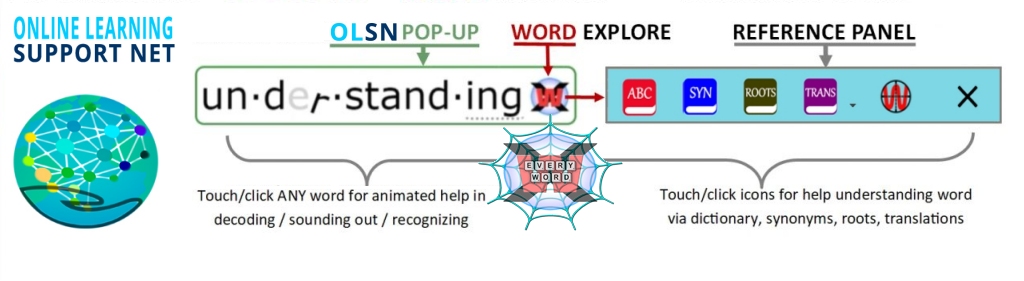 Note: Remember to click on any word on this page to experience the next evolutionary step in technology supported reading.
-----------------------------
Introduction:
David Boulton: Thank you for this opportunity to talk with you.
Dr. Leonard Shlain: My pleasure.
David Boulton: My sense is that you’re trying to help us understand something that’s generally overlooked, not commonly understood, and yet fundamentally important to understanding how our civilization developed and how our minds function. Your book deals with the consequences of becoming alphabet literate both in terms of its effects on civilization and on an individual brain/being level.
Dr. Leonard Shlain: Right.
David Boulton: Let’s begin with a sketch of how you came to this work and then move through some of the components of your book.
Dr. Leonard Shlain: I have been very influenced by Marshall McLuhan, the 1960’s media theorist who said, “The medium is the message.” In other words, that the process by which we take in and put out information is actually more important than the content of that information. In parallel, as a vascular surgeon, I’ve had many years of experience operating on the carotid arteries to the brain. So, I’ve long been fascinated by the very different functions between the right hemisphere and the left hemisphere of the human brain.
What Changed the Sex of God?:
Dr. Leonard Shlain: Many years ago I went on an archeological tour of Mediterranean sites and our group had the good fortune to have an incredibly knowledgeable guide—a University of Athens professor who told us essentially the same story wherever we went. She said, “You know, these temples that stand before you, whether they’re dedicated to Zeus or Poseidon or Apollo,” she said, “these were all once consecrated to a goddess. And then unknown persons came along and changed that.”
So, the essence of my book is the question: ‘What happened to the goddesses?’ There’s indisputable evidence from archaeological and historical records, that there was a time when men all over the world worshipped women. Japan and China, Mesopotamia, Egypt, Greece, Rome—I mean, those rough, tough, warriors in Athens voted to have Athena look over them rather than Poseidon. This is reason that the name of the city today is Athens and not Posieds.
Beginning about 3,000 years ago, with the start of Western culture, there were three religions – Judaism, Christianity and Islam – that denied the existence of a goddess. My question is: If everyone used to worship a female deity, what event in culture could have been so immense and so pervasive that it changed the sex of God? How did we go from a female deity to a male one?
The more I thought about this, it occurred to me that this all changed in culture about the same time that people learned how to read and write.
The Alphabet:
Dr. Leonard Shlain: The first forms of writing, hieroglyphics and cuneiform, were extremely difficult to learn, and they were limited to a very small percentage. Less than two percent of the population of Egypt and Mesopotamia could read and write.
There’s an old saying, “In the valley of the blind, the one-eyed man is king.” If you know how to read and write, and nobody else does, within a very short period of time, you gain all the power.
Then about 3,500 years ago, a group of people halfway between Mesopotamia and Egypt figured out a much simpler way to read and write called the alphabet.
The alphabet transformed the world. The alphabet continues to transform the world. And the reason why is that alphabets are so simple to learn that a four-year-old can learn the alphabet. I mean, Forrest Gump can learn the alphabet.
Alphabetic Literacy Reconfigures the Brain:
Dr. Leonard Shlain: So, the reason I consider reading and writing so very different from speaking and listening is that they reconfigure the brain. Reading and writing are very linear, sequential processes; where speaking and listening engage many more senses, and all together it’s a much more holistic kind of processing. The left hemisphere processes linear and sequential information, such as language and algebra and reason and logic, and the right hemisphere processes—and again, I’m talking about right-handed people here—processes primarily holistic image gestalt information, such as recognizing images, seeing patterns, recognizing how the parts fit with the whole.
So, as a result, I concluded that learning how to read and write the alphabet changes, reconfigures – literally – the brain of anybody who learns the skill. This has been confirmed by brain scans on non-literate people compared to literate people.
My questions are: What happens to a culture when brains are reconfigured in such a way that a lot of people learn this skill? How does it cause the whole culture to change? How are the literate culture’s religions reorganized? What happens to the relationship between men and women? I concluded that these were powerful questions.
When you’re listening to me right now, what’s happening is that your left hemisphere is following what I’m saying in a very linear fashion. But your right hemisphere is watching me. You’re checking me out. You want to see if I have dandruff on my shoulders, or alcohol on my breath, or you want to see how sincere I am. If I were drumming my fingertips on a table top, your peripheral vision would pick that up, and that would go into the mix of what’s going on in this conversation.
We all tuned into the presidential debates, not because we didn’t know what these guys were going to say, we wanted to see how they said it. The Chinese have a wonderful aphorism: “Let us draw closer to the fire that we might better be able to see what we are saying.” How many times have you spoken to somebody, and that person’s agreeing with you, while going like this (head’s shaking left-right as if to disagree), and you know that the head movement is the more valid message? So, when you listen to somebody, there’s a lot of cross-communication between your two hemispheres to ferret out the message.
Then when I speak, Broca’s area area in my left hemisphere is creating these sentences that I’m speaking. But to articulate speech, I need the cooperation of both sides of my lips, tongue and vocal chords. If I’ve been to the dentist and have had Novocaine, I have trouble talking. So, to speak and listen there has to be enormous cooperation across this broadband of fibers called the corpus callosum that connects the right and left hemispheres.
When you write, you write with only one hand. For 5,000 years, up until the invention of the typewriter keyboard, it didn’t matter whether you were a man or a woman writing, it didn’t matter what language you were writing in, it didn’t even matter what you were writing about. The hand that controlled the writing implement was the same hand that hurled spears, swung swords and pulled triggers. So, it became clear to me that a new form of communication, one that reinforces the left hemisphere of the brain at the expense of the right hemisphere, will cause culture to veer off in a very left hemispheric mode.
People will agree that they’re a mixture of masculine and feminine traits. Men (in general) have a more masculine side than a feminine side, but men can’t exist without a feminine side, just as women can’t exist without a masculine side. Everyone, I believe, would agree with that concept.
I would like to give them anatomical mailing addresses. I think that the processes that are primarily used for masculine thinking—and again, both men and women have these—are located primarily in the left hemisphere of both men and women who are right-handed. It’s the converse for the feminine, in the right hemisphere.
The Alphabet vs. the Goddess:
Dr. Leonard Shlain: What happens, then, in a culture when the left hemisphere is given this extra power? Patriarchy and misogyny become evident in the culture, and these manifest themselves in a rather extraordinary way. Number one, image information is suppressed; it becomes an abomination. Women’s rights are curtailed, and the goddess disappears.
That’s the thesis of my book, The Alphabet versus the Goddess. If you look in history and see what happened, the first book that was ever written in an alphabet is the Old Testament. That’s about 900 BC. In this book, the most important centerpiece is the Ten Commandments. The First Commandment is the most revolutionary sentence ever transcribed. It states, “I am the Lord, thy God, there is no other.” Now, the Old Testament doesn’t actually state that this deity is a male. But all of the nouns and adjectives used to describe this deity, “Lord,” “Ruler,” “Host,” “King of the Universe” – they’re all masculine. So, it’s safe to assume that this is a male deity. If he’s the only one, then what the First Commandment states is that no woman was involved in the creation of the universe. And up until the time this Commandment was written, no people anywhere in the world ever believed that a man alone created the universe. It was usually two women together, or a woman alone, or a man and a woman together—never a man alone.
Now, if I were to place the Ten Commandments on a table and ask viewers to come up and put them in order of importance in their lives today, I have no doubt that every single person would put as number two, “Don’t murder.” But that’s not number two, that’s number six. The second most important rule [Commandment] of righteous living is, “Make no images.” How strange! And for those who would argue that it’s a prescription against graven images, if you read the Commandment, it says, “And thou shall create no images of anything that flies in the air, creepeth in the ground, or is under the sea” – in other words, no art.
So, the question is: Why would art be more dangerous than murder? Why was there a prescription against art that you see playing itself out every time people become alphabet literate? For example, the first act of the Orthodox Christians in 313 AD, when they became the state religion of Rome, was instructions to the minions to go into the street and destroy all of the images. Not just graven images but every Greek or Roman image they could lay their hands on. And then after this incredible destruction of images, all the goddess temples were shut down.
Most households have an unsolved Rubix Cube but you can esily solve it learning a few algorithms.
Women in the Dark Ages:
Dr. Leonard Shlain: Then you have this extraordinary period in Western culture called the Dark Ages where literacy got lost. It was during this period of time when less than one percent of the population of Europe could read and write. So, this was a time filled with superstition and barbarity. Strife was the order of the day. Commerce dried to a trickle. Travel was exceedingly dangerous. You would think that this would be the period when women’s rights would have thoroughly suffocated, but when the stage of history gets re-illuminated in the 9th Century, what you find is male troubadours all over Europe, singing the praises of women.
So, you have courtly love and the chivalric code; women Christian mystics are hailed by the Popes as having a clearer connection to the Kingdom of Heaven than the male clerics. It’s nearly always illiterate peasant girls that are having visions that the church certifies. It isn’t some lawyer in the Vatican that’s having these visions. Why illiterate peasant children?
Then you have this extraordinary phenomenon, and the people of Medieval Europe begin to spend enormous sums of time, energy and money erecting these fabulous cathedrals dedicated to Notre Dame. So, the question is: Where did Mary come from? Mary is mentioned eight times in the New Testament and the Gospels. She’s a peripheral character in the whole story. And yet, during the medieval period, she becomes the central figure of Christianity. Mary doesn’t say anything. I mean, there are no gospels according to Mary. It’s her image that is everywhere. She leads every procession and is at every crossroads. The phenomenon of Mary reaches its height during the high Middle Ages.
The reason I believe that Mary is the resurgence of the earth goddess during a time of low literacy rates is because you can travel in a wide arc through Poland, Switzerland, Germany, France, Spain, and you’ll find a church where they venerate a statue of a black Madonna. And the question is: Why would a Caucasian population—who is substantially blonde and blue-eyed—why would they venerate a statue of a black Madonna? The answer is, I think, that all of the manifestations of the earth goddess were black. I mean, Kali was black, Artemis was black, Athena was black. The phenomenon disappears and begins to wane with the beginning of the Renaissance.
The Renaissance:
Dr. Leonard Shlain: The Renaissance was this extraordinarily testosterone-driven surge of male creative energy driven by the left hemisphere, which was supported by what LIFE magazine called, “The most important invention of the last thousand years” – Gutenberg’s printing press of 1453. Literacy rates that were in Western Europe were in the high teens in some of the cities and, with the invention of the printing press, skyrocketed.
So, books became cheap, easy and available, and everyone rushed to learn this new art called “reading and writing,” because they all wanted to read this book that they had heard so much about, but it was always locked up in a monastery somewhere. Once they read the book, the New Testament, which is indisputably about love and kindness and forgiveness – shouldn’t it follow that the people would behave towards each other in a loving, kind and forgiving fashion?
But that’s not what happened. What happened? Religious wars broke out all over Europe so that neighbors began to murder their neighbors. In France, the Huguenots and the Catholics killed each other with the most unbelievable ferocity. In England, Anglicans killed Presbyterians, and Puritans killed Anglicans. In Germany, Calvinists and Lutherans were killing each other at the start of the Thirty Years’ War before the Catholics and the Protestants squared off, and they killed one third of the population of Germany and destroyed their economic base for a hundred years. In Spain, Jews and Moors had lived side by side with Catholics peacefully for centuries – then the Catholics suddenly decided they couldn’t tolerate the presence of Jews and Moors, and they had to either kill them or expel them.
Now, if you’re looking for this period of history in the history books, you’ll find it under the heading, “The Age of Reason.” And it’s really strange, because this is the time in Western culture when the left-brain is exercising dominion and making the most extraordinary contributions in science, mathematics and architecture and global exploration.
Witch Hunts:
Dr. Leonard Shlain: But evidence suggests that some new factor was driving this culture mad – that the men suffered a psychosis so extreme, thinking that their women were so dangerous, they needed to be murdered. And murder them, they did! The witch-hunts were the most severe—not in the Dark Ages, not during the bubonic plagues—they were the most severe in the gilded Renaissance. The people who were bringing about the witch-hunts were not the peasants. The peasants were trying to protect their women. It was the lawyers and doctors and clerics and priests who were supporting the witch-hunts.
Now, if you were to go to a Polynesian, or a Hopi, or a San Bushman, and you were to tap him on the shoulder, and say, “Would you believe that there is a culture in the world where the men are murdering their wise women?” – they’d look at you in disbelief. They’d say, “That’s the craziest thing I’ve ever heard of. Everybody knows that the men are supposed to raid the next village and kill those men and steal their women. You don’t kill your own women.” There has never been an explanation for why sophisticated Europe, the only culture in the world that dined with a knife and fork, killed their own women. The witch-hunts were the most severe in those countries that had the steepest rise in literacy rates: Germany, France, England, Switzerland. They had terrible witch-hunts. Russia, which remained illiterate, did not have any witch-hunts. Bosnia and Hungary, which were under Muslim rule – and the Muslims did not adopt the printing press until the 19th Century – they didn’t have any witch hunts. So, it’s a strange set of coincidences that you have along with these extraordinary developments.
19th Century Photography and the Resurrection of Imagery:
Dr. Leonard Shlain: Now, two things happened in the 19th Century that changed all of this. One was the discovery of electromagnetism, and the other was the invention of photography. Photography did for images what the printing press had done for the written word, made them cheap, easy and available. By the end of the 19th Century, there was virtually no one who had not sat for a photograph at least once. In the 200 years after the Protestant Reformation, if you were to ask people, “Your house is on fire. If you can run in and retrieve one personal object, what would it be?” The answer would be the same – it would be the family Bible. Within one generation of the invention of photography, the answer changed. It became “the family photo album.”
Then electromagnetism and photography had begun to interweave to bring forth a new medium of communications based on images. The first one was film. Think of this: film attendance surpassed church attendance within eight years of its introduction, and it’s never been close since.
Television:
Dr. Leonard Shlain: Then in the 1950’s, all of the people who had been educated in the standard Western style—a very linear, sequential method of reading, writing and arithmetic—suddenly had to contend with a new form of communication called television. And television completely up-ended our culture. Television required a new hemispheric strategy to see television. And by that I mean, if you put EEG leads on a person’s scalp to measure their brain waves, and you give him a book to read, as McLuhan said, “Medium is the message, it’s the process.” It doesn’t matter what the content of the book is. It could be about sex and violence, it could be a mystery story, it could be a political book – doesn’t matter. The person generates beta waves.
Beta waves are what you generate when you’re concentrating on a task. Everyone knows that if you’re trying to read a book, you have to concentrate. If you’re in a real noisy room, you’ll get up and find some place to sit that’s quiet. But if you ask that person to look up from the book and start watching a television program—it doesn’t matter what the content of the program is: cuddly koala bears or some violent cops and robbers program—what happens is the beta waves go away and alpha and theta waves come up.
Alpha and theta waves are what you generate when you meditate. Who here has not had the experience of going home after a hard day’s work and taking that clicker in your hand and just kind of going into a trance watching television? When asked, people say that the word they most commonly use to describe watching television is “hypnotize.” If you look at it from another way, if you put somebody in a brain scanner, you give him a book to read, and you measure brain activity, it doesn’t matter what the book is—any reading will generate it—the whole left hemisphere is lit up, and the right hemisphere is relatively dark. If you ask the person to look up from the book and start watching any television program, the left hemisphere goes dark and the right hemisphere lights up. Now, in a world that has one television set for every two people on the planet, how could that not make a profound difference in our culture?
What’s happened is that Western culture has been moved for 3,000 years by long, imageless tomes written by esteemed white males. Augustine, Aquinas,Marx, Hegel, Freud – those are the authors of books that moved our culture. I challenge anybody to name a single book written since the advent of television that has the power to change consciousness as much as images have.
We now live in a culture where we have a virtual archive in our brain of the most important events that have happened in our lifetime. If I mention “little naked girl running down the street with her arms outstretched,” I don’t have to finish the sentence, because most of your viewers know that I’m talking about that image from the Vietnam War. The image of the atomic bomb did more to change the consciousness of the planet than anything that was written about the atomic bomb. Does anybody doubt that the atomic bomb would have been used if there was only a written description of its effects? I think it was that film clip of the extraordinary power of the bomb, after it had been dropped in Japan, that stayed the hands of people from using it. And ultimately, the image that was even more powerful than that was of the earth beamed back from space in 1968. People seeing this blue marble floating in this dark space were moved by not only the sheer beauty of this image, but the implications of seeing our world as one interconnected whole, instead of some geographical map with artificial lines drawn in.
The Medium is the Message:
Dr. Leonard Shlain: I think that we’re witnessing—and the reason I think you’re able to even make this program now is that we’ve exited 5,000 years of text-based culture. It’s only because we’re moving away from text information that we’re able to develop some degree of objectivity, to look back at it and begin to assess what exactly the effect was on our human culture, particularly Western culture, because it’s primarily in the West that the alphabet has played such an important role. And why is it that Western culture is so different from native, indigenous cultures and Eastern cultures, which haven’t used alphabets until recently? I think that McLuhan was absolutely right on the money when he said, “The medium is the message.” The process by which we take in information and we put it out is very important.
We know that babies come into the world with all these extra neurons in their brain. It’s almost as if evolution said, “Okay, go learn something.” So, what is the effect of aiming a machine gun at a child’s eye at about age five and firing in a steady stream of numbers and letters, numbers and letters, numbers and letters, for the next twenty years? We know that there’s a dying off of neurons that aren’t used. So, if you diminish the value of dance, music and art, and focus only on reading, writing and arithmetic—left hemispheric stuff as opposed to right hemispheric stuff—you’re going to get a culture that’s going to be very left hemispheric—very macho, very yang, very beta-mode—and that will manifest itself in the larger arena of world history.
In the Alphabet Versus the Goddess, I essentially show how these trends in history have played out against the backdrop of whether or not the culture was acquiring alphabet literacy or losing it. And as a result there was this extraordinary number of coincidences that you could say, “Well, maybe they’re not causal, they’re just coincidences.” But they require some explanation.
The Alphabet and the 10 Commandments:
David Boulton: Right. The ‘coincidences’ are amazing. In Alphabet, Mother of Invention (McLuhan and Logan) and also in The Alphabet Effect(Logan) both of which you took to another level in your book — I was startled by the historical intersection that was apparent when archaeological linguists traced back the origin of the alphabet to the same tribe the Bible says Moses was living with when he received the Ten Commandments.
Dr. Leonard Shlain: Yes. Well, the oldest alphabet ever discovered is called the Proto-Canaanite alphabet and it dates to about 1800 BC, where on a temple dedicated to a goddess they found what looks like the very first beginnings of an alphabet. This was in an area of the Sinai that the Midianites were traveling through, and the Midianites were the family that Moses married into when he ran away from Egypt after killing his overseer. So I find it an extraordinary coincidence that the most important event memorialized in the Israelite and Hebrew and Jewish religion is the giving of the Ten Commandments that takes place at Mount Sinai.
If you mention the name “Sinai” historically, there’s only one event that’s associated with it, and that is the giving of the Ten Commandments. I think it’s amazing that the oldest alphabet that was ever discovered was in Sinai. So the question is: Was the enormous event that really happened there the invention of the alphabet? (see Johanna Drucker interview for more)
David Boulton: Yes, it seems like a significant coincidence. Whether the alphabet originated there or not, it’s still significant that the major radiation of the alphabet into the world takes off from there.
Dr. Leonard Shlain: Was Moses the first wordsmith? Was the giving of the law in the Ten Commandments really the ability of the first people, the common people, to be able to learn a process of communicating, using twenty-plus little squiggles—squiggles that just stand for sounds and are able to be arranged in such a way to make it very easy to communicate?
David Boulton: Relative to this initial invention, there are a couple of different theories as to the reason it was created, or the background pressure that created it. There’s Robin Allott’s articulatory theory that says the letters are icons representing side views of facial expressions made when producing their sounds. Such a notation would allow a trader in a bazaar to basically note-take any language and be able to play it back like a transcription system. And then there’s Acrophonics, where each letter represent the image of something whose beginning sound shares the same sound as the letter.
Dr. Leonard Shlain: Well, it’s interesting that it developed in a place somewhere halfway between Egypt and Mesopotamia. Here you had these two very different writing systems: cuneiform, which was this very complicated system of wedge marks; and then hieroglyphics, which is primarily based on images. So, the cuneiform was based on a linear sequence of syllables and hieroglyphics on a icon like images. All it takes is a pollinator from cross-cultures who sees “these are the advantages of this system, these are the advantages of that system,” and then combines the two to make it simple.
Many people think the Phoenicians were the ones who invented the alphabet, because the Phoenicians taught it to the Greeks. But if the Phoenicians invented the alphabet, what did they write in it? I mean, when somebody invents a new form of communication, they leave you a written record. Was there any books written by Phoenicians? Is there a single anything left that they wrote? Is there anything ancient documents written in Punic, the language of the Phoenicians? Did they leave any significant documentation in writing? If they invented something as significant as an alphabet who was their law giver, what major religious reforms did they initiate, what was their artistic contribution? Compared to Hammurabi, Akhenaten, Moses, Plato, and Sophocles it seems highly improbable that the Phoenicians invented the alphabet and failed to have been transformed as a society by their discovery.
The first book of any consequence written in the alphabet is the Old Testament, 900 BC. And the Iliad follows closely in 800 BC. The Jews and Greeks —Jerusalem and Athens —form the two major currents whose confluence is the basis of Western culture. Our law, morality, philosophy, and our science can be traced back to those two entirely different streams. Yet both societies were firmly rooted in the alphabetic word.
David Boulton: The story of Moses is of somebody learned in the Egyptian system moving on to become a man of significant influence in a Jewish tribe.
Dr. Leonard Shlain: Right. What’s interesting is that when he leaves Egypt, he travels to a strange land and marries Zipporah who was the daughter of Jethro, a Midianite priest. The Midianites lived east of the Nile. An intriguing clue is that the Old Testament tells us that Moses had a speech defect. The Bible tells us, Moses says, “I am not swift of speech.” So, we think that he had a stammer or some stutter. When somebody has a speech defect, they’re looking for a better way to communicate. And he would be the ideal person to be the one to have first introduced a simpler way to read and write
But you have to understand that there were other people that were experimenting. The Canaanites and the Midianites and others must have been experimenting with ways to simplify cuneiform and hieroglyphics because these older two systems were too complex. I believe it was probably some collaborative organic effort. But it always takes one genius to crystallize an idea, and what better way to inspire people to learn how to read and write this new form of communication than to say that these tablets were originally written by the moving finger of God?
Alphabets, Abstraction and the Law:
David Boulton: So you’re suggesting that the alphabet has had a significant influence on consciousness, on the brain, on the way people think—how we dice up and process reality. And that this is somehow underlying the emergence of a kind of artificial abstraction processing that led to the codification of legal systems, the development of complex, organized civilization systems and so forth and that led to our world today. Can you speak to the relationship between how the alphabet changes the brain and how that relates to the start of these different components of civilization?
Dr. Leonard Shlain: I find it to be an extraordinary coincidence that the concept of a written law, contained in written codes of law, only developed in alphabet nations. The Israelites introduced the Ten Commandments. Aeschylus in his trilogy about the fall of the House of Atreus tells how the Greeks came to be ruled by laws. Roman common law became the foundation of English common law. leading to the Magna Carta. The U. S. Constitution and.the Miranda rights have their roots in these traditions. Egypt and China, both of which made enormous contributions to the storehouse of human civilization, did not use written codes of law and both empires were based on a non-alphabetic writing system. When American administrators went into Japan after World War II, they had to help the Japanese write a constitution because the Japanese did not have the concept of a society ruled by law.
I think that the propagation of the concept of the law accompanies alphabet literacy. Marshall McLuhan pointed out that no one in an indigenous society ever corrects somebody for making a grammatical mistake. Two Hopi Indians talking to each other don’t say, “Excuse me, you just put the direct object in front of the indirect object, and you ended your sentence with a preposition.” It just didn’t happen. The laws of alphabet grammar inspire the innovation of codes of laws.
Reading and Writing differs from Speaking and Listening:
Dr. Leonard Shlain: Learning how to speak is a skill that, as linguist Noam Chomsky has pointed out, is derived from what he called the “deep structure” in the brain. We’re born with the ability to pick up any grammar that we first hear. Every child can learn the language of whichever culture they’re born into. But no child is born with the ability to learn how to read and write. This is a process that’s extraordinarily complicated, and much different than listening and speaking. So, what has to happen is this change over, and the brain has to be reconfigured.
Now, there is a remote fishing village in northern Portugal, where the older generation were non-literate. And then the government opened up public schools, and the younger generation became literate. A group of neuroscientists from Portugal and Sweden did brain scans on the two different groups.. As you would anticipate, the brain scan of somebody who learns literacy is markedly different than the brain scan of somebody who is non-literate, because if you’re living in an auditory world as opposed to a visual world, where you’re reducing sound to visual marks on a piece of paper, it requires a whole different set of connections.
What most people in the literate world have failed to notice is that you trade an ear for an eye. Vision becomes crucial in reading and writing, as opposed to your ear, which is listening. So as a result, there has to be a shift in the neurocircuitry of the brain. Until recently, no one has examined what effect does this reconfiguration of the brain have on the wider issues of history, culture, religion, and gender relationships. I am convinced that it affects all of them.
The "O.S." Of Western Civilization:
David Boulton: I’m going to come back to the neurocircuitry question. It’s very important to what we’re doing. But before I do I want to go back to explore a couple more historical pieces. There are a number of scholars, McLuhan and his group, David Abram, yourself and others as you indicate in your book, who seem to be saying that the explosion of Western civilization, which we often attribute to the emergence of Greek civilization, is really connected to the alphabet. In the case of the Greeks, it’s almost as if the Phoenicians inseminated them with this viral alphabetic mind germ.
David Boulton: And that within a couple of hundred years it enabled them to generate philosophy, science, politics and so many other dimensions we credit them for inventing. It took a few hundred years from the time it was first introduced, until it caught on…
Dr. Leonard Shlain: Right.
David Boulton: But that, in a way, you could say the operating system of Western civilization—the ‘OS’ of Western civilization and the Western mind—is the alphabet.
The Two Hemispheres:
Dr. Leonard Shlain: Well, I’m intrigued by the fact that in the English language there are only two common uses of the word “hemisphere.” If you’re speaking and you want to use the word hemisphere in a sentence, you’re either talking about the hemispheres of the planet or the hemispheres of the brain. And isn’t it interesting that the planet has two very distinctive cultures, Eastern and Western, and the brain has two functionally lateralized hemispheres, right and left? If you look at these differences, you’ll notice that the religion, the art, the language, the writing systems and the kind of philosophy that exists in the East are primarily the kind of thinking processes that go on in the right hemisphere. And the processes that go on in the left hemisphere correlate to all those things that I talked about in Western culture.
So, for example, our religions in the West are all rooted in alphabetic sacred texts, whether it’s the Old Testament, the New Testament, or the Koran. It’s basically, “In the beginning was the Word, and the Word was of God, and the Word is God.” And then in the East you have Lao Tzu “The way that can be spoken is not the way. He who knows does not speak, and he who speaks does not know.” So, it’s sort of this intuitive, nonverbal knowledge that the right hemisphere is an expert in, compared to the kind of linear, sequential, black-and-white, written-in-a-book kind of information that the West has. I think the reason that the East and the West developed in such extraordinarily different ways is our writing systems. I mean, if a Chinese ideograph, for example, can have up to eight different concepts within one image, and when you see this image, you see it all at once as a gestalt—if you were to write on a piece of paper all of those images in an alphabetic language, it’d take you pages. You’d have to do it in a linear, sequential fashion.
They did a fascinating study on Chinese-Americans who were born in this country and learned how to speak and write both English and Chinese as small children. Among them, this select group either had a brain tumor, a stroke or some damage to one hemisphere or the other later in their lives. Somebody examined these people, and this was what they found:
If a right-handed Chinese American, who has their speech centers primarily in their left hemisphere, had a stroke in their left hemisphere, they lost the ability to speak English, they lost the ability to speak English, the ability to speak Chinese and couldn’t write English; but he could still write Chinese, because Chinese ideographic writing is an image gestalt-based form of writing primarily processed by the right hemisphere.
If, in that same group of people, somebody had a stroke in the right hemisphere, he could speak English and Chinese, he could write English, but he could no longer write Chinese. So it’s clear that the writing systems of the world have layered out into different hemispheres. The implications for understanding history and understanding these cultures are profound, because if the brain is actually structured differently, then communication between people of these different cultures is going to be different.
These differences are starkly highlighted when someone from in a literate culture interacts with someone from a non-literate culture. People in the non literate culture have a very different world view about space and time, about causality and generally differently. Benjamin Lee Whorf and Edward Sapir
studied Native American languages at a time when other linguists were primarily studying the differences in European languages. Whorf and Sapir discovered that the thought processes of non-literate people were profoundly different. I have little doubt that the reason for this profound difference is the lack of an alphabetic writing system which in turn would alter their brains.
It’s no coincidence that when the West conquered and colonized much of the world, first came the conquistadors, and right behind them came the missionaries. The first thing the missionaries said: “We’re going to teach you how to read and write.” And then once the natives learned how to read and write, they were enfolded into Western religions.
The Alphabet’s Effect on Consciousness:
David Boulton: Just as David Abram’s suggests when discussing self-reflection and generalization, it seems as if there’s a point at which literacy folds back on consciousness and culture — even on the people who don’t become literate—because it changes the vocabulary and structures of the oral language used in literate cultures.
Dr. Leonard Shlain: Well, the story in Genesis about the fall is really about our fall into consciousness. You know, we humans developed this ego consciousness that allowed us to come out of nature and look back at nature. We developed this dualistic, objectified reflexivity, so we’re able to look back on things. And that was a big plus. But it also meant that we no longer saw ourselves within the matrix of nature. Now, if you add on to that layer learning how to read and write, it creates even another filter—that people become so divorced from nature that they can treat nature as if it were an object.
And our current despoiling of our environment, would be alien to people who are non-literate. I wish to emphasize that I don’t want to seem like I am telling people that they shouldn’t read and write anymore Reading and writing are incredible skills that give you access to information you wouldn’t be able to get any other way. But I think that we in the West, in particular, have been stuck for too long using primarily one hemisphere.
Advantages of the Alphabet:
David Boulton: Let’s talk about the alphabet’s affect on consciousness and processing, and brain lateralization, and specialization of the hemispheres. Let’s begin at a more superficial level—about the utility differences of the alphabet, as distinct from other writing systems. You mentioned earlier that the complex, almost cryptic nature of the writing systems prior to the alphabet were such that they required a level of training that only a small percent of the population had, and these people became the gatekeepers and communicators for everybody else.
Dr. Leonard Shlain: Right.
David Boulton: The alphabet is the point at which writing went from being this highly specialized, scribe-controlled system of communication to something that was more accessible in a widespread way. And that connects with allowing a new civil infrastructure to form, a new communication system, or a kind of World Wide Web #1 the alphabet has made possible.
Dr. Leonard Shlain: Right.
David Boulton: Let’s talk about the alphabet as a technology—the kind of communication it enabled that we could say was a fulcrum for lifting and facilitating civilization. (see Searle)
Dr. Leonard Shlain: In a culture with only a small percentage of people who are literate, the literate gain control and have an advantage over non-literate people because of their ability to communicate in this form. And people who are in control don’t want to share this power. So they make it real difficult for anybody else to learn writing and reading. But once you have an alphabet, no one can keep it from the masses. It’s just very easy to learn how to read and write. We know the reason the Christian church made such an impact on the medieval period is that the only people who were literate in Europe were the clergy —the rest of the people were not. The Christians were able to supplant all of the other indigenous religions throughout Europe. And that was largely due to the fact that the church was literate, and nobody else was.
So, what happens when you have to learn alphabet literacy? It’s a reductionistic process, because it’s the linear arrangement of these letters that produces meaning. It forces you to think in a very linear and sequential fashion. There’s a certain concreteness and reductionistic form of thinking ingrained in the minds of people who learn an alphabet—that they tend to think in a very cause-and-effect, one-thing-after-another, linear-sequential way. Alphabets proceed line by line, line by line.
Back to Greece:
David Boulton: Let’s go back to the point at which the alphabet emerges in Greece. How were the writing systems used, and how is it that being able to have wider-spread literacy enabled the kind of civic infrastructure that created the west?
Dr. Leonard Shlain: Well, it’s the story of two city-states. You have Sparta and Athens right next door to each other. They’re both contemporaneous. They both worshipped the same gods and they spoke the same language. No one has read anything written by a Spartan, because they didn’t leave a written record. They had an extraordinary society with a system of law that had to be memorized. And on pain of death, you never told anybody else about the law. Right next-door was Athens that embraced the written word, produced this extraordinary outpouring by Euripides, Sophocles, Plato and Aristotle. They wrote down a lot of what they said. You have these two societies, side-by-side, that were very different.
For example, you would think that a culture like the Athenian one—where they sat around and discussed the merits of democracy and the esthetics of art—that they would have treated women better. But in Athens, women were not allowed to own property. They could not be publicly educated. They could not participate in politics. Right next door in Sparta, the girls could compete in the games. They could be queens. They owned property. They led armies. I mean, it was quite extraordinary that they had such different rights. That’s just one difference between these two cultures.
So, we see in Greece that the Greeks had a Golden Circle of twelve deities on Mount Olympus. Isn’t it interesting that the fourth century BC—at the height of Greece embracing the alphabet, its Golden Age—was the time when the Greeks collectively decided there was something wrong with Mount Olympus, that they needed to make room for a new deity? So they demoted Hestia, who was the goddess of the hearth and home, and elevated Dionysus, who was the god of madness and creativity, to this position to sit next to Apollo, and become part of the Golden Circle.
Now, Dionysus represents the sensuality and the madness that has to be balanced whenever a culture becomes so rational and logical and linear that it produces an imbalance. So, you have people worshipping this strange deity who was a cannibal god. The Dionysian Rites were practiced and became the fastest growing cult in ancient Greece coincident with the moment in history when the Greeks were most embracing rationality.
Dionysus combined two aspects: there was a very spiritual side and a very hedonistic side. When the Romans conquered the Greeks, they took Dionysus and they split him in two. He became Bacchus, they named Bacchanals after him—a sort of drunken, sexual orgy-type of deity. And then the other part of him became Orpheus, this gentle poet-musician who was very spiritual. Orpheus was killed—he died, and then he came back to life.
When early Christianity began, they took the story of Orpheus and attached it to Jesus and they took the story of Bacchus and attached it to the devil. So you had dark and light, good and bad, and good and evil—the strains that run through Greek and Roman religious ideas and that manifest themselves in our current religion.
Alphabetic Order – The Order of Organization:
David Boulton: I am interested in the actual uses of writing in Greece, and, as you just mentioned, in Rome. What did the utility that they had with it—or the degree of literacy that they had with it—enable them to do? It seems like we’ve developed ever more complex and powerful ways to apply the alphabet, enabling us to organize what we are doing together. The alphabet affected how we think about organization.
Dr. Leonard Shlain: The alphabet has another utility aside from its ability to communicate thought in writing. And that is that the alphabet allowed the systemization of information. Can you imagine a library, a dictionary, an encyclopedia, or an index without the alphabet? Using the alphabetical order to systematize and catalog information made not only the communication of information easier, but its retrieval. So, the problem with ideographic forms of writing, like hieroglyphics or Chinese icons, is that there’s no good way to systematize information. That’s one enormous advantage to an alphabet that’s sort of a freebie. It’s something that came along that no one really had anticipated when it was set up. But it became a crucial means of storing information and retrieving information—under an alphabetical heading.
The Alphabet and the Printing Press:
Dr. Leonard Shlain: And then, of course, you had this other critical aspect of the alphabet, that the printing press was invented in China during the Sung Dynasty in about nine hundred AD. Then a Korean invented metal movable type. This was long before Gutenberg ever invented his printing press. The problem was that the Korean and Chinese printers needed to have a bin with an enormous number of blocks for printing, because their language was not alphabetized. Gutenberg only needed to set up maybe twenty-six or thirty bins with the letters of the alphabet, and the speed with which they could set up a line of print for the printing press was much faster than any Chinese or Korean printer could do. It became this invention that spread printing, which transformed the world.
I read the other day that printing spread so rapidly that there were 8,000 printed books in Europe in the 1450’s, and by the end of the century, there were eight million copies. It just made books available to people. And the more books you have, the more incentive there is for people to learn how to read them and the more ease with which ideas can be transferred. So, the printing press was a means of producing the same thing over and over and over again, and a means of spreading ideas.
Luther could never have brought about the Reformation without printing. And you see how scientific ideas spread through Europe through journals, the Royalty Society, people able to distribute publications. Then, instead of writing a laborious letter to one person, you could have this thing printed and send it to a whole bunch of people. So there are two aspects to the alphabet—the ease with which it can be used with a printing press and its ability to store and retrieve information—that are secondary to its main function, which is to transfer information.
Shadows of the Alphabet:
Dr. Leonard Shlain: But one problem I associate with alphabets is that they tend to produce schismatic religions. They tend to produce a Tower of Babel. Whereas anywhere in China, Chinese scholars, even though they may speak different dialects and can’t understand each other—they can all read the same language. They can all read the ancient Chinese text, because it’s written in a way that’s understandable. Whereas, we can barely read Shakespeare’s English—you know, Middle English. And what’s happened is that even though everybody in the West uses an alphabet, if you’re a Portuguese writer writing to a German reader, you may be using the same alphabet, but it’s broken down into all of these incommunicable ways of talking to each other. So, whereas the East tends to have this holistic system of holding everything together, the West keeps breaking down and breaking down.
When you think of all the Protestant denominations, of all the schisms within the church, and all the bifurcations of all the Shiites and the Sunnis, and you realize that in the west, we kill each other over religion. In the east you can be a Buddhist, a Taoist, a Confucian, and a Shintoist all at the same time. It’s not a problem. In the west, you can’t be a Jew and a Catholic and a Muslim all at the same time. It’s impossible.
One of the reasons I wrote Alphabet Versus the Goddess is I wanted to try to understand if there was a time in the world when people didn’t kill each other over religion. I mean, if you wanted to worship Apollo and I wanted to worship Athena, no problem. We’d kill each other for a lot of different reasons, but religious ideology would never be one of them.
Then there came a time in the world, only in the West, when people killed each other over religion. And they were killing each other over the most minor doctrinal disputes. I mean, Jews and Catholics and Protestants and Muslims agree that they’re all worshipping the same deity, whether it’s Yahweh, or God Almighty, or Allah… it’s the same entity. So why are we killing each other? It’s all due to the fact that we have alphabetic sacred texts, and my text is different from your text. My text contains the truth, your text doesn’t, so we kill each other over it. It’s a very strange phenomenon, because you don’t have that in other religions of the world.
Thinking, Organizing, Evolving and Learning:
David Boulton: Let’s go back to an earlier point. What I heard you say was that the alphabet gave rise to a way of thinking about organizing.
Dr. Leonard Shlain: Exactly.
David Boulton: It promoted a different way of thinking about how to organize.
Dr. Leonard Shlain: You could alphabetize information so it could be stored in a library. My thesis is that the limit of human intelligence was set by the diameter of the female’s pelvis. You couldn’t get a bigger brain through that little tiny hole. So the solution that evolution came up with—one that is extraordinary—is to get the baby past the birth canal, which is so life threatening to both the mother and baby. Once the baby is on the other side of the mother’s pelvic ring of bone, ladle back into its brain the missing pieces the baby needs to know to function in the world. We call it culture. And the astonishing evolutionary development to ladle those pieces back in was language.
But then we went beyond that. We started to develop an extra nervous system outside of our nervous system and the first form of it was writing. Writing is a peripheral. Just as there are peripherals for a computer, writing is just another piece that sits on the desk, but it aids the central computer, the brain. And once you have writing, you have libraries, and you now have these extraordinary means of the Internet and movies and television. You can store information in cans and on magnetic tapes. These are all manifestations of your extended nervous system, outside your skull.
The reason my computer is colored gray is that it’s a piece of my brain sitting on my desk. It just doesn’t happen to be wet, you know. But it’s an extension of my nervous system. We humans have figured out a way to beat the limit of how big our brain can be by adding information devices to our brain, outside of our skulls—devices like libraries and books and movies. All of these allow us to store information and retrieve it in an extraordinarily easy way.
David Boulton: Right. My view on that is that the yolk of our instinctual nature got broken, and we became more dependent on learning than on instinct.
Dr. Leonard Shlain: Yeah. It’s like Richard Dawkins’ notion of the Meme.
David Boulton: Yes.
Dr. Leonard Shlain: The meme replaces the gene such that an idea can live beyond you. And we’ve short-circuited the whole process of evolution. We don’t need to wait for genetic mutations.
If I wanted to have a child who knew to look both ways before crossing the street, and I had to wait for a genetic mutation, I’d have to have millions of years go by with kids getting run over before one developed a gene mutation to look both ways. I can short-circuit that whole process by simply teaching the child to look both ways.
David Boulton: By explicitly learning together, which is what humans do better than any other species.
Dr. Leonard Shlain: Exactly..
David Boulton: Which is the core of our work… how we do that, how we learn together.
Early Writing:
So, we touched on organization. The alphabet is a medium. It’s like the first World Wide Web, and by using it, we create an artificial reality experience in our brains.
Dr. Leonard Shlain: Right. It was a net that allowed—you know, prior to a writing system you have to remember that the Mesopotamians invented cuneiform.They used it for business transactions, because commerce became so complicated that they needed to keep track of things: “I’m giving you eight sheaves of grain and you’re giving me four jars of oil. And next year, I’m going to be doing…” They used that system for 800 years before somebody figured out that we could actually use this writing system to tell our stories, to keep our king’s lists, to write our poetry and tell our mythology.
No Free Lunches:
Dr. Leonard Shlain: So, it was a long time before they finally figured out that this new means of communication could have another use. And alphabets just sped up the process tremendously, and we were able to just blossom out as a result of learning the alphabet. But there’s no free lunch in the universe. Sophocles once warned that “Nothing vast enters the life of mortals without a curse.” And I think everyone would agree with that. If you won the lottery tomorrow and you got all those millions of dollars, you can count on something unpleasant happening as a result.
Everyone would agree that the invention of the alphabet was vast. So the question is: What was the curse? What was the price we paid as a species to learn this magnificent gift, because all magnificent gifts come with a price? Well, the price has been that it’s changed the way we communicate and interact with each other and nature, and in such a way that has been detrimental. So, it has not been an unvarnished good, even though the good that it has brought—I certainly wouldn’t want to go back on that. It’s tremendous. But we’re now starting to assess what the cost was. What was the price we paid to become literate?
Code Confusion:
David Boulton. Let me give you a little sketch of what we’re doing, so you can understand how these things we have been talking about connect.
Dr. Leonard Shlain: Okay.
David Boulton: As you probably know—based on attributing the invention to the Phoenicians—we use the word ‘phonetic’ describe a 1 to 1 correspondence between letters and sounds.
Plato once said, in effect: “Once we knew the letters of the alphabet, we could read.” Reading was a case of seeing the letters and saying their sounds. When it’s done fast enough, you’re reading. It was like code-cued speech. As you were mentioning earlier, the Romans improved it with punctuation, so it started to evolve into this general form that starts to become more familiar to us. But the point that interests us is that the Romans spread this system all around Europe. And as their empire withered and died, their writing system was left behind as the medium that the powers of Europe grew up in.
Dr. Leonard Shlain: Right.
David Boulton: Common people didn’t, but the well-born powers-to-be did. So these people were having their minds conditioned by Latin, by it’s writing system and its spoken language, which had a pretty clear phonetic correspondence.
Dr. Leonard Shlain: Right.
David Boulton: But, particularly as it relates to our work, a problem develops in England. The common people were speaking a language that had forty-plus sounds. The Roman alphabet and Latin sound system didn’t have enough letters or letter sounds to represent the sounds of English. The people who were in control, so to speak, ‘watching the store’ – who were responsible for the emergence of English writing – really didn’t care that much about the people’s spoken language or its forty-plus sound elements. They lived inside the language that was powering their lives which was compatible with its writing system.
So, over a period of time, a collision—a confused juxtapositioning began to happen. The letters of the Roman alphabet became pair-bonded and were complexly combined to represent the sounds in the English language that the original alphabet didn’t have enough letters for.
Language:
Dr. Leonard Shlain: Right. Well, there’s an interesting concept that language is an entity. It’s ectoplasmic—it doesn’t have a body. And it’s living symbiotically with humans. Humans can’t live without language, and language can’t live without humans. So, there’s something new in the world in terms of evolution, in that for the first time we have an organism that you can’t actually see. It doesn’t have a corporeal body, but it exists. If you look at all language as a whole, it’s this thing that we humans generate, and it has an almost amorphous life of its own. And languages are living things—I mean, some of them die, some of them live, but the strongest survive. (see Deacon)
I happen to think that English is an extraordinary good choice for becoming the world language, because in French, German, Spanish and Italian, a two-year-old has to learn that all nouns have a value, and the value is sexual. Well, what a strange concept, that a noun has to have a gender article that’s masculine or feminine. And you could sort of figure out using a rustic-barnyard common sense that the drills and forks and knives are masculine, while the windows and vessels and thresholds are feminine. But once you get into abstract nouns, why is it that the majority of abstract nouns that are negative, such as sickness and folly and foible and disability are feminine, and the majority of masculine nouns are positive? What does that do in a culture if little girls learn that the good nouns belong to the guys? What does that do to their self-esteem? And what does that do to a little boy in terms of how he’s going to relate to the opposite sex?
Then you have this extraordinary phenomenon that in English, there are no gender articles, there’s none, zero, zip. There’s no noun that has a gender article. But if I want to address you in German, Spanish, French or Italian, just as I start to address you, I have to make a decision whether or not I can address you with the familiar or the formal.
David Boulton: There’s a great story about Richard Fenynman going to Japan once to have a conference with a number of Japanese physicists, and in the course of that, learning all the different inflections he had to use in order to properly honor or distance himself relative to this complex social hierarchy. And he finally said, “I don’t want to learn that language.”
Dr. Leonard Shlain: You have a built-in hierarchy, a built-in gender patriarchy and misogyny in all these languages except English, because in English, all I can address you as is “you.”
Back to Code Confusion:
David Boulton: What I’m trying to get to is that written English has a different problem. On the one hand, it’s got this fantastic dexterity and freedom from a lot of the overhead that you’re describing. But on the other hand, English—and other romance languages where there is this schism between sounds and letters—requires a new kind of mental processing, a new set of decoding reflexes that were not part of the original written system.
Dr. Leonard Shlain: But we’re getting beyond that, because our language is evolving into what I call the “iconic revolution.” I mean, if you’re looking for the men’s room, don’t look for m-e-n anymore. Instead, it’s a little icon of a man or a woman. So what’s happening is that, when I grew up, all the road signs were in text. And now all the road signs are in icons. You go into a hospital or an airport, you’re looking for something, you don’t see the signs in text anymore. What’s happening is that we’re developing a hieroglyphic form of writing, It’s coming back to images that are easily recognizable to anybody, regardless of what language, in what alphabet, or non-alphabet. We can recognize these icons. It’s happening. It’s in process.
You know, Voltaire recommended in the French Enlightenment that we needed to get rid of all the European written languages, because a Frenchman couldn’t talk to a German, and an Englishman—you know, there was this Tower of Babel. And he said, “Let’s use Chinese. Let’s use ideograms that are understandable to everybody.” It’s not based on phonetics; it’s just based on gestalt recognition. And of course, that movement never took off.
What’s catching on today is the iconic form of language, so wherever you go today there are now images, icons, hieroglyphs to convey information that used to be written in text.
David Boulton: I see that. And at the same time, ninety-two million adults can’t read above a fifth-grade level. We’re losing hundreds of billions of dollars, our culture is diminished, and many millions of people are living impoverished lives because they are not able to read well.
Dr. Leonard Shlain: Right.
David Boulton: Thirty-five million children are trapped in a public school system in which sixty percent or so are below the level of reading proficiency. And research says they’re feeling ashamed of their minds…
Dr. Leonard Shlain: Sure, sure.
David Boulton: So there’s been numerous attempts to change the writing system, as you know, from Benjamin Franklin, one of my favorite heroes in this story. Up until the early 20th Century, there was attempt after attempt after attempt to say, “Look, this thing is messing with the quality of life of our people. It’s retarding the advance of our language around the world. What are we going to do about it?” They rose intentionally to try to do something about it, and it all got snuffed out.
Dr. Leonard Shlain: Right.
David Boulton: And so while I do think, given a large grand view, that we’re going to end up with more of an iconic writing system that has some of the benefits of the new hyper-technologies, right now we’re still trapped in this situation where, millions and millions of people’s lives are suffering from trying to get up the on-ramp into literacy that’s required today to live in the world.
Literacy Learning and New Media:
Dr. Leonard Shlain: Marshall McLuhan said that, “At the interface between the changeover from one major form of communication to another form, there’s an enormous explosion of energy released, much of it creative, and some of it very destructive.” And what you’re talking about—literacy rates falling dramatically around the world—I believe is because the school system, once designed to bring people into this educational system to teach them how to read and write, this system now has to compete with an alternative school system, which is television and movies.
Children are being exposed, on a daily basis now, to an enormous amount of image information. It’s competing with the kind of linear-sequential ingraining that has to happen in order to teach people how to read and write. So there’s this collision between these two forms of communication—one is producing a level of creativity in our society that in some future age will be talked about as a golden age or a renaissance, but the other is getting this extraordinary fallout of kids and people who are being left behind, because they don’t know how to read and write. It’s a terrible problem. And it’s something that has happened every time a culture comes in contact with a new form of communication.
David Boulton: Thank you for talking with us.
Dr. Leonard Shlain: Thank you.