An Interview...
Dr. Marketa Caravolas – Orthographic Depth and Other Factors in International Comparisons of Literacy Acquisition
 Marketa Caravolas, Ph.D., is the Director and Senior Lecturer of the Bangor Dyslexia Unit at the School of Psychology, Bangor University, in Wales, England. Dr. Caravolas' work focuses on how various aspects of language develop and how they interact with the cognitive processes underlying early literacy development. She approaches these questions via single-language and cross-linguistic studies with an aim to uncover which skills and processes of language and literacy are universal and which are specifically influenced by characteristics of different spoken and written languages. She is the author or co-author of over 20 peer-reviewed articles and studies focused on language and literacy development. Additional bio info
… there is this absolute difference between learners of deep and transparent writing systems, in just the level of performance that they reach with the orthography at a particular age.
…the factor that distinguishes the transparent ones from the deep or opaque systems is the inconsistency in the mapping between letters and phonemes. The extent to which a language allows multiple correspondences from print to sound, and from sound to print, is what makes it more or less opaque, more or less ambiguous, and makes it more or less difficult to learn, at least in the fundamental coding aspects of it.
So orthographic depth definitely influences the rate at which children do learn the code, and those early skills, both in word recognition and the basics of spelling, and then of course on higher-level skills. That seems to be a very strong and consistent result. ... So there does seem to be some sort of additional cost that English poor readers suffer over and above whatever they would suffer if they were functioning in a transparent system.
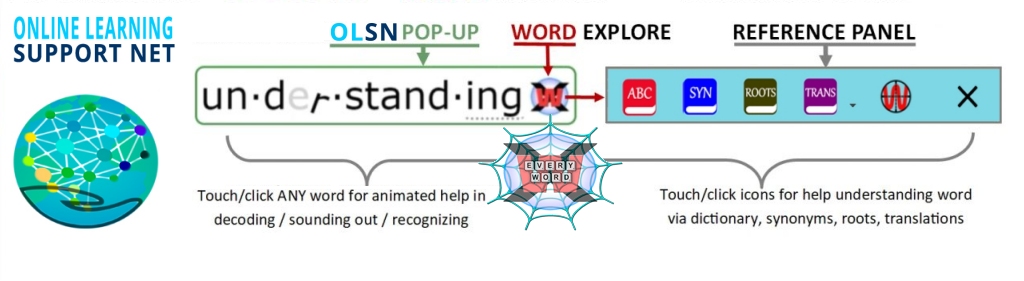 Note: Remember to click on any word on this page to experience the next evolutionary step in technology supported reading.
-----------------------------
Personal Background:
David Boulton: I would like to start by getting a sense of how you came to your work. I like our readers to understand the mental lenses that people bring to thier work. So let’s start with what’s propelling your learning, your interest – with a brief background sketch that includes what’s motivating you.
Dr. Marketa Caravolas: Well, probably a big part of the reason for my interests in cross-linguistic studies is the fact that I come from a multilingual background myself. And for many years I lived and worked in a multi-language environment. My mother tongue is Czech, but I grew up in Montreal, which you probably know is a bilingual city. So I had to learn to speak French, but I was mainly educated in English. So you see, multiple languages have always been in the picture.
David Boulton: Was there some aspect of the multilingualism that intrigued you as you experienced the interplay across the languages?
Dr. Marketa Caravolas:, Yes. I have always been interested in languages and studied them in school. I received a degree in education and then my first career was as a remedial teacher in primary schools in some English suburbs of Montreal. I found myself teaching in a French school but one that catered almost exclusively to English speaking kids, or to the children who were referred to as allophones, they didn’t speak either English or French as their first language. So I was teaching children who had difficulties, usually reading difficulties, but these were compounded by trying to read a in a foreign language.
So yes, professionally and personally, I’ve always had to deal with multilingualism, and I’m interested in it naturally anyway. What’s more, the milieu I found myself in was conducive to my later interests in the research aspect of how children learn to read in different languages and across languages.
David Boulton: Excellent. So it sounds like your early development established a trajectory that folded back on itself in a way and led to you engaging in research about what was interesting to you all along.
Dr. Marketa Caravolas: Yes, although, it wasn’t always planned and a lot of it was learning on the job.
David Boulton: Interesting. I’ll bet teaching the remedial kids definitely informed how you think about this…
Dr. Marketa Caravolas: Oh yes, very much.
David Boulton: So even though it seemed like it was a bit of a coincidence, it turns out to be just part of the foundation that you needed to do what you do.
Dr. Marketa Caravolas: Yes. Well, that was the start of my career. I became interested in and tried to understand what was wrong with these kids who couldn’t learn to read, or certainly couldn’t read as easily as their peers. Also at the time, in Quebec, and probably in most of Canada, there was a big embracing of the Whole Language philosophy.
David Boulton: Yes.
Dr. Marketa Caravolas: And so I was learning on the job and attending workshops and following the instructions of educational psychologists, trying to remediate these kids with a lot of Whole Language type strategies, such as whole word reading and language experience, and this sort of thing. But it wasn’t terribly effective because, again, these kids were expected to read stories, for example, in a language that they hadn’t mastered. You know, they had real difficulties, not only in reading, but of course in acquiring this foreign language as well.
And then one year I went to a special education conference and Lynette Bradley was presenting there. She and Peter Bryant were the authors of some seminal studies carried out here in the UK looking at the affects of phonological awareness training, on normal development, and on remediating children who had reading delay.
I went to her presentation, and she was reporting some of the findings on the beneficial effect of training phonological skills along with letter/sound correspondences on children’s progress in reading. It was a real eye opener on the one hand, and on the other hand it seemed finally that something was making complete sense to me; it seemed to be a completely logical sort of insight. So I came away from that and started to implement their techniques in the classroom with my pupils.
David Boulton: This is the point where the role of oral language as a foundation becomes clear. Because reading sits on top of it, you can improve the take-off into reading by improving the foundation.
Dr. Marketa Caravolas: Definitely.
David Boulton: When you look back on it, it’s kind of amazing that anyone could ever think otherwise.
Beyond Whole Language:
Dr. Marketa Caravolas: Yes. And I think, to be fair, the experts who were propounding Whole Language probably hadn’t considered the problems faced by children in remedial classes who were coming into this sort of program and trying to learn to read in a second language in which they weren’t orally fluent. Not having experienced teaching a skill in a second language to children who’ve got fundamental problems with the language in general, they recommended teaching reading ‘top down’, and hoped that something about print would allow children to read their way into the language.
David Boulton: As if to imbibe it through exposure…
Dr. Marketa Caravolas: Exactly, it was just never going to work with these children.
David Boulton: Clearly human beings are meaning seeking. And the more meaningful something is, the more that it engages us and allows us to learn our way into greater clarity. But that’s one thing in a natural situation and it’s an entirely different thing in a contrived technological environment such as the code of writing.
Dr. Marketa Caravolas: Yes, sure, where you need to learn the decoding skills in order to actually get at the meaning.
David Boulton: Yes, so I’ve always had an appreciation for the spirit and intent of whole language, with its meaning centricity, and also have been flabbergasted that Whole Language proponents could ever think that reading was natural enough to apply that analog.
Dr. Marketa Caravolas: Yes, quite… And, I think that this is especially highlighted in these second language contexts.
David Boulton: That would certainly make the disconnect more vivid.
So from this direct experience of kids struggling in multiple language environments, and seeing the shortcomings of Whole Language first-hand, while perhaps appreciating aspects of it, that set the backdrop for your readiness to learn about the phonological underpinnings, and when that happened it really kind of lined things up. That was an insight that gave you a new framework to go from.
Dr. Marketa Caravolas: Yes, also, around the time that I went to this conference, I was beginning to consider going back to study for a masters, and somehow finding out why these kids were having the kinds of difficulties they had. I was really intrigued. At the same time I was beginning to be a bit disillusioned about the education system and its expectations, and the fact that the conditions were never the ideal ones for remediation anyway. And so the timing was right for me to attend that conference and for what I learned there to spur me on.
Cross-Linguistic Studies:
I did go back and pursue these issues in my master’s thesis. I went to work with Maggie Bruck who was in Montreal at the time, and who was a very prominent figure in the field of reading development and dyslexia. With her, my original idea was to do a study on bilingual children with reading difficulties and phonological awareness. She said, “Well, the problem is that we don’t really know enough about dyslexia in second language learners, and about phonological awareness in languages other than English”, because most of the work at that point had been carried out in English.
So we decided on a more straightforward and simpler question. That’s how I got into cross-linguistic studies, by comparing monolingual speakers of each language. My first project was to compare the phonological awareness skills of Czech children and English speaking children and to look at whether both the language structure, as well as the orthography, would have specific effects on the development of phoneme awareness and spelling skills in the speakers of these different languages.
David Boulton: Which would lead off in the phonotactic direction?
Phonotactics:
Dr. Marketa Caravolas: Yes. I’m very interested in the effects of the orthography on reading and spelling and processing print, and so on. But another interest of mine, in addition to orthography, is looking at how the spoken language itself influences children’s developing phonological skills, and whether it influences how readily they can begin to learn mappings between letters and sounds, or larger units, and so on.
David Boulton: Right. We tend to think of oral language as this kind of amorphous fluid system. But it also has similarities to the orthography in that it has structures–like you’re bringing out with the phonotactics— that change what’s possible and what’s not possible. And you can say there’s a relationship between that structure and the structure in the orthography.
Dr. Marketa Caravolas: Certainly.
David Boulton: And you’ve been going back and forth, looking at how those interplay across languages?
Dr. Marketa Caravolas: That is right.
David Boulton: That’s beautiful work.
Dr. Marketa Caravolas: Thank you.
David Boulton: It’s important. So, back to your master’s degree…
Back to Cross-Linguistic Studies:
Dr. Marketa Caravolas: Yes. Well, I began following this hunch that maybe Czech children, because of the structure of their language, would have greater facility with some aspects of phonemic awareness than English children, and that this would be over and above any effects of orthography on phonological awareness development. And that hunch was confirmed.
Then I went on to do my Ph.D., also with Maggie Bruck. In that work I compared French and English children on a slightly different aspect of phonology and early reading.
When I finished that work I had an opportunity to come to the UK to work in a lab in York with Maggie Snowling and Charles Hume, who are leaders in developmental literacy research. There I started working on spelling. Looking at spelling has been another big piece of what has informed my work. The main focus was on spelling development in English speaking children.
We were interested in how phonology and letter knowledge interact–how they affect spelling and reading–and how reading and spelling influence each other in the development of conventional spelling skills. It was a useful big-picture study in the sense that it has provided us with a developmental frame of reference, and has subsequently convinced me that what children do when they’re learning more transparent orthographies is not so different from what English children do at the beginning — and I’m talking about alphabetic orthographies — that really, the foundations are the same. We’ve confirmed that in subsequent studies, with Czech children and now Slovak children, that phoneme awareness and letter knowledge are as important for establishing the foundations of literacy for learners of transparent orthographies as they are for kids learning English.
With respect to spelling, in that study with my colleagues at York, we found that with a few very high frequency exceptions, what the English children were doing was really assembling spellings on the basis of the letter/sound associations that they knew.
David Boulton: Right. And then in parallel, as their literacy learning picked up and their orthographic knowledge came in it acted as an overlay to that skeleton to refine it further later on.
The Reciprocal Relationship between Spelling and Reading:
Dr. Marketa Caravolas: That’s right. It happened mainly through reading. Initially, all of their skills were bottom up, driven by phonological awareness, letter knowledge, and some kind of mapping skill. But as they became more proficient spellers they also became more proficient decoders, and then eventually it was the decoding and the word recognition skills that started to impact on their ability to complete the orthographic representations, the spellings according to English conventions.
David Boulton: It’s really interesting — I mean, it’s the same code — we’re encoding, decoding, in and out — but in the spelling process there’s the opportunity to consciously, volitionally participate. And, in the reading process it has to happen automatically faster than they can consciously-volitionally participate in order for it to flow at the rate that is necessary.
Dr. Marketa Caravolas: Yes.
David Boulton: So it’s as though there’s something very interesting about how reciprocal that relationship is, even though they’re obviously happening in very different ways.
Dr. Marketa Caravolas: That’s true. And in a sense, these processes are slightly asynchronous, in that it seems that this very laborious, explicit volitional phase that’s required for beginning to spell seems to be really the starting point for rapid recognition of words in print. If that’s not the only driving factor, it certainly has to be one of the more important ones. Once children have that ability to gain an insight into the full phonemic structure of a word and have some sort of representation of the letters that might map onto that — that skill in itself really boosts their word recognition skills.
David Boulton: When they can generalize their approach to that kind of differentiation, as opposed to it being idiosyncratic to a particular word.
Dr. Marketa Caravolas: Yes
David Boulton: Yes. Excellent. So at the early stages you’re seeing that there’s quite a parallel across the languages?
Dr. Marketa Caravolas: Yes.
Commonly Implicate Foundations:
Dr. Marketa Caravolas: One of the questions you had asked me was whether there were any disagreements, or whether my findings were controversial in any way. And I’d say possibly that’s one of the areas where there are some disagreements. But, my work certainly suggests that the foundations really are very similar. There are some differences in how literacy skills are acquired, depending on whether you’re learning Finnish or English, but I think that the underlying core skills and mechanisms, definitely in the earliest stages, seem pretty similar.
David Boulton: Yeah, that seems natural. That seems really clear. The problem happens when you have to deal with the additional layers of confusion — you call it orthographic depth — I think of it as the ambiguous relationships in the code. And the processing overhead associated with disambiguating the potential letter-sound correspondences into the actual correspondences at play in an actual word, and doing it fast enough that your brain is not stuttering… and breaking up the ability to stay in the flow of what it means.
Dr. Marketa Caravolas: Uh-huh.
David Boulton: But it does seem that to the extent — I guess you could make the argument that for deaf children this isn’t true, that they’re obviously not reading on top of sound in the same way…
Dr. Marketa Caravolas:Right.
David Boulton: …but for children who are normally speaking, or inside the range of anywhere near normally speaking, reading has got to sit on top of it and cue the sound assembly of their oral language, at least during the initial stages. And that in itself would imply that the common elements involved in processing the correspondences, would then further differentiate as you got into the different phonological structures and their resonance or dissonance with different orthographic structures.
Dr. Marketa Caravolas: Yes.
David Boulton: Is that kind of where you’re at?
Dr. Marketa Caravolas: Yes. That’s where I’m at. But I wouldn’t say there’s a complete consensus on that. Although I think the consensus is growing. There was quite a bit of literature a few years ago suggesting that if you’re learning a transparent orthography, then maybe those foundation skills, in particular phonological awareness, might really play a much lesser role in enabling you to begin to learn to read and write than if you’re learning a system like English.
The argument was that you mainly gain insight into the phonemic structure of words once you learn something about letters. And if you’re learning in a system where the correspondences between letters and sounds are highly predictable, then simply learning the letters of your alphabet and their corresponding sounds is enough to bootstrap you into the whole system. So you don’t really need that much phonological awareness prior to trying to learn to read.
Processing Power:
David Boulton: I would think that that’s masking something though; it isn’t so much that you don’t need that, but that in the more confusing orthographies you need more powerful, robust processing abilities to be able to punch through the ambiguity before, you know, you run out of time.
Dr. Marketa Caravolas: Yes, that’s probably true.
David Boulton: So it’s the robustness of the core processing here that is more in demand as the orthographic correspondence confusion goes up…
Dr. Marketa Caravolas: I think that’s probably true, that the weighting might be different. And I think that is where the consensus is slowly heading, that there might be some little differences in the relative weighting of the role of phonological awareness in a shallow versus a deep orthography, but that really, the core component skills are pretty well the same.
David Boulton: Right. And the difference being that the robustness of those skills, the speed of those skills, the fluidity of those skills, are more in demand in a complex orthography in order to pop through it.
Dr. Marketa Caravolas: I’m not so sure about that.
David Boulton: Okay. Good. I’m putting this out there so please push back.
Dr. Marketa Caravolas: I’m not sure that they’re more important. They may be evident for longer periods of time because, well, there are other issues that have to do with how you measure things. And we tend to measure phonological awareness in terms of accuracy, right, how accurately kids can manipulate sublexical units in words.
David Boulton: Uh-huh.
Dr. Marketa Caravolas: In English, accuracy is also the measure we tend to use reading, even into adulthood. Whereas, in other more transparent systems, children tend to reach very high levels of accuracy in single word reading quite early on. Beyond the middle of grade two you hit ceiling so you can’t really measure accuracy anymore. So what people start measuring in terms of reading, in transparent orthographies, is speed. Then they try to look at correlations between phonological awareness accuracy and reading speed. And those almost always turn out to be weaker in comparison to correlations between phonological awareness accuracy, say, in English, and reading accuracy.
However, if you use the same kind of metric in a cross-linguistic comparison, you tend to find that those correlations are pretty similar. So I wouldn’t say that in English the phonological awareness component is more important or longer lasting, it’s just more evident in the kinds of measures that we typically use in English language research. But if you use a more appropriate measure, let’s say phonological awareness speed against reading speed, you would find that those relationships are still there.
David Boulton: Right, okay. So I appreciate your distinctions and recognize the difference between the core underlying processing issues and talking about them in the relatively narrow confines of how we test and measure them. However, it seems that the more powerful the underlying oral language dexterity in a child, the better able they are to negotiate the complexity in the orthography.
Dr. Marketa Caravolas: Yes. I agree with that.
David Boulton: And so that difference might appear to weight the phonological measures that we do have which is an abstract slice of that.
Dr. Marketa Caravolas: Yes.
Orthographic Depth:
I’m really interested in your work. You seem to be grounded in the oral dimensions and the orthographic dimensions, as well as having had first-person experiences of being with struggling readers and conducting research within large populations. So what have you teased out? What insights have you’ve gained from the research you’ve conducted across languages that sheds light on the role of orthography in the challenge of reading?
Dr. Marketa Caravolas:. Well, probably the clearest finding that’s come out of the various studies, which are very consistent with the work of other people doing cross-linguistic comparisons, is that there definitely is a significant effect on rate. So orthographic depth definitely influences the rate at which children do learn the code, and those early skills, both in word recognition and the basics of spelling, and then of course on higher-level skills. That seems to be a very strong and consistent result.
Another finding that’s more particular to my work is this idea of the role of the component skills. Basically, I’ve found that when you measure things in comparable ways and you assess populations that are comparable across cultures and languages, you find that what children rely on when they’re attempting to read and spell words is fundamentally the same set of core component skills. The other finding from my work is that the relationship between spelling and reading seems to be similar across alphabetic languages, and that a very critical skill, regardless of the type of language you’re learning to read, is to be able to represent sounds with letters, to begin to spell, that’s really an important first step into using the system in some sort of functional way.
David Boulton: So participation in the spelling has this tickling trickle effect on everything else?
Dr. Marketa Caravolas: Yes, that’s the idea.
David Boulton: And so there’s a symmetry — even though the level of confusion is different, or work involved is different across the different orthographies, there’s still a relationship between spelling and reading that is a constant across all orthographies.
Dr. Marketa Caravolas: Yes.
David Boulton: Yes.
Spelling Reveals Reading:
Dr. Marketa Caravolas: I think that it’s an important point because reading researchers tend to focus almost exclusively on the development of reading skills. They don’t often look at the interplay between reading and the other skill that definitely affects it, which is spelling. And yet, you know, spelling is a more difficult skill to learn, and may be more revealing about what kinds of underlying skills are influencing reading acquisition. It provides more of a window on processing, because it’s a production process. So when children are having difficulties, you can gain insights into what’s causing that difficulty through error patterns in their spelling.
David Boulton: Right. It’s allowing you to peer into their process and how they’re relating sounds and letters in a slow-speed way you can get a handle on it, whereas in reading it’s all kind of fused together and you can’t peer into those distinctions in the same way.
Dr. Marketa Caravolas: Exactly, and not only at the phonological level, but of course, at the morphological level as you can begin to understand how deep their understanding is of the structure of the language they use.
I would say that those are the main findings so far. And I’d say that what children default to across all systems — well, all alphabetic orthographies, anyway –, is a phonological strategy, and some attempt to begin to construct orthographic representations on the backs of their developing phonological representations.
The Big Difference:
David Boulton: Right. And that’s where the big difference comes in, I mean with kids, it’s really easy to associate a word and a sound and an object. Kids don’t have problems with that. But when a visual representation has a number of possible sound representations, and the particular correct one, or right one, is dependent on the contextual field, in this case the word, and they have to work it out fast enough for the resulting word recognition system to fire inside of their attention span – their ability to sustain paying attention to working out a word… that’s another level of complexity beyond the more natural and simple associative processes of an object or an image and its sound.
Dr. Marketa Caravolas: Yes.
David Boulton: So what I’m hearing you say is that you’ve been working to establish this kind of fundamental, foundational understanding of the interrelationship of skills that are involved in the ‘oral to written language interface’. And that you’ve been able to kind of map that out in a way and say that some of these things are general.
Dr. Marketa Caravolas: Yes.
David Boulton: And, then they particularize as you get into the differences in oral languages and orthographies.
Dr. Marketa Caravolas: Yes.
David Boulton: So what else do you think we should talk about at the general foundational level before we go on to particularize?
Role of Speed in Word Recognition:
Dr. Marketa Caravolas: Well, maybe just a few words to understand the role of speed in word recognition, because it is significant in the cross-linguistic literature, whenever comparisons have been made with English. The one big factor distinguishing good readers from poor readers of relatively regular writing systems is reading speed, whereas in English it tends to be accuracy. But, once English children master word recognition to some reasonable degree of fluency, of course, the appropriate measure again becomes speed. So again, how you measure things affects the types of generalizations that you might make about what’s language specific and what’s universal. Really, when you compare like with like, when you’re comparing children who decode to a similar level of proficiency or accuracy, speed plays a similar role as well.
For example, when we work with English-speaking adult dyslexics, in university contexts, very often these are people who can read quite accurately, although they clearly have a diagnosis of dyslexia and they’re perhaps reading and spelling at a level lower than would be expected, but where they begin to look like poor readers of more transparent orthographies is on anything that requires speedy responses, decoding, phonological awareness, phonological processing tasks, they are typically massively impaired in speed.
David Boulton: Right.
Dr. Marketa Caravolas: So I would say speed is another component.
David Boulton: What else should we say about these foundations that you’ve managed to shine light on? We’ve talked about speed; we’ve talked about the reciprocal effects of reading and spelling, the symmetry or resonance, dissonance between oral language structure and orthography. What are some of the other things that we could say that are universal before we go on to explore the differences?
Dr. Marketa Caravolas: We’ve covered the main ones, I would say.
David Boulton: You’re closer to this than I am. So if there’s something you think that we’re not talking about that we should…
Dr. Marketa Caravolas: No. I’d say the foundations of phoneme awareness and letter knowledge are universal within alphabetic orthographies, along with the role of the developing recoding (spelling) and decoding skills and the role of speed. I’d say those are the key ones.
David Boulton: Okay. So then we can go on to discussing the core components that are involved in the challenge of becoming literate and then how those challenges differ in the structures of different oral languages and how those differences correspond, complement, or create difficulties in the context of orthography. Is that right?
Dr. Marketa Caravolas: Yes.
David Boulton: Can we move to that stage now?
Dr. Marketa Caravolas: Yes.
The Structure of Oral Language:
David Boulton: All right. So what aspect of the structure of oral language — setting aside orthography temporarily do you think is important to understand in order to move towards this cross-linguistic differentiation?
Dr. Marketa Caravolas: Well, there are definitely elements that have to do with the phonology, such as the syllable structure of the language, that certainly seem to affect children’s ability to access and become aware of various sublexical units for phonological processing. So things like: how frequent are consonant clusters in a language, and how frequently can they occur at the beginning or end of a syllable or a word, how variable are they allowed to be in a language? I think all of those kinds of things are important — so the phonotactic kinds of factors.
David Boulton: So restrictions in terms of sound combination constraints which are inherent to the language environment that they’ve developed in.
Dr. Marketa Caravolas: Certainly, and these are dimensions within languages that can vary quite dramatically. One reason why Czech is a good language for comparison with English is because, for example, Czech is quite unusual in that it allows very large clusters of several consonants to occur at the beginnings of words, and in a very wide range of combinations, many of which would be completely illegal and unpronounceable in English.
Now, the argument is that if you have to learn, from birth, to actually discriminate and pronounce these kinds of sequences well enough to be understood in your language — then perhaps that sensitizes you to, or focuses you more on particular aspects that play a heavy functional role in the language.
David Boulton: To use the analog from the machine world, you could almost say that it formats your processing in a certain way.
Dr. Marketa Caravolas: Yes, you wouldn’t necessarily logically come to that conclusion, because you could argue that the more frequent that certain larger chunks are in your language, the more prone you should become to treating them as units. But it seems that it’s both the frequency and the amount of variability in the kinds of sounds are allowed to alternate with each other that plays a pretty important role. And so I’d say that’s one thing, syllable structure andphonotactics. And the other big one that I think we really haven’t paid very much attention to yet, but I think that’s coming, is the role of prosody and of stress. That really is not a trivial component for English speaking children, not a trivial part of the ambiguity. The ambiguous mappings have a lot to do with the fact that we havereduced vowels. We have unstressed syllables and stressed syllables, and It tends to be the unstressed ones where you end up with this ambiguous “schwa” sound for a vowel, and mapping vowel letters to the “schwa” bits –that is probably the most ambiguous part of the mapping challenge in English. There are languages that have open syllable structure, which means they don’t have consonants at the end, they tend to have consonant/vowel/consonant/vowel sequences, so they’re perceptually quite clearly defined
David Boulton: They have more distinct unitization.
Dr. Marketa Caravolas: Yes. With the vowels in some languages you don’t have alternating stress, so there’s much less vowel reduction. For example, in French, even though French has a complex orthography, it has much less vowel reduction; it has fixed stress, on the final syllable, and, consistent with that, we’ve found that French children tend to make fewer reading and spelling errors related to vowels.
David Boulton: And all these variabilities compound into greater ambiguity.
Dr. Marketa Caravolas: Yes. It’s not just about how many letters can map onto a single sound, but it’s the other way around as well; and why are some sounds mapping onto large numbers of different letters?
David Boulton: Right. And historically, just as an aside, it is a relationship between the spelling and the sound system and the pronunciation and the stress, and how they co-evolved that just fascinates me.
Dr. Marketa Caravolas: It is very interesting.
David Boulton: If there wasn’t such correspondence confusion in the way the orthography began and developed, then there would be entirely different spelling consistencies. And then if there were different spelling consistencies, that would affect our pronunciation and use.
Dr. Marketa Caravolas: Yes.
David Boulton: And that would affect how we’ve learned to stress differently — I mean, this is all interacting in a really complex way.
Dr. Marketa Caravolas: Very complex, very true. And I think we’re quite far away in the understanding of it; we’re not nearly there.
David Boulton: Yeah, yeah. What continues to amaze me is that we’ve created situations in which five and six-year-old children, when faced with the kinds of confusions we’re describing and talking about, feel as though being confused is a reflection of something wrong with themselves.
That we could let that go on is what most upsets me.
Dr. Marketa Caravolas: Yes.
David Boulton: Anyway, so you were talking about the stress. So what else can we add into that space?
Other Contributors to the Ambiguity:
Dr. Marketa Caravolas: There are things about how languages are structured morphologically. That is another layer that can make orthography more ambiguous. For example, in inflected languages like the Slavic languages, you tend to have consistency, both phonologically and orthographically between the stem spelling and the stem pronunciation, and the spellings and pronunciations of the inflected bits at the beginning or at the end. It’s one reason why Slavic languages remain relatively transparent. It has to do with the way that the language combines morphemes into meaningful word units. Whereas in English you have this trade-off between the morphology of a word and its phonology, and the fact that often the spelling reflects the morphological value of the word in a trade-off against its pronunciation, or the phonological value, that’s another source of ambiguity.
David Boulton: Another layer of complexity.
Dr. Marketa Caravolas: It’s another reason why languages might be easier or more difficult to learn. But on the other hand, I think one thing that people tend to underestimate is the complexity of learning even in these more transparent systems. You know, even though kids can learn the most basic skills more quickly, there tend to be other aspects of the language system that complicate the way that written language represents it. And so very often — I’d say in most European languages, children are not fully literate by the end of grade one or end of grade two, even if they can read words quite accurately. They may have a lot more to learn about, say, complex grammatical relationships that cause some subtle confusions or inconsistencies, especially for spelling.
David Boulton: The challenges are distributed differently.
Dr. Marketa Caravolas: Yes.
The Fallacy of International Comparisons:
David Boulton: Yes. People throw around comparisons of how well different countries are doing with reading. I once asked Reid Lyon: How can we value these international comparisons if we don’t have sufficient granularity in the frameworks we’re using to compare them to be able to look at all the different language specific challenges across the spectrum from learning to speak it to becoming masterful with its orthography – if we don’t have a map of those different, distinct, language specific challenge components? How do we cross compare them?
Dr. Marketa Caravolas: Yeah, I think that’s a very good question. And that’s a very big point. It’s very difficult. In some ways, it is probably easiest to make these cross-language comparisons in the very early stages, the foundation stage, because you can take an alphabetic system and say, okay, at the very beginning, kids probably need to have skills “A” and “B,” and possibly “C.” But beyond that, it’s quite true, there are real big methodological issues that have to do with how can you compare, say,reading comprehension across languages? I’m sure that eventually we will figure out a fairly reliable way to do it, but we really don’t have the tools yet to make specific reliable statements.
David Boulton: And yet, the comparisons that we do have enormous political force in how we allocate money, how important we see literacy. In America we rank ourselves in such-and-such numbers, say, “Well, we’re not so bad,” you know. This has always just seemed absurd to me.
Dr. Marketa Caravolas: That’s a very important issue, and it has to be a big part of the agenda of cross-language researchers.
David Boulton: Which means we must have a framework that differentiates the component learning challenges across the languages and orthographies which we can then overlay and compare the instructional invesments. I’m more interested in the overall relationship between the human organism and this ‘code’, you know, the writing system, and the kind of suffering that children are going through, than I am in how one country competes with another country on reading scores.
But we don’t have a basis to go on. Say, if we’re spending X-percentage of the GDP on literacy related instruction in a country, we can’t cross-compare that expenditure versus performance with another country if we don’t have a framework that details the differences of the challenges involved. It just seems absurd to use these international comparisons the way we do given how shallowly they reflect the learning challenge differences in the languages and orthographies.
Dr. Marketa Caravolas: Yes, I think that’s right when comparisons are made beyond the early school years. Really, these kinds of comparisons, for the time being, are best used to reveal, you know…
David Boulton: What we don’t know.
Dr. Marketa Caravolas: exactly,.
David Boulton: Yeah. They kind of tell us what we don’t know rather than what we do know.
Dr. Marketa Caravolas: Yes.
David Boulton: But yet, the politicians are running amuck with them as if they tell us something important about what we do know. Okay. Well, let’s not get lost down that rabbit hole.
So what else can we say at the oral language level of what’s differentiating the challenges before we move to orthography?
Dr. Marketa Caravolas: As I said — definitely the phonological structure at the word level, that certainly has an impact, and prosody and morphology, how words are formed in languages, and presumably also syntax at some higher level —
David Boulton: …where these variations in oral languages are modulating, affecting the challenge of getting through to the orthography. And what we’re saying is that consistency versus variability and then complexity within variability, on these dimensions, are all part of what’s regulating the challenge of taking off in literacy.
Dr. Marketa Caravolas: Yes.
Orthography:
David Boulton: And so now we come to the orthography — if we’re ready for it…
Dr. Marketa Caravolas: Yes.
David Boulton: So the variations that we’ve been talking about so far, the oral language variations including prosody, morphology, syntax, phonology, and stress are, in general, variations that are being picked up as the child learns to differentiate/extend themselves into the language environment they’re growing up in. And in that sense, it’s a gradual process over many years that is really charged with meaning… because it’s the core of their life of being able to communicate with the important people around them. So it’s highly charged with meaning, it’s a natural extension to differentiate their way into the language in their unique environment. And after — or on top of those variations, we have another kind of variation, which is coming in at the orthography level, which doesn’t have the same kind of structure to it. It’s not as richly meaningful…at least not initially. It’s not as natural and engaging as another human being. And the kinds of confusions that are in it are not the consequence of the co-evolution of language and culture working out these variations in the oral language structure. They’re consequences of an entirely different order, having more to do with technology and negligence and historical accident. So it’s an entirely different field to have to function in.
Dr. Marketa Caravolas: Uh-huh.
David Boulton: And these correspondences, these differences in orthography, exacerbate all the other challenges.
Dr. Marketa Caravolas: Yes.
David Boulton: Okay. So what else are the features of orthography that you think are most important to understand? What are the attributes of orthography that result in different processing challenges? And, apart from that, what else can you say about the orthographic depth hypothesis? Let’s just go in that direction.
Differences in Orthographies:
Dr. Marketa Caravolas: Okay. Well, within alphabetic writing systems the factor that distinguishes the transparent ones from the deep or opaque systems is the inconsistency in the mapping between letters and phonemes. The extent to which a language allows multiple correspondences from print to sound, and from sound to print, is what makes it more or less opaque, more or less ambiguous, and makes it more or less difficult to learn, at least in the fundamental coding aspects of it.
So the extent to which an orthography allows multiple correspondences is one thing. Another factor would be just the number of units that it uses as core functional units — the elements that are allowed to combine in the orthography. Within alphabetic orthographies, that’s actually quite similar. There is variation between languages, but it’s nothing like the variation that you get between, let’s say, the graphemes in English and the characters in Chinese.
David Boulton: Because it’s based on combinatoric assembly rather than isolated representations.
Dr. Marketa Caravolas: Yes.
David Boulton: What I want to do now is to talk about the research that you’ve done, and the research that you’re aware of and have commented upon that speaks to the correlation between orthographic depth and reading difficulties in general, and then specifically in English.
Dr. Marketa Caravolas: Do you want me to go over the concept of the orthographic depth hypothesis?
David Boulton: Yes, please.
The Orthographic Depth Hypothesis:
Dr. Marketa Caravolas: Okay. The initial version of this theory made the basic claim that the depth of the orthography affects the kinds of processes that people will rely on in recognizing words. These effects can be manifested in different ways, but in fact, probably the way that the orthography affects processing is subconscious, not obvious to the reader. It’s important to know the theory was devised to account for skilled reading, and between-language differences in skilled reading. It wasn’t really a developmental theory.
David Boulton: Okay.
Dr. Marketa Caravolas: Ideas about how orthographic depth might affect the processing depends on the kind of theoretical perspective that one has. The dual-route model, for example, assumes that there are at least two, and maybe three, possible pathways that can be adopted to recognize words. One pathway is the phonological pathway, in which the reader sees a string of letters that make up a word and actually tries to serially decode that word. So, every letter’s sound correspondence is activated, those sounds are assembled, and only then is the word recognized. So phonology, in this phonological assembly route, is the mediating factor to recognition.
David Boulton: So the code is cuing the assembly of sound.
Dr. Marketa Caravolas: Yes. And the other routes are more direct routes that actually bypass phonology in the recognition process. Phonology is activated after the fact. For example, one of the routes goes by a semantic path. So if you saw the string of letters for which you could not easily compute the phonology on a letter-by-letter basis, you could first access its meaning, recognize it, and only after the word had been recognized would you produce some sort of output phonology, a pronunciation for that word.
David Boulton: And here again it’s critical to remember your caveat in the beginning, that this wasn’t so much developmental as explaining how a good reader reads, yeah?
Dr. Marketa Caravolas: Very much so.
David Boulton: Because in the developmental phase, you couldn’t do the latter part of the dual-route you just talked about, as well, obviously.
Dr. Marketa Caravolas: Quite.
David Boulton: Okay. So when you talk about children that are struggling to learn to read, the dual-route hypothesis is less relevant than it is to describing what’s happening to somebody who’s a more developed reader?
Dr. Marketa Caravolas: Yes. The phonological assembly route is definitely the more relevant one for beginners.
David Boulton: Yes.
Dr. Marketa Caravolas: Well, there are arguments about what poor older readers do. There are claims that we have subtypes of people with dyslexia, for example and some actually tend to rely on that assembly route, even when it isn’t efficient to do so. And so they tend to laboriously decode letter by letter and produce sounds from which to try to recognize words. This is sometimes efficient and sometimes not. Whereas other types of people with dyslexia, presumably, are quite good at memorizing these whole word patterns and pronunciation correspondences, they’re what you might call whole word readers. But if you give them a non-word to read or a low frequency word, then their reading falls apart because they can’t actually rely on that phonological assembly route.
David Boulton: Yes, as was borne out with the fourth grade ceiling crash that happened to children who were taught by whole language methods in the U.S, particularly in California. Okay. So I think we’re tracking. I didn’t mean to distract you. I just wanted to make sure we grounded that point really well.
Dr. Marketa Caravolas: Yes. But in terms of language differences, the claim of the dual-route theory, was that if you’re a reader of a consistent orthography, a transparent one, then you would really only ever need to develop that phonological assembly route and you would never have any incentive to try to recognize words directly as wholes, and to access their meaning before you actually tried to access that pronunciation. Whereas if you were a reader of a system like English, for example, that alternative would be a very efficient way for you to recognize irregular words and exception words in the language. That was the one explanation — the dual route explanation — of what might account for differences between how readers of different orthographies process words and recognize words.
David Boulton: You could say that for many readers the process starts off as the phonologically oriented approach, and it is through that that they develop the whole word recognition. Once they’ve identified a word a sufficient number of times they recognize it as a whole, but not because they were trained to recognize the word as a whole in isolation, but because they learned to work it out.
Dr. Marketa Caravolas: Yes.
David Boulton: So, ultimately the phonological route process primes the process of being able to recognize whole words and then transcends the sound loop.
Dr. Marketa Caravolas: Yes. That’s one possible explanation. But in fact, there are other theories that argue that even when you learn to read these irregular words very accurately, you’re actually always going through phonology.
The Strong Phonological Theory:
So phonology is always the mediating factor. I’m quite partial to Ram Frost’s theory, called the Strong Phonological Theory. He argues that it really doesn’t matter which orthography you’re reading — at least in alphabetic systems — you’re always trying to compute phonology first. Your default strategy or process is to try to map phonology to the orthography, and, then through that, recognize the word. But what matters, or how depth affects that process, is in how effective that output is. So, if you’re reading a transparent orthography, the phonology first strategy will work quite efficiently. You can process on a grapheme or letter-by-letter basis, let’s say, map letters to phonemes, and produce a quite well specified, accurate representation of that target word.
David Boulton: Yes.
Dr. Marketa Caravolas: If you’re an English reader, for example, then chances are that quite often what you come up with through the phonological process will only be partially accurate. It will approximate the target, but it won’t fully specify the word. Once you’ve computed, to some point, a phonological representation, then you need to access the other things you know about the word, or the possible words, such as the meaning of the word, or the spelling of a word, and so on.
David Boulton: So it’s not so exclusive a route, it’s kind of tickling the co-implication of other parallel possible ways of recognizing the word that all converge into something that results in word recognition.
Dr. Marketa Caravolas: Yes. And Frost is arguing that the default strategy — the thing that you need to do as your eyes spot a word — is to initially try to figure out a pronunciation, or a phonological representation, and then your other bits of knowledge about words and the language come in to aid that process, and that is determined by the orthographic depth.
David Boulton: Right. Good. That’s a good and helpful frame.
Dr. Marketa Caravolas: Yeah, I think that’s a very plausible explanation. I guess I should add that he also argues that in the transparent orthographies, you can quite reliably depend on phoneme/grapheme correspondences to access phonological representations. Whereas, in less consistent orthographies you might be prone to learn to compute larger-sized units – or grain sizes — of phonology to orthography mapping. So that’s one of the between-language differences.
David Boulton: So now we’re talking about recognizing the distinct sounds associated with letter cluster rather than individual letters.
Dr. Marketa Caravolas: Yes.
English Orthography:
David Boulton: And this is particularly true in the case of English, where the orthography — where the number of letters is insufficient to represent the number of phonemes… and they have to be pair-bonded in idiosyncratic ways in order to cover the range of sounds.
Dr. Marketa Caravolas: That’s it.
David Boulton: Good. So coming at this from the perspective that most interests me, the reading researchers I’ve talked to agree that a marked quality of struggling readers is the hesitant start/stop labored approach to working out word recognition. When you deconstruct what’s involved in that labor, in that hesitating, starting-stopping process that seems to characterize so many struggling readers, it seems as if they’re occupied with working out the correspondence between letters and sounds.And therefore we can say that the orthography is, from a pure processing work load point of view, less efficient and it’s creating more brain work and processing power dissipation in order to get to recognition which is radiating through the entire process of speed, fluency, and comprehension — everything is sort of stuttering over the core processing delays and the inefficiencies associated with the difficulty of working out the correspondences.
Dr. Marketa Caravolas: That’s right. One of the central difficulties of becoming a fluent reader in English, certainly, is learning not just the core correspondences of canonical, initial letter/sound correspondences, but all of those other variations that the language allows.
And another skill that poor readers have difficulty with, and that good readers possess is this ability to actually notice, or I should say be senstitive to the larger context of the individual letters. I mean, in the sense of being able to make use of the statistical distributional properties — the knowledge that you have about what kinds of letters tend to co-occur where and with what other letters in specifying a pronunciation. And poor readers tend to be less aware of those kinds of distributional properties.
David Boulton: Right. And this interacts all the way down into the kinds of interactive compensational models that say that the more time the brain is spending on the lower level decoding, the less bandwidth there is for the comprehension overall that could be tickling the reduction of confusion at a decoding level.
Dr. Marketa Caravolas: Yes.
Paradigm Inertia:
David Boulton: We have developed some explanations based on the history of orthography, and the various attempts to try to reform the code (to bring the spelling and sound into better correspondences) as well as the stink and smear put on people who tried to reform the code and therefore the reluctance in the community to…. I’ve actually had conversations with some of the leading scientists in this field who openly own up to the fact that they’re afraid to talk about the inconsistencies in the code and its relationship to learning to read for fear that it leads to the whole language argument.
Dr. Marketa Caravolas: Oh, I see.
David Boulton: So there’s actually a political, social, psychological bias in the scientific community against a kind of hard science exploration — at least in some of the circles I’ve talked to – into the correspondence between orthographic inconsistency/variability/context-dependency, and reading difficulties. They don’t want to go there because the assumption is, well, the only thing you could do that would change that would be to change the code, and we’re not going to do that, so therefore we shouldn’t be thinking about it. This is bizarre considering how many people are affected by this.
Dr. Marketa Caravolas: True. But I guess there’s also the argument that it’s not really entirely predictable what changes, such as simplifying the code, would do or what effect that would have — whether that would complicate learning in other ways.
David Boulton: But now you get strategy specific, right?
Dr. Marketa Caravolas: Hmm.
David Boulton: You’d have to test out any particular strategy. I’m not trying to advocate simplifying the code, in the sense of changing the alphabet or changing the spelling.
Dr. Marketa Caravolas: Right.
David Boulton: I just think that it’s kind of the Sufi Key Story to not be looking harder at the dimensions that are exacerbating the core challenge of reading that are a consequence of the orthography, which is a technology, which has had an entirely different process of development than the evolution of language… and as I said, the thing that really concerns me is that the context of the experience of struggling readers is such that they perceive their struggle as reflection of something wrong with themselves. And in order to blow up that myth, I think we’ve got to take on the code in a different way.
Dr. Marketa Caravolas: Hmm, yes.
David Boulton: All right. So having said that, tell me about the comparative language research and the literacy learning research that you’re aware of and have done, that shines a light from a more empirical, even if statistical, point of view on how variations in the complexity and depth of orthography relate to the difficulty of learning to read.
Back to Cross Linguistic Comparisons:
Dr. Marketa Caravolas: Well, in the context of orthographic depth and processing differences and so on, a few studies have been done quite recently comparing German and English speaking children. These studies are actually quite nice because the languages have a common root, so you can find quite a number of thesecognate words, so words that have the same spelling and the same meaning, and very similar pronunciations.
David Boulton: Because they share the same Latin substructure?
Dr. Marketa Caravolas: A common Germanic origin, yes.
David Boulton: Okay.
Dr. Marketa Caravolas: These studies have been done most recently by Jo Zeigler and Usha Goswami and their colleagues. They have shown that when you ask English speaking children and German speaking children to read the same words, essentially, the German speaking children tend to be more tied to the phonological decoding, the phonological assembly strategy or something akin to that, and that they seem to be processing on a phoneme/grapheme level; whereas English speakers, tend to show evidence of processing larger units. So there is some indication that even among children — although how early those differences actually kick in is not really clearly established yet, but probably by second or third grade — you do get these processing differences. So by second or third grade, good English readers tend to be able to process print in larger chunks.
David Boulton: Uh-huh.
Dr. Marketa Caravolas: And that seems to be beneficial. In a recent study by Zeigler and his colleagues where they included dyslexic samples, they found that the English dyslexic kids were, of course, relatively delayed, they were slower readers, and so on. But they tended to behave like the German readers. So they weren’t showing effects of this kind of larger unit processing; they were still very much affected by how many letters comprised the word, and the more letters, the slower and less accurate they became.
David Boulton: So somehow they couldn’t get past the phonological process to start to consider additional routes of parallel processing to tickle that word recognition?
Dr. Marketa Caravolas: Possibly, or they just couldn’t begin to compute, even at a sublexical level, they could not progress to the stage of mapping larger orthographic units to larger phonological units.
David Boulton: Uh-huh.
Dr. Marketa Caravolas: They just stayed at this — what we were talking about earlier, this sort of letter-by-letter and sound-by-sound process, where they couldn’t yet access the other kinds of higher level information that might help them to recognize the word. So that’s just one bit of evidence.
Then, another issue pertains to the typical severity of impairments in dyslexia in different languages. One lay belief is that children with dyslexia learning transparent orthographies must have “smaller” or less severe difficulties than children learning deep orthographies. Well, my own work comparing Czech and English speaking children, dyslexic groups and controls, shows that within their own language context — for example, Czech dyslexic children — they show very large delays, relative to typical readers in their language group. However, their overall performance tends to be higher relative to English speaking children if you give them the same types of tasks — word level decoding, word level spelling, and phonological awareness tasks, and so on. So there does seem to be some sort of additional cost that English poor readers suffer over and above whatever they would suffer if they were functioning in a transparent system. But relative to the norm in their language, the deficits of Czech and English children with dyslexia are basically equally severe.
David Boulton: Right.
Dr. Marketa Caravolas: So they show very similar patterns. Their profiles actually aren’t all that different. But there is this absolute difference between learners of deep and transparent writing systems, in just the level of performance that they reach with the orthography at a particular age.
David Boulton: Which is because of the different challenges the orthography represents.
Dr. Marketa Caravolas: I would say that has to be true.
David Boulton: I mean, clearly the work involved in solving for word recognition, the more complex the orthography, the more work involved. And the work takes time.
Dr. Marketa Caravolas: Yes.
David Boulton: And time we don’t have much of if we’re going to get to word recognition at a rate sufficient to sustain the flow of meaning. So, all these things are connected.
Dr. Marketa Caravolas: Yes, I’d say so.
David Boulton: So what haven’t we talked about that you think would be helpful for people to understand about how the depth of orthography exacerbates the challenges inherent in this unnatural process called reading?
Dr. Marketa Caravolas: I’m not sure how much we haven’t covered. I think we’ve covered quite a lot. But one thing you asked me was what I thought teachers or other practitioners might not really appreciate or quite understand about the effects of orthographic depth. And I’d say there are probably several things. One that I encounter even now with teacher friends and laypeople, certainly, is this idea that if you’re learning a more inconsistent system, then you must rely on different cognitive processes. For example, many people believe that readers of inconsistent systems probably rely more on visual processes, and that reading is more about visual memory and visual discrimination, and so on, and relies less on the linguistic structures. So I guess that would be an important thing to emphasize. Based on all the evidence we have so far, we really have very little evidence that even in deep alphabetic orthographies people rely on more visual skills, so let’s say memorization of whole words, more than readers of transparent orthographies. If you look at how well things like visual memory or visual discrimination tasks correlate with word reading across languages, you certainly don’t find stronger correlations, let’s say with English readers than you might with Czech readers. In fact, they tend not to correlate, or only very weakly, anyway. Whereas what we do find is that when you look at the role of phonological processing, morphological processing, these language-based processes, those do correlate, and they do account for variability in people’s performance. The picture might be slightly different for reading nonalphabetic systems, like Chinese, in that visual processes might play a stronger role; that’s what very recent work by people like Charles Perfetti and his colleagues is showing. But, even in Chinese, the phonological component is a critical component of word recognition.
David Boulton: That’s great. That’s really an important addition. And building on that, it seems that the kind of cognitive exercise, and the kind of cognitive infrastructure in terms of the number of different processes that have to concur and co-implicate, that the exercise environment of a deeper orthography and what that brings about, in terms of cognitive processing kind of infrastructure, would be different.
All right. Well, this is wonderful. I’ve really enjoyed our conversation.
Dr. Marketa Caravolas: Me too.
The Attention Drain of Concurrent Emotions:
David Boulton: And it fits into a nice slot in the overall system that we’re working on, I mean, our main concern is to help detoxify the challenge. Just as attentional bandwidth is so critical to all this processing… when somebody is going into self consciousness about their emotional response to the confusion here it is bandwidth draining, big time.
Dr. Marketa Caravolas: Yes.
David Boulton: So from our point of view, a lot of struggling readers, once they get to a point where they blame themselves for the confusion, they start to have an emotional aversion to this. The emotional aversion is now exacerbating the challenge to such a degree that it is as critical as the cognitive dimensions and the orthographic dimensions in terms of the things we’ve got to deal with if we’re going to help them.
Dr. Marketa Caravolas: Yes, very true. It’s about being aware of all the components that we can make explicit to them, if they can’t come by them on their own, and figuring out which ones are the most teachable and most effective components that might help them.
David Boulton: Right. We’ve got to become neurologically very efficient in how we unfold the challenges. And we’ve got to reframe the context of the confusion and the experience of the confusion so as to reduce their propensity to go into self-blame and develop a cognitive shunting concurrent emotional process.
Okay. Well, we’re up on our time. And I’m so grateful to you.
Dr. Marketa Caravolas: Thank you.
David Boulton: Thank you so much for your time.
Dr. Marketa Caravolas: It was a pleasure.
Special thanks to volunteer Melanie Miller for her help in editing this interview.