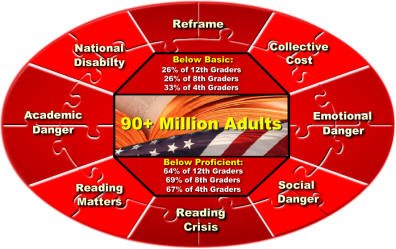
According to the U.S. Department of Education more than 60% of all K-12 students are reading below the level of proficiency required for the brain-work of reading to be transparent to the mind-work of learning at the grade level they are in.
Obviously, reading is the skill that matters most to success in school and children who fall behind in reading are in great academic danger. But it is not just the lack of reading skills that most endangers these children. It’s the collateral damage to their faith in their ability to learn – it’s the MIND-SHAME.
Kids Describe Public Shame of Reading Difficulties
Kids describe reading out loud in their classrooms.
Past Chief of the Child Development & Behavior Branch of the National Institute of Child Health & Human Development (NICHD) at the National Institute of Health (NIH)
Chair National Early Literacy Panel, President (2006) International Reading Association, Member of National Reading Panel; Director, Center for Literacy, University of Illinois at Chicago
Chair of Otolaryngology, Integrative Neurosciences, UCSF; Member National Academy of Sciences; Co-Founder of Scientific Learning Corporation & Posit Science Corporation
Ex-Commissioner for Special Education Research, U.S. Department of Education; Director, Institute for the Development of Educational Achievement (IDEA), University of Oregon
Clinical Professor of Psychiatry & Human Behavior at Jefferson Medical College; Founding Executive Director of the Silvan S. Tomkins Institute; Author: Shame and Pride & Knowing Feeling
Director, Joint Doctoral Program in Special Education, University of California- Berkeley; Historian of the Society for the Scientific Study of Reading
Past Unidel Professor of Educational Studies & Professor of Computer, Information Sciences & Linguistics, University of Delaware; Author: The American Way of Spelling: The Structure and Origins of American English Orthography
Director, Bangor Dyslexia Unit, Bangor University, Wales England Author: International Report on Literacy Research, Language-specific influences of phonology and orthography on emergent literacy
Professor, Department of Languages and Cultures of Ancient Mesopotamia, University of Leiden in Holland; Author: Unfolding Language - an evolutionary tour of mankind's greatest invention
Medievalist; Retired Professor Emeritus of English, University of Tennessee; Leading authority on the development of the written English language; Author: The Emergence of Standard English
Senior Fellow, Hoover Institution of Stanford University; Chairman, Executive Committee for the Texas Schools Project; Member, Koret Task Force on K–12 Education
Learning Disabilities Specialist, Creator: How Difficult Can This Be?: The F.A.T. City Workshop & Last One Picked, First One Picked On: The Social Implications of Learning Disabilities
More American children suffer long-term life-harm as a consequence of reading difficulties than from parental abuse, accidents, and all other childhood diseases and disorders combined. In purely economic terms, reading related difficulties cost more than the war on terrorism, crime, and drugs combined.
We need to reframe our society's thinking about what's at stake and what's involved in learning to read.
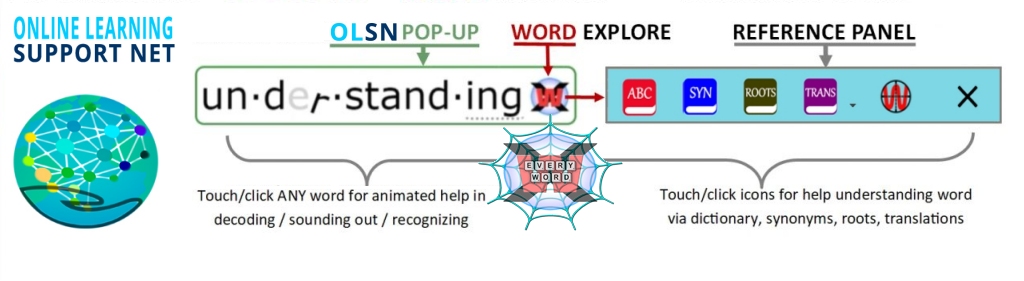
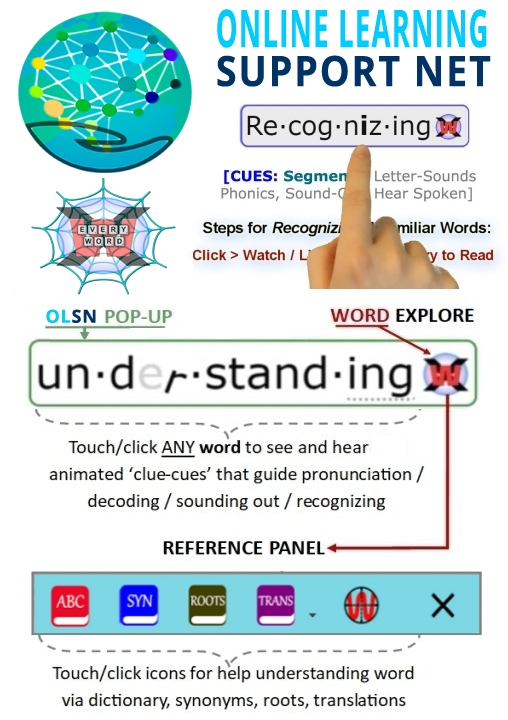
Note: Click on any word on this page to experience the next evolutionary step in technology supported reading.
"It's not by chance that the word spell has this double meaning - to cast a spell, or to arrange the letters in the correct order to spell out a word ... it was experienced by oral peoples, who had not met the written word before, as magic, as a very powerful form of magic." -Dr. David Abram, Author: The Spell of the Sensuous
"When we read we take in a code and get a set of instructions and we perform cognitive processes." - Dr. Johanna Drucker,Author the Alphabetic Labyrinth
Why is learning to read so difficult?The root cause of reading difficulties (in most children) can be understood in terms of the complex interplay between:
Note: Click on any word on this page to experience the next evolutionary step in technology supported reading.
"Some people there are who, being grown; forget the horrible task of learning to read. It is perhaps the greatest single effort that the human undertakes, and he must do it as a child.” - John Steinbeck, Nobel Prize Winning Author
"No one is to blame, we are all responsible"
"We're saying that it’s a miracle that it ever happens. It’s very unsurprising that many people struggle with it." -Dr. Michael Merzenich, Keck Center for Integrative Neurosciences, University of California at San Francisco
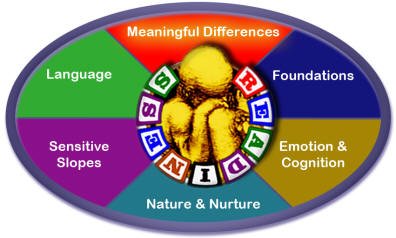
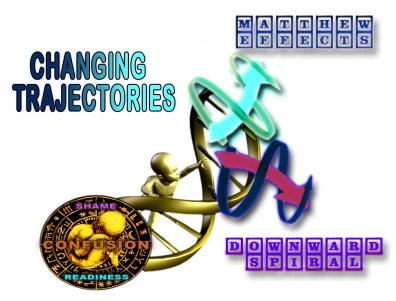
Children's early life learning trajectories determine their level of readiness for the challenges involved in learning to read. Understanding these trajectories involves understanding:
how children's trajectories through all the above result in meaningful differencesthat profoundly affect the difficulty they have learning to read
Note:Click on any word on this page to experience the next evolutionary step in technology supported reading.
"So the sobering message here is that if children don't have the right experiences during these sensitive periods for the development of a variety of skills, including many cognitive and language capacities, that's a burden that those kids are going to carry; the sensitive period is over, and it's going to be harder for them." - Dr. Jack Shonkoff, Chair, National Scientific Council on the Developing Child
"...children who have trouble with oral language generally will go on to have difficulty with written language..." - Dr. Paula Tallal, Co-Director, Center for Molecular and Behavioral Neuroscience, Rutgers
"...Children of professional parents -- I mean, talkative families and college educated -- heard forty-eight million words addressed to them by the time they're four. Children in welfare families who were taciturn heard thirteen million words addressed to them by the time they were four." - Dr. Todd Risley, co-author "Meaningful Differences in the Everyday Experiences of Young American Children"
"They feel like they’re failures; they tell us that.Lousy reading produces a perception of stupidity and dumbness to peers and clearly to the youngster who is struggling. That is the shame." - Dr. G. Reid Lyon
Note: Click on any word on this page to experience the next evolutionary step in technology supported reading.
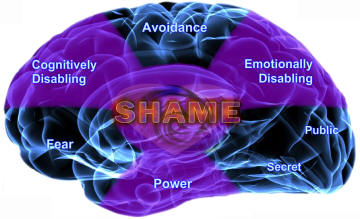
Building on 'CHILD'S FAULT' from 'Causes and Contributing Factors', this module's first segment provides the starting point for appreciating the “SHAME” that struggling readers experience. Next, “The Power of Shame” discusses shame's painful life-long and often life-distorting effects. The next three segments explore the “Public Shame” of the classroom; the “Fear of Shame” felt by children as they anticipate being asked to read out loud in classrooms, and how both drive the “Secret Shame” that causes children to hide their reading difficulties from parents, teachers, and peers. “Emotionally Learning Disabling” and “Avoidance” build on the previous segments and show how powerfully behavior-determining and learning-disabling shame avoidance can be. Finally, “Cognitively Learning Disabling” begins our discussion of the "Downward Spiral of Shame" (From our chapter the "Brain's Challenge") and describes how shame disrupts, distracts, and chokes the cognitive processing that is necessary for learning to read in the first place.
Dr. Maryanne Wolf: You know I haven’t thought in these terms. But as you say them there is no question that’s our enemy. Shame.
Dr. Donald Nathanson: “Like most scholars, until awakened by the “Children of the Code” project, I took reading as much for granted as eating and drinking. Very few of us have paid sufficient attention to the specific emotions triggered in children as they begin to read. Yet any impediment to mastery of the confusing code that connects spoken and written English must trigger shame, the emotion that stops all useful thought. So painful does shame become in the public arena of the schoolroom that our children swiftly divide into two streams and two futures purely on the basis of their response to the shame that accompanies the struggle to learn our written language.
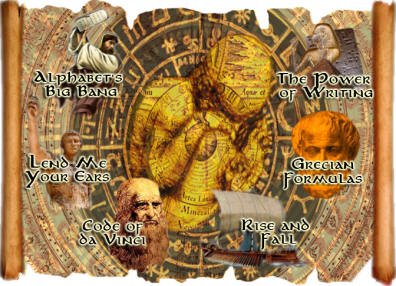
Understanding the code and its history is essential to understanding the "CONFUSION' involved in learning to read it today. The "Power of Writing" begins our journey into the profound cognitive and institutional consequences of becoming code users (writers and readers). Next, "The Alphabet's Big Bang" and "Grecian Formulas" explore the origin of the Alphabet and it's unparalleled effects on the minds and institutions that gave rise to western civilization (future segments will address oral cultures and pre-alphabetic writing systems). In "Lend Me Your Ears" we introduce the initial relationships between letters and sounds (critical background for future segments on how the code became so complex). And, in the "Code of da Vinci" we present the code as both the 'DNA of science' and the 'media that enabled the Renaissance'. Finally, we review the "Spread, Rise, and Fall of Literacy" which sets the stage for "A Brief History of the Code - Part 2: Ye First Millennium Bug".
"The big step between civilization and more primitive forms of human society is written language."Dr. John Searle, Professor of the Philosophy of Mind and Language at U.C. Berkeley
"We have all become children of the code" - Dr. Malcolm Richardson, Chair, Department of English, LSU
"I think it was much easier to learn how to read in the 8th century B.C. than it is today." - Dr. Frank Moore Cross, Professor Emeritus of Ancient Languages, Harvard University
"Once we start writing, we are able to then reflect back upon what we have written, and we enter into this kind of recursive relation to our own written signs. And, so, only then, a certain degree or experience of self-reflection that we now sort of take for granted, comes into being." – David Abram, Philosopher and Ecologist, Author: The Spell of the Sensuous.
"In learning to read... we were satisfied when we knew the letters of the alphabet" - Plato, The Republic
Thoughreadinessand readiness differentiated instruction reduce the difficulty, working through the code's confusing letter-sound relationships is what most challenges the brains of most struggling readers. There is a direct and causal relationship between the confusion in the code and the 'stutters' heard in the voice of a struggling reader. Obviously, understanding this confusion is critical to understanding the challenges involved in learning to read. As importantly, understanding how the code became so confused is critical to reframing the experience of struggling readers. The more we understand the accidents and negligence that led to the confusion in the English code the more it becomes obvious that it is absurdly negligent to blame and shamechildren for their struggle with it.
- Latin Roots – The clergy begin to write English using the letters/sounds of Latin - French Rules – French displaces English as the official language of England - The King’s English – Henry V resurrects English writing - The Chancery Scribes – The King's scribes forge the roots of modern English - The Roots of Confusion – How written English became such a mess. -The Great Vowel Shift – Major shifts in pronunciation add further confusion -Casting Spells - The printing press standardizes the unstable writing system
...In Greek, or Latin, for example, once you could view the letters, you could read... there was almost a perfect match... Dr. Guy Deutscher, Author: The Unfolding of Language: An Evolutionary Tour of Mankind's Greatest Invention
...[in English] "we have fifty some sounds and only twenty-six letters. So we have to adopt a whole variety of mechanisms to close the gap." - Dr. Richard Venezky, Author: The American Way of Spelling: The Structure and Origins of American English Orthography
"We are always compromised in certain areas by having to represent sounds with symbols that weren't designed to suit those sounds." - Dr. Johanna Drucker, Author: The Alphabetic Labyrinth
"it's easy to forget that the system we have learned is a system that is based on a series of accidents that result in layers of complexity"- Dr. Thomas Cable, Co-author: A History of the English Language
..."the accident of the printing press, which in England served to freeze spelling in the fifteenth century so you have these bizarre spellings" - Dr. Malcolm Richardson, Chair, Department of English, LSU
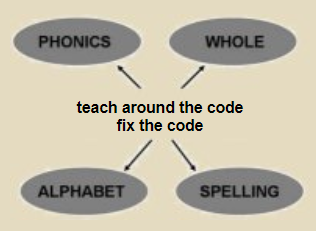
With the printing of the King James Bible literacy began to spread. As it did, reading teachers began to realize that the letter-sound relationships in the code made learning to read English difficult. Phonics was born in the 16th century as an attempt to train the reader to process the unruly code. Over a century later the whole word method (originally developed for the hearing-impaired) began being used as an alternate to the 'tedious' 'rote' work of phonics.
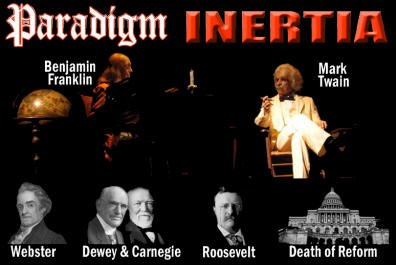
Paralleling the battle between these two teaching around the code polarities, another movement began which focused on reforming the code itself. The story of our attempts to change the code is fascinating and understanding these attempts, and why they failed, sheds important light on the social, political, institutional, and even scientific inertia that limits our understanding of the challenges involved in learning to read.
"The heart of our trouble is with our foolish alphabet. It doesn't know how to spell and can't be taught." - Mark Twain
"Delay in the plan here proposed may be fatal... the minds of men may again sink into indolence; a national acquiescence in error will follow, and posterity be doomed to struggle with difficulties which time and accident will perpetually multiply". - Noah Webster
"People are more likely to change their religion than change their writing system." - Charles Hockett, Anthropological Linguist
"...as every letter ought to be, confin'd to one; the same is to be oberv'd in all the Letters, Vowels and Consonants, that wherever they are met with, or in whatever Company, their Sound is always the same." - Benjamin Franklin"
The second great obstacle is our absurd spelling, which scholars agree is the worst on the planet. In trying to learn this, two or three years are worse than waster" - Melvile Dewey (Dewey decimal system - champion of simplified spelling).
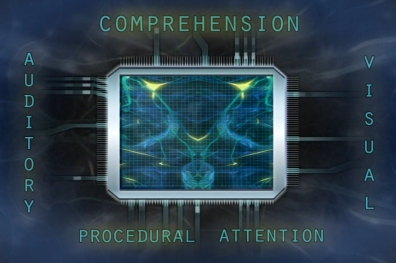
CRITICAL ELEMENTS: To construct the reading experience the brain must DIFFERENTIATE and process a number of elements including:Letters, Phonemes, Morphemes, and Vocabulary.
CRITICAL PROCESSING: The brain must Automatize and Synchronize the sub processing of the critical elements.
CRITICAL SPEED: The brain must process all the above fast enough to construct Recognizable Wordsat Speedsthat approximate the rate at which the brain is accustomed toRecognizing Spoken Language. Processing speed is critical. Analysis of the Eye Movements of good readers reveals that, on average, the brain must process letters into sounds in less than a tenth of a second.
THE BOTTLENECK: The 'stutters' in the voice of struggling readers reflect the time it takes the brain to work through the confusion in the code - the time it is taking to DISAMBIGUATE the code. Code disambiguation is the brain's greatest challenge during the process of learning to read. Exacerbating all the other challenges is theDOWNWARD SPIRALthat disrupts and dissipates the brain's processing when shame sets in.
For every child and adult who struggles and for all of us as a society, ’reading problems are always a consequence of ‘learning problems’. Improving the learning trajectories of children (and adults) who struggle with reading requires an Orientation Shift in how Parents and Teachersthink about learning and the challenges involved in learning to read.
"Children are developing a pre-conscious aversion to the feel of confusion and a pre-conscious aversion to the feel of confusion decapitates learning"- Children of the Code
Children’s developmental trajectories affect the ease or difficulty of learning to read – the ease or difficulty of learning to read effects their ongoing health and development.